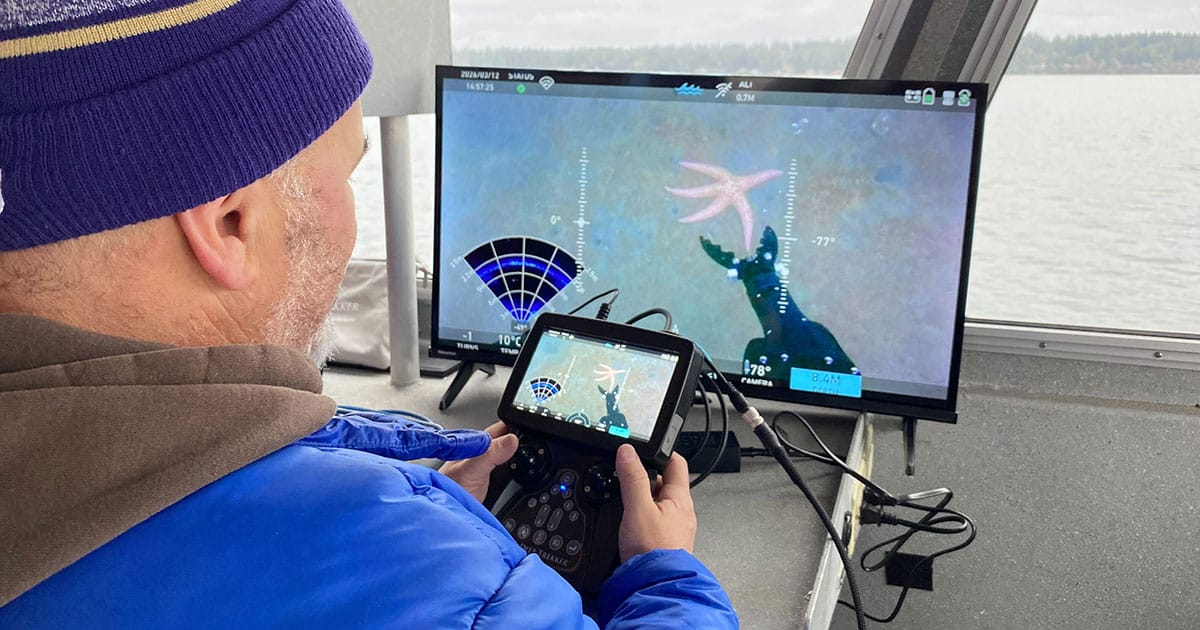
Regulatory constraints further limit interaction with sensitive habitats, requiring non-invasive approaches to data collection. Remotely operated vehicles (ROVs) are addressing these constraints by providing controlled, repeatable access to submerged environments. These systems allow operators to conduct underwater inspection, capture high-resolution imagery, and collect environmental data without disturbing the site.
Standard Tools
An ROV is a tethered robotic platform controlled from the surface, transmitting live video and sensor data in real time. Because power and communication are delivered through the tether, these systems can operate for extended durations without the limitations associated with battery-dependent platforms.
In marine science, their role has shifted toward non-contact observation and measurement. Rather than collecting physical samples—an approach that is often restricted—ROVs are used to document habitats, monitor changes over time, and generate measurable datasets through imaging and integrated sensors. This aligns with current regulatory frameworks and reduces environmental impact while still providing reliable data.
Key Features for Field Performance
System selection is typically driven by operational requirements. Depth rating, imaging capability, and stability all directly influence the quality and consistency of collected data.
Depth rating defines the operating envelope. Most inland and coastal work occurs within 30 to 150 meters, while offshore or specialized research may require systems rated to 300 meters or more. At these depths, pressure resistance and corrosion protection are baseline requirements rather than differentiators.
Imaging performance is equally important. Light attenuation in water is significant—most visible light is absorbed within the first 200 meters—so ROVs rely on high-sensitivity cameras paired with adjustable LED lighting. Managing backscatter in turbid water is a persistent challenge, making lighting control and camera tuning critical for usable footage.
Navigation is another constraint. Since GPS does not function underwater, positioning relies on tether orientation, onboard sensors, and, in larger operations, acoustic systems such as USBL, DVL, and 3D Sonar SLAM. For close-range work, precise maneuverability and station-keeping are more important than absolute positioning accuracy.
Payload integration varies by application. In marine science, most configurations focus on observation and measurement rather than intervention. Common additions include imaging sonar for low-visibility navigation, water quality sensors, and samplers for environmental monitoring, and laser scaling tools for dimensional analysis.
Comparing ROV Models
The range of available ROVs reflects different operational needs, from rapid deployment in shallow environments to extended offshore missions.
The PHOTON ROV is designed for portability and ease of deployment. With a depth rating of 120 meters and an integrated low-light 4K camera, it is well-suited for inland water bodies, aquaculture sites, and nearshore research. Its compact form factor allows a single operator to deploy and recover the system quickly, making it effective for routine surveys and visual inspections where speed and accessibility are priorities.
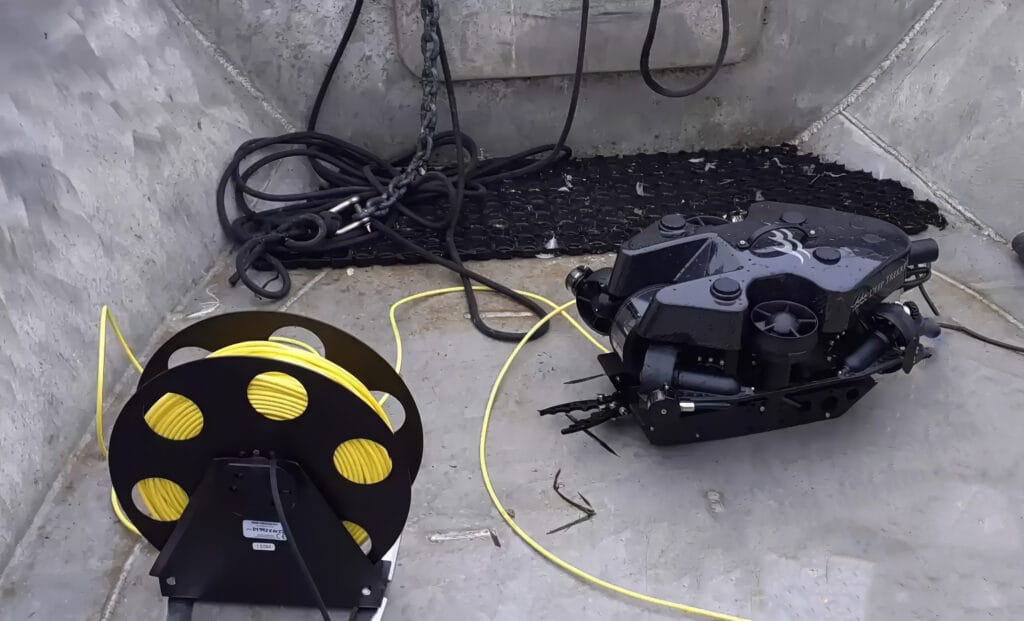
The PIVOT ROV is configured for more complex inspection and imaging tasks. It includes a tilt platform for tool positioning, allowing sensors to be angled without moving the vehicle. Its rotating camera system (up to 220°) supports full-field inspection from a fixed position. With a depth rating up to 305 meters and compatibility with sonar and laser scaling tools, it is used for photogrammetry, habitat mapping, and structural inspection requiring positional stability.
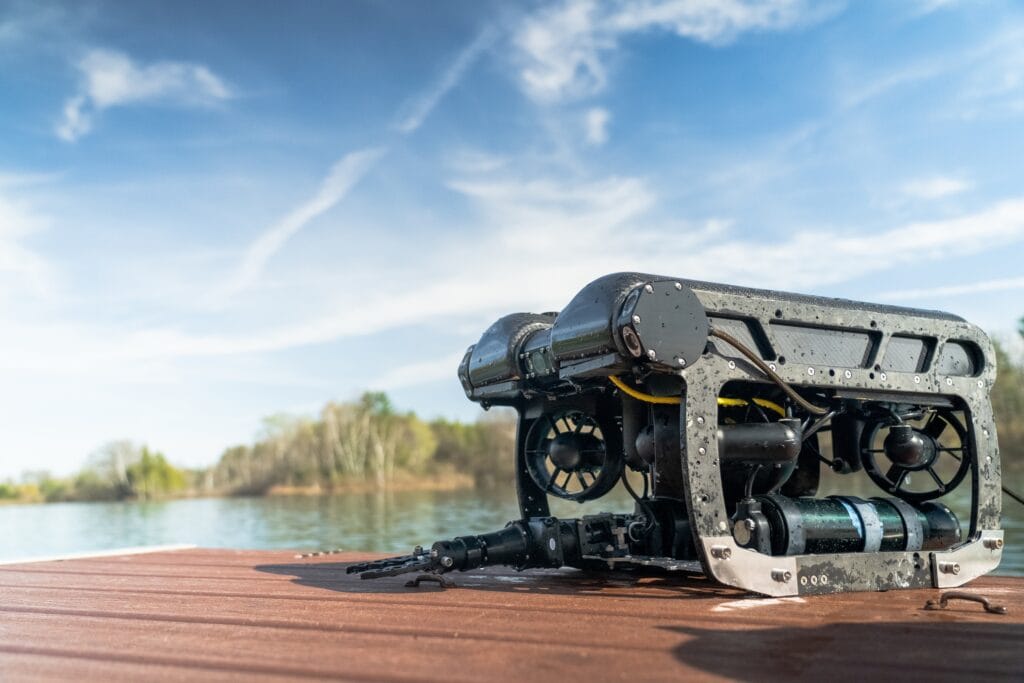
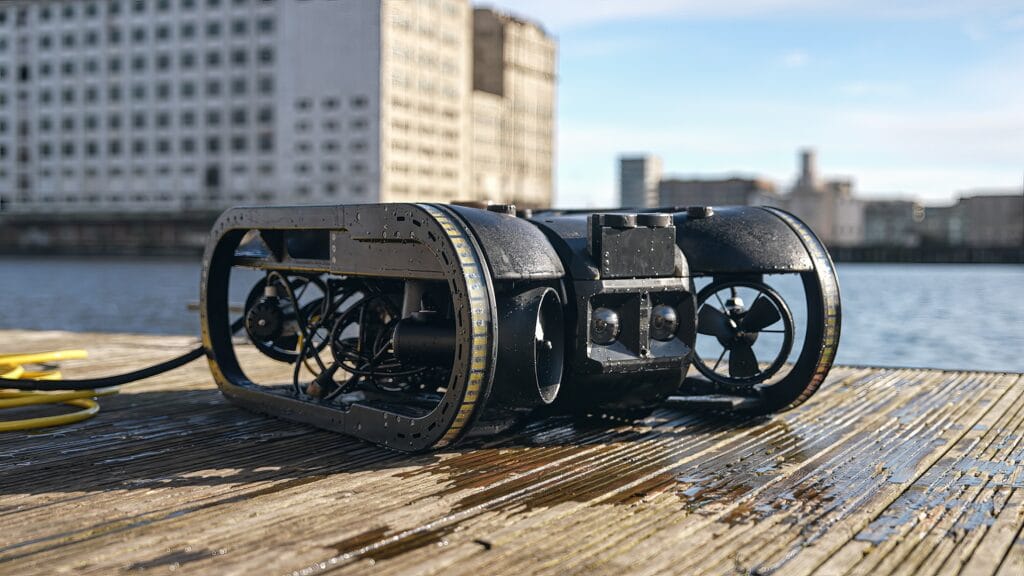
The REVOLUTION ROV is a more robust platform designed for operations that require additional power and payload capacity. Its six-thruster configuration provides stable control in moderate current conditions, while its support for multiple attachments allows for sensor deployment and light intervention tasks. It also features a unique rotating camera head that can be integrated with sonar, enabling synchronized visual and acoustic sweeping scans without repositioning the vehicle. In marine science workflows, it is typically used for placing or retrieving instruments, as well as conducting detailed inspections in more demanding environments.
For larger-scale operations, the SPECTRA system supports extended deployments and multi-instrument configurations. It supports lateral movement up to ~3 knots in higher currents, improving performance in dynamic offshore environments. It integrates a stereo camera system for depth-aware imaging and 3D sonar SLAM, enabling real-time mapping and localization in low-visibility or complex subsea structures. It is used for offshore surveys, infrastructure inspection, and multi-sensor research missions requiring coordinated data collection over extended deployments.
Operational Considerations
Selecting the right underwater robot depends on how the system will be deployed and what data is required. Smaller systems are often sufficient for localized studies and routine inspection work, while larger platforms are better suited for offshore environments or projects requiring multiple integrated sensors.
Environmental conditions—such as visibility, current, and depth—tend to dictate system performance more than any individual specification. Just as important is repeatability: the ability to return to the same location and capture consistent data over time. This is particularly relevant for monitoring applications, where changes in habitat or infrastructure must be measured accurately across multiple surveys.
Seamless Data Collection
Current development in ROV technology is focused on improving data reliability and operational efficiency. This includes better integration between optical imaging and sonar, more stable station-keeping, and improved workflows for generating 3D models from visual data.
Rather than replacing operators, these systems are reducing variability in data collection and enabling more consistent results across different environments. As a result, ROVs are becoming a standard tool not only for marine science, but also for broader underwater inspection and monitoring applications.
ROVs provide a practical solution to the access and safety limitations of traditional underwater research. Systems such as Deep Trekker’s PHOTON, PIVOT, and REVOLUTION cover a wide range of operational needs, from portable inspection to more demanding fieldwork, while SPECTRA supports large-scale, coordinated missions.
This feature appeared in environment coastal & offshore (eco) magazine’s 2026 issue II. Read in the magazine here.