 Javier del Real Tuñón, Head of Environmental and Stakeholder Management at Saitec Offshore Technologies, joined eco magazine for an exclusive “topside talks” interview to discuss how the company’s DemoSATH Lab program is testing nature-inclusive design and multi-trophic aquaculture directly on an operating floating wind platform, and what the results could mean for how future floating wind farms get designed.
A Real-Scale Testing Ground
DemoSATH, Saitec’s operating floating wind demonstrator off Bilbao, Spain, has become more than a power-generation platform. Through DemoSATH Lab, the company is using the structure as a real-scale testing ground to study environmental interactions, improve monitoring methods, and explore solutions that support coexistence with marine biodiversity.
Touching on what drove the creation of DemoSATH Lab as a real-scale testing ground for environmental interactions, del Real Tuñón shared: “From the very beginning, we understood that environmental monitoring and research had to be placed at the heart of the DemoSATH project. For us, demonstrating the technical performance of a floating wind platform could not be separated from understanding how it interacts with the surrounding marine environment.
“The extensive research and monitoring carried out during DemoSATH provided a unique opportunity to transform the platform into a real-scale offshore laboratory. DemoSATH Lab was therefore created to move beyond observation and actively test new solutions under real operating conditions.”
Where Wind Meets Aquaculture
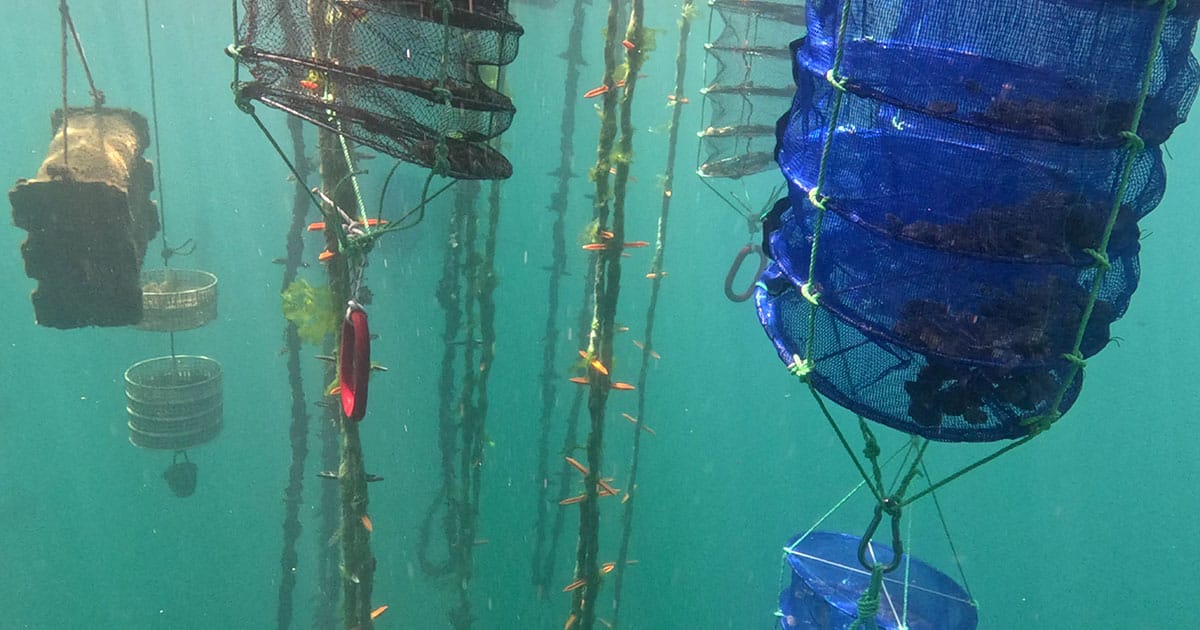
The latest phase of that program, the AQUASATH Project, is testing whether floating wind and aquaculture can share the same footprint. A multi-trophic aquaculture pilot integrated into the platform uses a mother rope to suspend lantern nets, mussel ropes, and collector ropes, assessing the viability of cultivating European flat oysters (Ostrea edulis), pullet carpet shell clam (Venerupis corrugata), mussels, and Ulva algae alongside floating offshore wind operations.
Speaking on the benefits of co-locating offshore wind and aquaculture opportunities del Real Tuñón, said: “Co-location may also help address the growing competition for marine space. Offshore wind, aquaculture, fisheries, navigation and environmental protection all require access to the sea. Combining compatible activities within the same area could improve the efficiency of marine space use and create additional value without proportionally increasing the occupied footprint.”
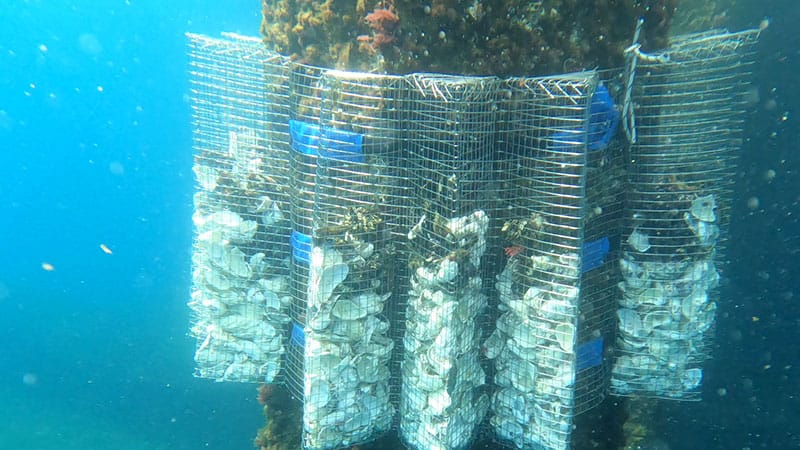
The recent offshore operation played out in two stages. Live material and Nature Inclusive Design (NID) elements, each tagged with a unique number and color code for full traceability, were first prepared at a mussel raft, organized by material type, and secured according to a raft layout plan. In the second stage, the elements were transported offshore for underwater installation on DemoSATH’s submerged columns, requiring coordination between the main vessel, support teams, mooring personnel, and professional divers. Filled with shells and mussels, the NID elements create new surfaces and microhabitats for marine organisms to grow, shelter, and feed around the floating foundation.
Saitec Offshore Technologies coordinated the operation. Mar Ceibe supplied the live material, Instituto Kardala provided the raft and support during the first day, Kotazero carried out the underwater works, and Amarradores de Santander provided the main vessel and mooring support. Grupo Peñascal Kooperatiba contributed to the creation of the NID elements.
Sharing more about the recent offshore deployment and the multi-trophic pilot, del Real Tuñón, said:
“The recent operation is a perfect example of the full-circle approach behind DemoSATH Lab. What began as a concept had to be transformed into a complete offshore procedure: adapting the designs to the real conditions of DemoSATH, preparing and protecting the living material, coordinating several specialized teams and, finally, carrying out the installation under demanding offshore conditions.
“Being present during the offshore installation reinforced just how important full-scale testing is. A system can be carefully designed, analyzed, and prepared onshore, but its real feasibility only becomes apparent when it has to be handled, transferred, and installed at sea. Some aspects that appeared relatively straightforward during the preparation phase required practical adjustments once the systems were being handled offshore. These are precisely the lessons that cannot be obtained from drawings, calculations, or laboratory testing alone.”
A Shift in Floating Wind Design
Beyond the installation itself, the operation is generating practical knowledge on how nature-inclusive solutions can be adapted, handled, transported, and installed on floating offshore wind structures, knowledge Saitec sees feeding back into how the sector designs future platforms.
del Real Tuñón, commenting on how NID has shifted thinking across floating offshore wind, said, “Traditionally, environmental work in offshore wind has largely focused on identifying impacts and then avoiding, minimizing, or compensating for them. Nature-inclusive design introduces an additional approach: assessing whether specific features or complementary elements can be incorporated into offshore wind infrastructure to provide suitable surfaces, shelter, or habitat opportunities for marine organisms.”
What Comes Next
Testing these solutions in real offshore conditions is essential to understanding their technical feasibility, operational requirements, and potential contribution to marine biodiversity. Saitec sees the lessons learned at DemoSATH informing future floating wind farms, supporting designs that build in environmental considerations from the earliest stages of development.
“We see DemoSATH Lab as a first step in building the evidence needed to move from individual pilot activities toward solutions that could eventually be applied in future floating wind farms,” del Real Tuñón said. “The [next] immediate priority is to monitor the systems already installed and understand how they perform over time. We need to assess not only their environmental response, but also their durability, maintenance requirements, compatibility with platform operations and behavior under real offshore conditions. This monitoring phase will allow us to identify which solutions are effective, which need to be adapted, and which may not be suitable for larger-scale application.”
Research and innovation programs such as the AQUASATH project, supported by the Department of Industry, Energy Transition and Sustainability of the Basque Government and co-funded by the European Regional Development Fund (ERDF), are essential to create the conditions in which these concepts can be developed, tested and refined before being considered for larger-scale application.
This feature appeared in environment coastal & offshore (eco) magazine’s 2026 issue III. Read in the magazine here.