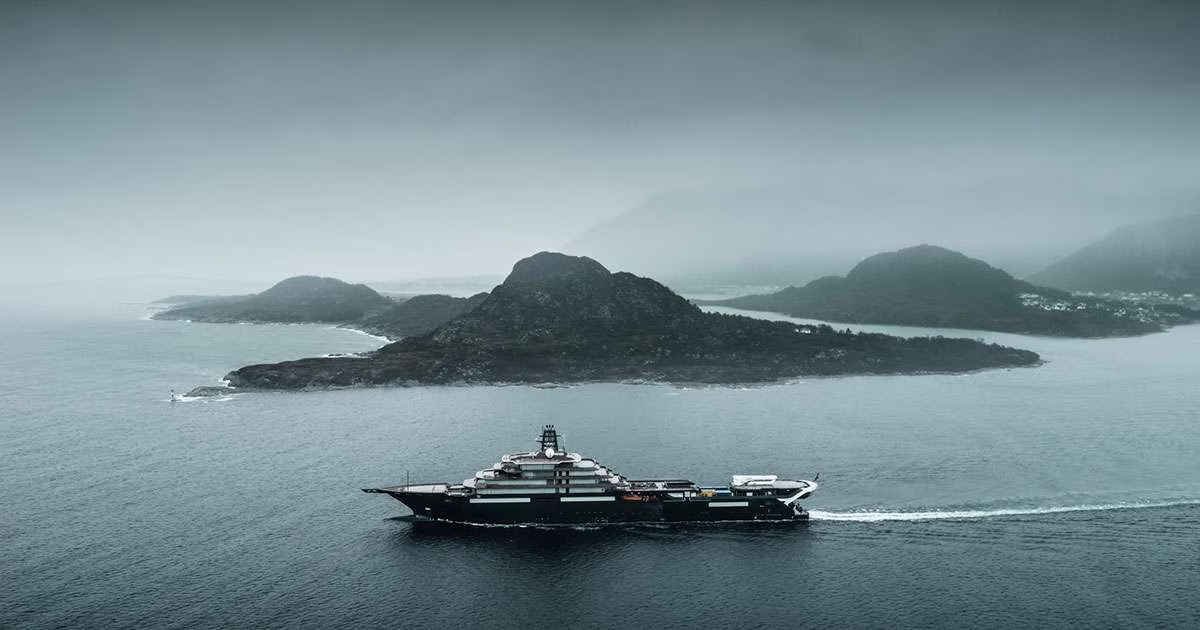
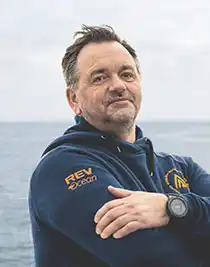
 Stig Vågenes, Head of Scientific Operations at REV Ocean, joined eco magazine for an exclusive “topside talks” interview to discuss how the organization is preparing its new research vessel for its 2027 maiden voyage and what it takes to translate ambitious science plans into dependable offshore operations.
Lessons from the Ice
Vågenes works across the subsea and scientific operations side of the vessel, where his role is to make sure its equipment, technology, and operational team can deliver what researchers need at sea. Among other things, that means preparing vehicles and instruments, supporting complex deployments, and getting samples safely back into the labs.
His background is in subsea operations and marine research technology. Before joining REV Ocean, he worked with the University of Bergen’s marine robotics team, where he led the buildup and implementation of the ROV Ægir 6000 system and helped develop it into an operational platform for deep-sea scientific research. He has also taken part in scientific expeditions in both the Arctic and Antarctic, including ROV operations beneath drifting sea ice.
Reflecting on that fieldwork, Vågenes said: “Operating an ROV under moving ice adds another level of complexity, requiring careful mission planning, close coordination between the ROV team, the bridge, and onboard scientists, and a constant awareness of the changing environment above the ROV. Those experiences taught me that having advanced technology is only part of the equation. What really matters is having the people, experience, and operational capability to use that technology safely and reliably in challenging environments—for real scientific needs.”
From Building to Operating
“It’s a huge milestone,” Vågenes said of the upcoming maiden voyage. “After years of designing, building, and integrating a highly complex vessel, this is the point where everything has to work together in live conditions, with science teams onboard.”
He pointed to a structural challenge in ocean science that the vessel is intended to address: “Ship time, specialized equipment, and experienced operators are scarce and expensive, which can determine which scientific questions get answered. Not many research teams can bring together a vessel, deep-sea vehicles, laboratories, technicians, and experienced offshore crew themselves. REV Ocean brings those capabilities together in one place and makes them available to the scientists coming onboard.
“The maiden voyage is where we move from building the vessel to putting it to work.”

Designed for Science at Sea
The vessel’s layout is built around the practical workflow of research at sea: deploying instruments and underwater vehicles, recovering samples, and moving them rapidly into laboratories for analysis. It carries nine laboratories, alongside flexible space for specialist equipment tailored to individual missions.
A large moonpool provides sheltered access to the water for deploying and recovering subsea equipment. Combined with the vessel’s hangars, lifting systems, mapping capabilities, and deep-diving vehicles, it allows the team to work from the surface through the water column and into the deep ocean.
Two Vehicles, Complementary Views
At the center of those capabilities are the vessel’s two main subsea vehicles.
“Our two main subsea vehicles give scientists complementary ways of exploring the deep ocean,” Vågenes explained. “Aurora, our ROV, can reach 6,000 meters and access approximately 98% of the deep seafloor. Aurelia, our crewed submersible, carries a pilot and two observers to 2,300 meters.”
Aurora can spend extended periods at depth, collect targeted samples, and allow scientists in Mission Control to participate in a dive. Aurelia, by contrast, puts scientists directly into the environment they are studying, giving them a sense of scale, context, and detail that screens alone cannot provide.
“Having both on the same vessel is powerful,” Vågenes said. “We can observe an area directly, use the ROV for extended investigation and targeted sampling, and have those samples in the onboard laboratories shortly afterward.”
Live feeds can also be shared around the vessel and, selectively, with people on shore, allowing researchers, students, and other audiences to follow deep-ocean work as it happens.

A Maiden Voyage Built by Invitation
The maiden voyage will carry 10 international research missions, ranging from Sargassum belt studies to deep-sea and coral reef ecosystems. The REV Ocean science team led the program’s development, with input from its Science and Innovation Advisory Board and in dialogue with invited mission teams and regional partners.
“The missions cover very different environments, but they are linked by priorities including strengthening ocean knowledge, supporting better protection and management, and building collaboration and capacity with regional partners,” Vågenes said.
Participation in this first program was by invitation. The selected teams bring ambitious scientific goals while recognizing that the first phase will involve trials and operational learning as the vessel, equipment, and teams come together at sea.
For Vågenes, that defines the job ahead: “From my side, the upcoming missions give us the operational framework we need to prepare for. My role is not to select the science, but to make sure the vessel, systems, and teams are ready to support it as effectively as possible.”
What Comes Next
Vågenes expects the first program to reveal a great deal about how the vessel, technology, scientists, and operational teams perform together under real-world research conditions: what works well, where procedures or equipment need adjustment, and how visiting science teams can best work with the crew and operators.
“Those lessons will feed directly into how REV Ocean plans and supports future missions,” he said. “An open call for future research proposals is planned for the end of 2026, which will begin opening access to the vessel more widely across the international scientific community.
“From an operations perspective, the maiden voyage is a test of the vessel, the equipment, the procedures and the team, and of how we turn ambitious science plans into safe and effective work at sea.”
This feature appeared in environment coastal & offshore (eco) magazine’s 2026 issue IV. Read in the magazine here.