
In an exclusive “topside talks” interview with eco magazine, Dr. Brennan Phillips, a Professor of Ocean Engineering at the University of Rhode Island, shared his insights into the successes of multidisciplinary teams and methods for investigations carried out in the deep sea.
From Pilot to Professor
Attributing broad-spectrum exposure to multidisciplinary deep-sea research to his early career experiences as an ROV engineer and pilot investigating shipwrecks in the Mediterranean and Black Seas, Dr. Phillips commented, “I started thinking about ways to lower the barrier of entry and logistical hurdles typically associated with marine technology development. That inspired me to go back to graduate school and eventually start my lab at the University of Rhode Island.”
As an Ocean Engineering professor for the past eight years, Dr. Phillips and his students have made advances in a wide array of topics, including 3D-printed deep-sea robots, biological sampling, fiber-optic microtethers, soft robotics, and distributed sensing. “Almost everything my team does is new and experimental. I’m proud of how we build things almost entirely from scratch,” Dr. Phillips remarked.
Tools and Methods
Dr. Phillips’ lab utilizes a wide range of hardware and prides itself on its ability to adapt to work on almost any oceanographic platform required. From mid-size and observation-class remotely operated vehicles (ROVs) to winches, telemetry systems, and power systems for the big boats and more.
Dr. Phillips attributes his lab’s ability to adapt to one of the main qualities that brings opportunities to collaborate on all kinds of interesting projects to their door.
“We look to other industries and markets a lot for creative options—for example, big game fishing gear can be used for all kinds of science work. We also use electric fishing reels now for fiber optic microtethers, and they allow us to go deep with cameras and sensors, currently up to 1,000 m, on any boat that has a rod holder,” Dr. Phillips commented. “We’ve been using large drones as well, which don’t require a boat at all. The drone racing industry also has some nice compact electrical tools that are great to have in the kit.”
Novel Sampling Equipment
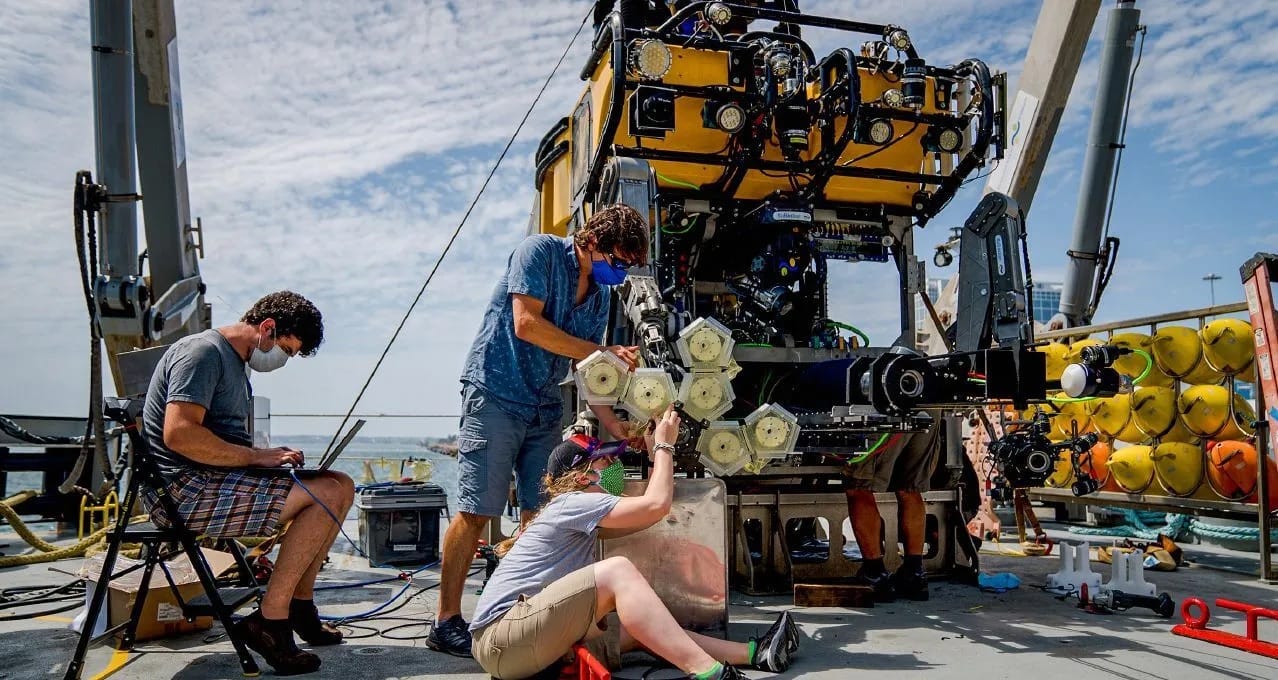
In recent research findings, published in the journal Science Advances in 2024, Phillips and others characterized four deep-sea animals with unprecedented levels of detail, down to the genetic level. This characterization was made possible with the use of an origami-inspired encapsulation device, known as the Rotary Actuated Dodecahedron (RAD).
Speaking on the upcoming second-generation RAD sampler, Dr. Phillips shared, “The RAD sampler is now in its second generation of design, and it works well at encapsulating delicate midwater animals quickly.
“We’re now working with our collaborators at Harvard University (Rob Wood’s lab) to design and prototype what will essentially be a deep-sea biopsy device—something that can gently take a tissue sample of delicate animals without destroying it or even disturbing it.
“The rest of the system is capable of preserving DNA quickly, at depth—allowing for study of things like gene expression.”
When asked about the process of designing and engineering a novel tool, such as the RAD sampler, Dr. Phillips explained, “We almost always start with a whiteboard session to sketch out ideas and to encourage creative thinking. Crazy, outlandish ideas are encouraged—even if they are ultimately unfeasible.
“From there, we try to boil them down to 2–3 viable directions to explore further. I usually push to get a functional prototype made as quickly as possible, as it can accelerate the design and iteration process if you jump immediately into making something that you can learn from.
“I tend not to dwell too long in the conceptual/ design phase. I’m also not afraid at all to return to that step as many times as needed; as I mentioned earlier, we fail a lot, and that’s all part of the process.”
Dr. Phillips and his collaborators are excited to take the next generation of the RAD sampler far offshore with the hope of discovering species unknown to science. The next expedition is expected to take place in late 2026, somewhere in the South Atlantic Ocean.
Recently, Dr. Phillips and his team received $2.2 million over three years from the Ocean Shot Research Grant Program, an initiative to encourage bold research in ocean discovery and technology. With the award, the multidisciplinary team of scientists will build upon previous research to delve deeper into the lives of fragile deep-sea organisms and potentially discover new species.
This “topside talks” appeared in eco magazine’s 2025 autumn edition—Multidisciplinary Sampling & Monitoring. Read more of the magazine here.