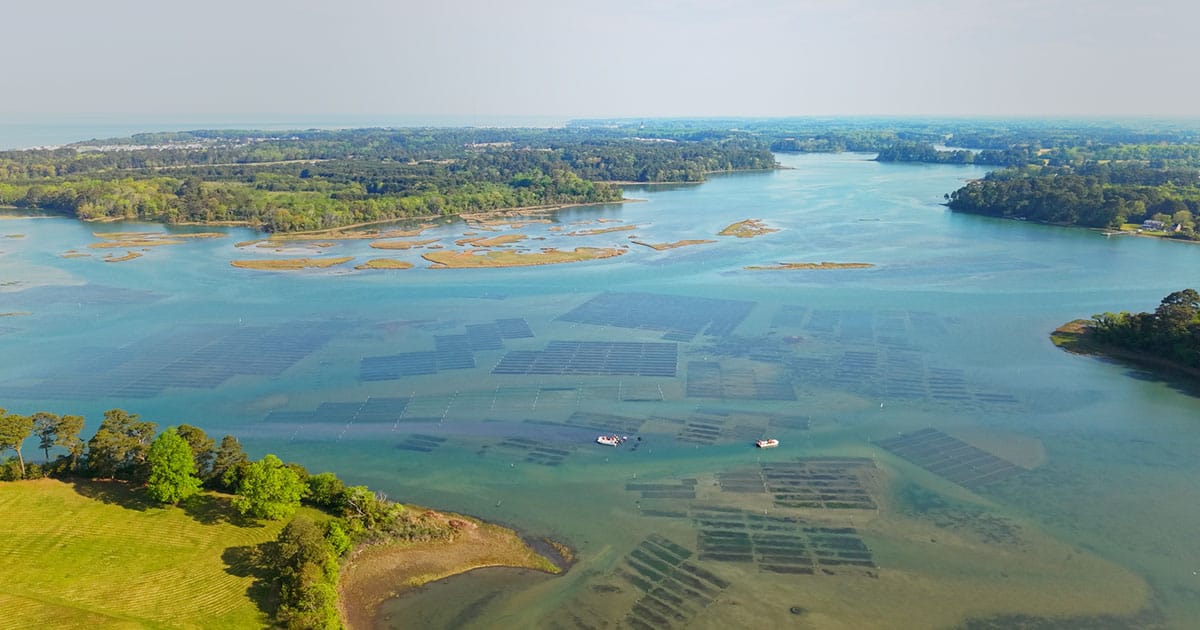
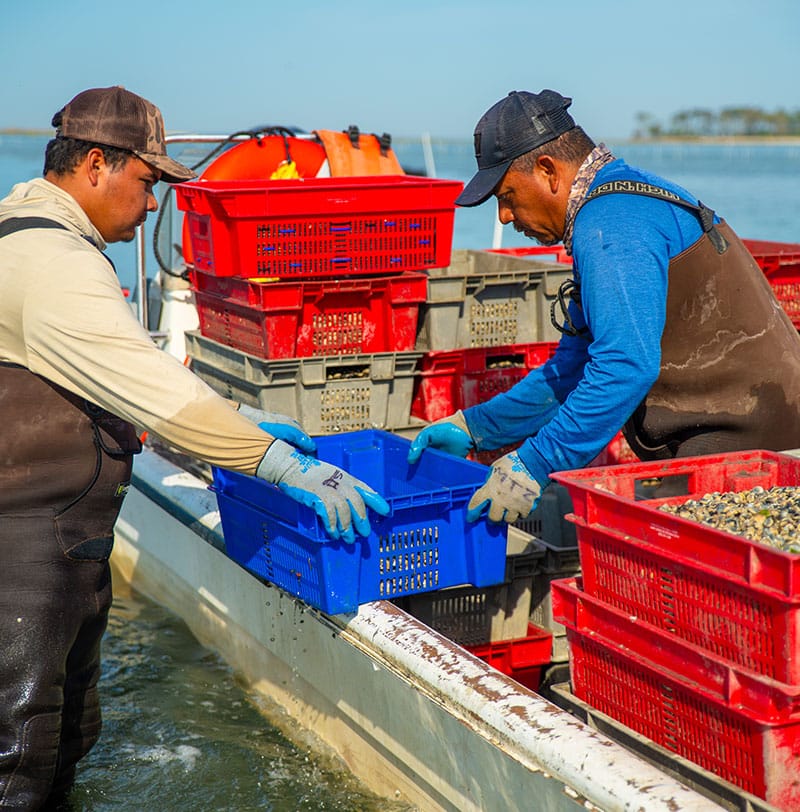
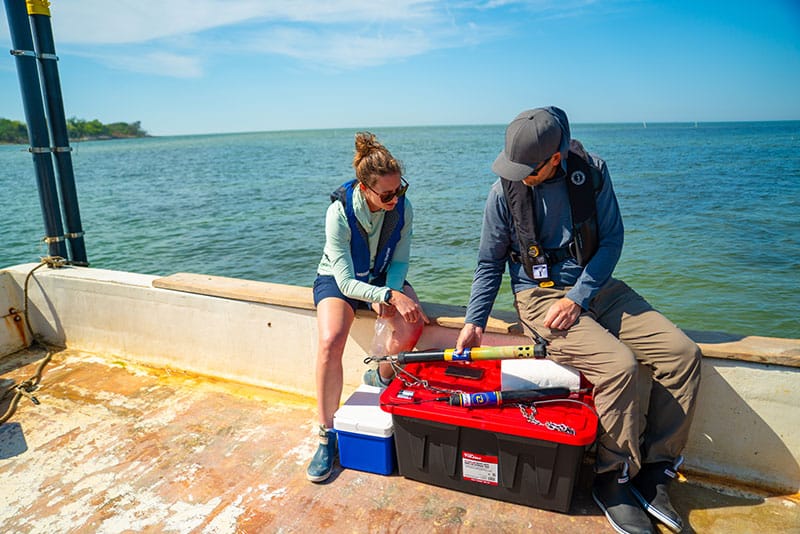
The team recently added a new layer to their time-tested operations, welcoming Aqua TROLL water quality sondes as new additions to the crew.
New “Eyes” on the Water
Shellfish are filter feeders, so their health depends directly on the water they grow in. That connection is central to Cherrystone’s work and to Virginia’s shellfish industry, which leads the nation in hard clam production and the East Coast in Eastern oyster production. It also means any shift in water conditions can show up quickly in the shellfish themselves, something a team with generations on the water is well positioned to notice.
“Over the past decade, we’ve seen changes in the environment and in production,” said Tim Rapine, COO of Cherrystone Aqua-Farms. “We wanted to understand what might be causing that, so we applied for a grant to build some baseline data.”
That baseline, in practice, means collecting consistent data over time, long enough to understand the expected range of conditions at each site, so that any unusual shift becomes easy to identify against that pattern. It’s the kind of insight that builds gradually, which is part of why Cherrystone sought support to build it.
To do that, Cherrystone turned to a USDA National Institute of Food and Agriculture (NIFA) grant, supporting farm sustainability and natural resource health. The multifaceted grant supports research across water quality, genetics, disease, and husbandry, giving the team a way to better understand the shifts they’ve observed in their growing environment and production over the past decade.
Choosing the Right Equipment
The next challenge was finding equipment that could deliver the consistent, reliable data the team was after. Cherrystone weighed several water quality monitoring systems before settling on In-Situ’s Aqua TROLL 600, a five-port multiparameter sonde with interchangeable sensors, drawn in part by its durability and consistent sensor design.
“It was the most user-friendly system we looked at, and the sensors weren’t intimidating to work with,” said Lexy McCarty, Director of R&D at Cherrystone Aqua- Farms. “The sales and support team made a real difference too. They set up calls and came out to the farm, which helped us see it wasn’t as complicated as it might seem.”
The simplicity carried through to setup. Each sonde could be configured entirely from the VuSitu mobile app, which walked the team through exactly what to do, when to do it, and how to do it, at every step of the process.
Keeping Watch on the Water
The team then placed six sondes across growing sites spanning the seaside of the Eastern Shore into the Chesapeake Bay, each tracking temperature, salinity, pH, dissolved oxygen, and chlorophyll a in real time. That range gives the team a broader picture of water quality than any single site could offer on its own. VuLink telemetry relays the data automatically, without daily manual effort from the team.
Across all six sites, the sondes transmit data through VuLink to HydroVu, a web-based platform McCarty keeps open throughout the day. She checks in regularly to make sure each sonde is pinging as expected and to watch for any spikes or readings that seem off.
That visibility extends beyond the R&D team. Hatchery and nursery staff, along with those working the farms, have all wanted eyes on the data too, each with their own reasons for keeping a close watch on the water, a sign of how much conditions matter at every stage of the operation.
Jeff Conrow, Farmer at Cherrystone Aqua-Farms, has felt that shift firsthand. “Before this, I was keeping records for myself. Now it’s so much easier to compile the data and look back to understand what was happening in the water, and start to see a pattern,” Conrow said.
Data Today, Insights for the Future
That kind of pattern-spotting is only possible looking backward, but it’s also exactly what the team is counting on for the future. “Three years from now, if we see a die-off or a major shift in production, we can go back and look at what was different that year, in that area versus another, and start connecting it to water quality,” said McCarty.
That kind of insight is exactly what the baseline is built for, giving the team a reference point for understanding change rather than reacting without context. Over time, it could also shape dayto- day decisions, like matching specific breed lines to the sites where they’re most likely to thrive, one of several possibilities the team hopes to explore as the dataset grows.
Water quality is just one piece of that larger picture. Alongside the sonde network, the USDA NIFA grant is also supporting research into genetics, disease, and husbandry, giving Cherrystone a more robust dataset to draw on as they look for connections between environmental conditions and production outcomes. Together, these areas are designed to work in tandem, giving the team multiple lenses through which to examine the same underlying question: what is driving the changes they’ve observed, and how each factor might play a role.
For Tim Rapine, the value of the project extends well beyond any single finding. “I see doing projects like this so we stay ahead,” Rapine said. “I’m excited to see what the results are, and I think we all have a lot of questions. This equipment is going to help us get to some of those answers.”
It’s a new layer of insight, made possible by continuous water quality monitoring, for a farm that has spent more than a century getting to know these waters. With six sondes and the data systems behind them now part of daily operations, the Cherrystone team expects to keep building on that insight for years to come.
This feature appeared in environment coastal & offshore (eco) magazine’s 2026 issue III. Read in the magazine here.