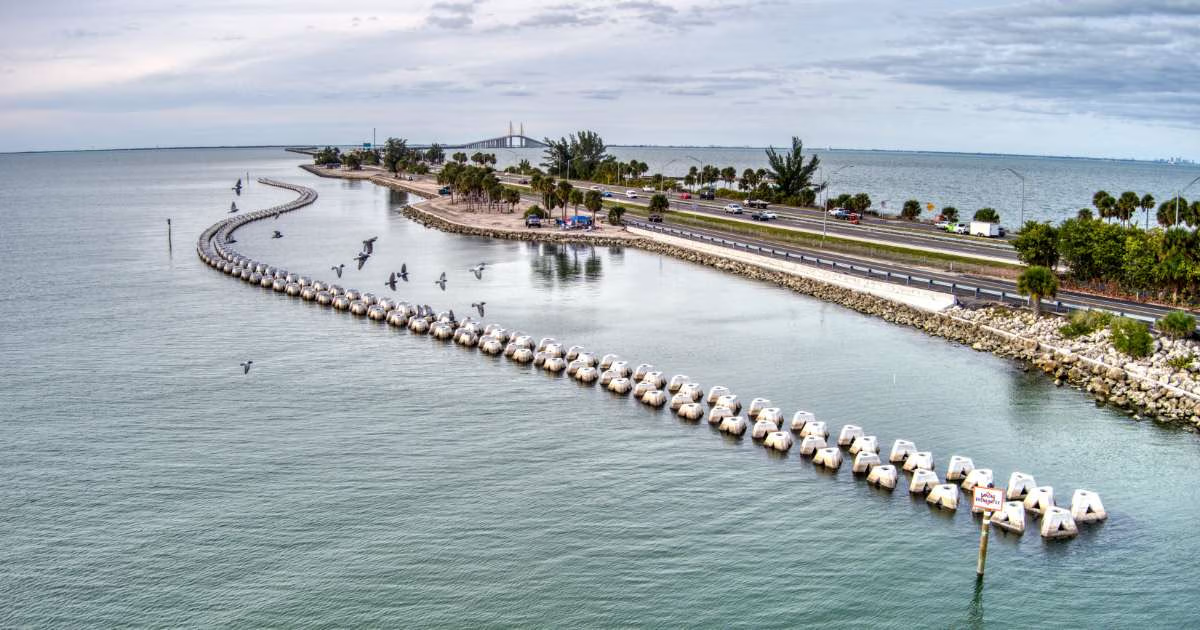
The results appear in the May 2026 issue of the Journal of Coastal Research. University of South Florida (USF) geoscientists Elizabeth Royer and Ping Wang measured how the installation, built from Wave Attenuation Devices (WADs) developed by Living Shoreline Solutions Inc. (LSSI), held its position and how much wave energy it removed before waves reached the causeway. The short answer: the reef stayed put through four named storms and cut wave energy by about 85 percent under the largest waves measured.
An Evidence Gap in a Growing Field
WADs are increasingly applied as multipurpose alternatives to traditional rubble mound structures, the authors note. The appeal is a smaller footprint over seagrass and benthic communities, plus habitat that rock revetments rarely provide. The stability, minimal settlement, and marine habitat benefits are increasingly considered value-added benefits of using WADs in coastal erosion projects. Living Shoreline Solutions has placed over 10,000 WADs in the water in the US and internationally.
The evidence base has not kept pace. Royer and Wang write that peer-reviewed literature has poorly documented the wave-reduction effectiveness of artificial reefs, with most data coming from laboratory flumes rather than full-scale structures. For agencies weighing nature-based options against conventional engineering, and for the funders asked to back them, that gap is a practical problem.
From Riprap to Reef
The Skyway causeway had been armored with a seawall and riprap that needed repeated repair under wave forcing. The Florida Department of Transportation (FDOT) determined that additional protection was necessary, with seagrass recovery set as a second major goal.
The system comprises two segments, roughly 480 m and 375 m long, set 20–70 m from the seawall depending on water depth. Most units stand about 3.2 m tall and sit along the 2.3 m contour, putting their peaks roughly level with the top of the seawall. Each pyramid is perforated and leaves gaps near the surface, so the arrays use two overlapping rows rather than the gapped segments typical of rubble mound breakwaters.
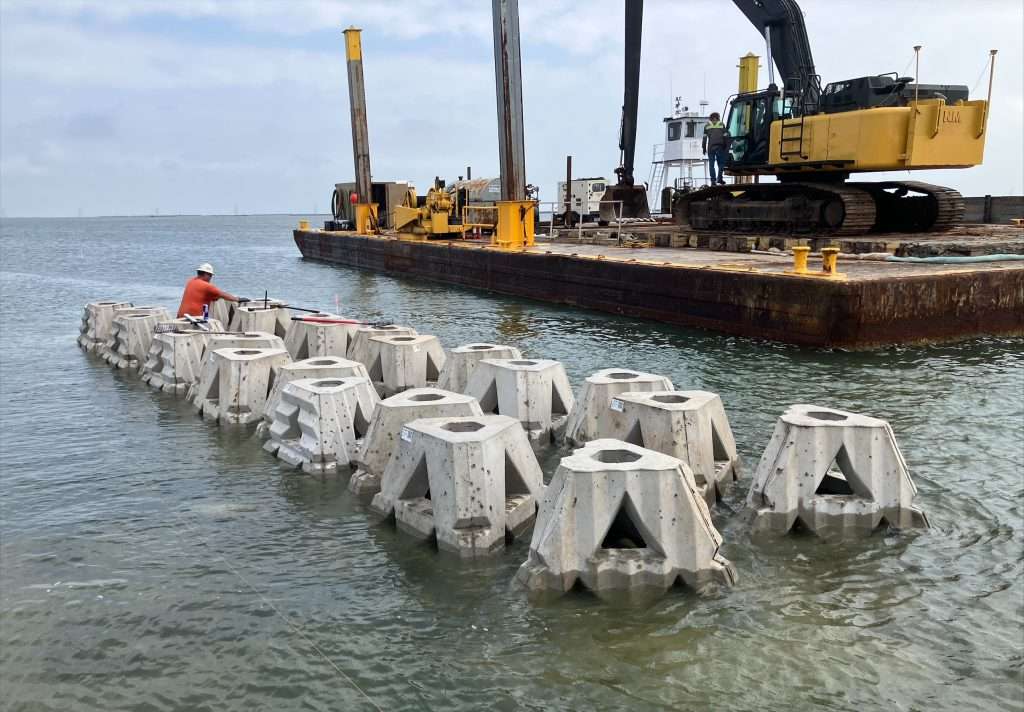
The design avoids scour behind flat-faced barriers by using attenuation rather than deflection: angled faces and tapered openings break up incoming energy instead of reflecting it.
Holding Position Through Four Storms
The USF team surveyed the arrays in September 2023, immediately after Idalia, and again in February 2024. After the hurricane, the inner row sat, on average, just 2 cm below its design elevation, and the more exposed outer row 0.11 m below. Five months later, both rows had settled only about 0.02 m further and remained uniform alongshore. Settlement ditches along parts of the structure tracked installation conditions rather than wave scour, the authors conclude.
Field observations in January 2025, after Helene and Milton, found the units still stable and uniform. The researchers also recorded significant oyster growth on the WADs compared with the shoreline riprap, and point to seagrass recovery within the project area.
Bigger Waves, Bigger Reductions
To quantify performance, the team deployed two wave gauges, one on each side of the northern array, for 30 days starting January 15, 2024. During the most energetic conditions captured, the maximum wave height reached 0.58 m outside the reef but stayed below 0.27 m inside. Because wave energy scales with the square of wave height, the energy difference was starker: 424 J/m2 on the seaward side versus less than 92 J/m2 landward.
Performance improved as conditions worsened. Energy reduction was about 50 percent for waves under 0.1 m, more than 80 percent for waves above 0.35 m, and about 85 percent once incident waves reached 0.5 m. The authors fit a logarithmic relationship to the data with an r2 of 0.97 and found that tidal water level had only a secondary effect. The permeable structure was most effective against the steep, short-period wind waves common at the site.

Closing the Gap
The Skyway project sits within a longer deployment history. LSSI has carried out projects from Audubon Florida’s bird-nesting islands in Tampa Bay to Louisiana marshes and the Chesapeake Bay shoreline. At Bayou Caddy in Hancock County, Mississippi, LSSI installed 500 site-specific units in five 300 ft breakwaters for a US Army Corps of Engineers (USACE) shoreline stabilization project.
Much of that record rests on project reports and partner testimonials. What the Skyway study adds is prototype-scale measurement published in a peer-reviewed journal: the kind of data engineers need to size structures and owners need to justify them.
As public owners look for protection that also returns habitat, the Sunshine Skyway now offers a measured answer to a basic question: how much work does an engineered reef actually do? In Tampa Bay, under the waves that threaten the roadway most, the answer is most of it.
To learn more, visit: https://livingshorelinesolutions.com/