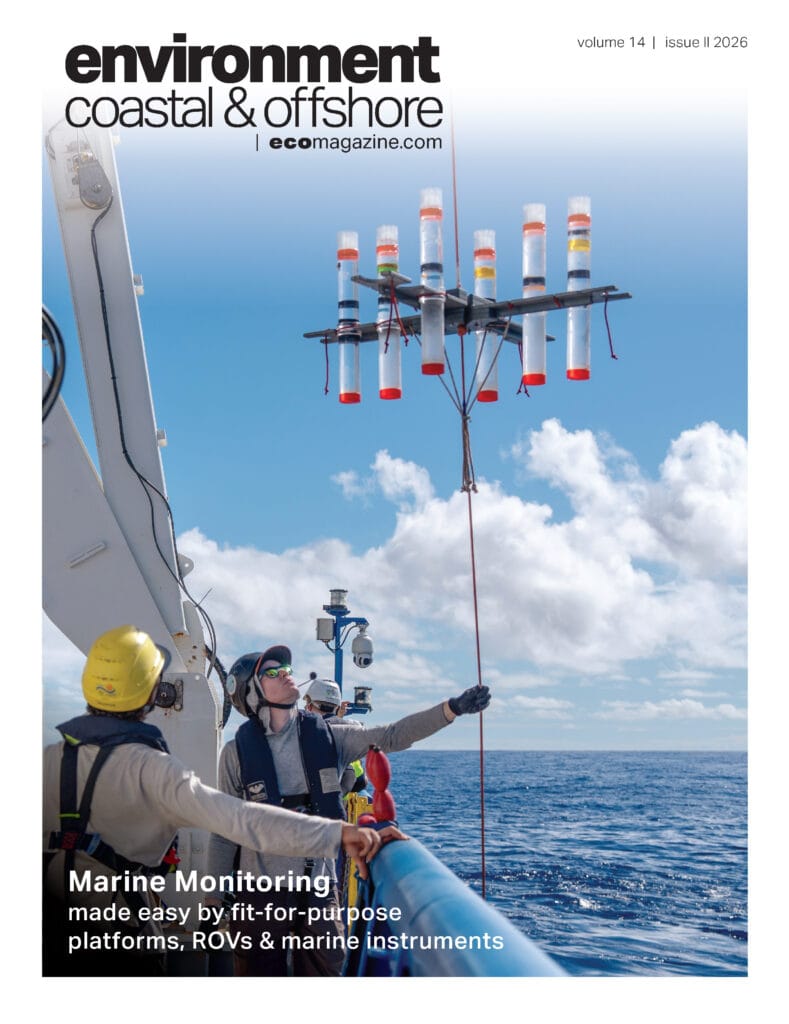
Multidisciplinary marine surveys are key in the development and permitting process and include a range of assessments, from seafloor and water column site characterizations and environmental impact assessments to post-construction monitoring and decommissioning studies. Traditional methods for in-situ biological assessments, such as net sampling, are slow and expensive, often incomplete, and rarely repeated due to cost and logistical constraints, making it difficult to holistically assess the costs and benefits of offshore industries. Better, faster, and more cost-effective site characterization methods are needed. Thankfully, scalable options are at hand.
eDNA Adoption Offshore
Environmental DNA (eDNA) is already being applied in many freshwater and marine contexts globally. It is used to map the location of imperiled species, provide early detection for invasives, improve fisheries stock assessments, and generate an inventory of species present simultaneously in support of biosecurity and environmental monitoring. What once required a variety of observational techniques can now be largely replaced using a single method: collection of a water sample and analysis of the DNA it contains. eDNA has proven to significantly improve accuracy, increase speed, and reduce costs.
These advantages make eDNA a much more practical means for monitoring offshore sites, enabling adaptive management of structures and operations. The method also offers a scalable approach to meet existing needs, enhancing and simplifying environmental monitoring to serve improved long-term management practices for the benefit of all.
Although many federal agencies use eDNA, applications remain primarily in research or comparative assessments, even though its utility for decision-ready results has clearly been demonstrated. Legislation, new rules, or just clear messaging from agency leaders is needed to give resource managers the confidence to base decision-making on eDNA information. Such a demand signal from the federal government is essential to encourage private sector investment in more eDNA goods and services.
Versatility in the Field
One of the key advantages of eDNA is its compatibility with automated workflows, making it highly scalable and well-suited for integration with advanced technologies. Recent advancements in automated samplers, sensors, and the platforms on which they are deployed are synergistically modernizing ocean observations using a variety of tele-operated and fully autonomous systems.
Whether on robotic platforms or crewed vessels, new technologies have set the stage for next-generation ocean observation. The integration of edge computing, machine learning, and artificial intelligence enables holistic and remote ocean observations without necessarily requiring a human presence is a game changer. Undoubtedly, this will continue to be an area of rapid innovation that will transform ocean robotics—and, along with it, data acquisition, analysis, and dissemination both ashore and at sea.
Path to Realization
Bringing these new tools and techniques to bear on solving the challenges and pitfalls of long-standing ocean observation requires the coalescence of industry working in partnership with cognizant government agencies and the academic research community.
The MTS eDNA Technology Committee provides an ideal forum to catalyze public-private partnerships to advance such practical and scalable applications that meet real-world needs. Our committee is working in pursuit of that goal with focused subgroups that concentrate on policy, method and data standardizations, and field-deployable instrumentation. The formal adoption of eDNA technology requires the alignment of those three key areas. Actionable policies that are based on agreed-upon standards, supported by deployable purpose-made instrumentation for streamlining sample acquisition and analysis, offer a path forward.
To find out more, visit: www.mtsociety.org/eDNA
This spotlight appeared in environment coastal & offshore (eco) magazine’s 2025 summer edition Rethinking Offshore Operations, to read more access the magazine here.