Furthermore, reaching remote monitoring sites for routine maintenance can be difficult, making autonomous power, durable construction, and reliable remote communications especially important.
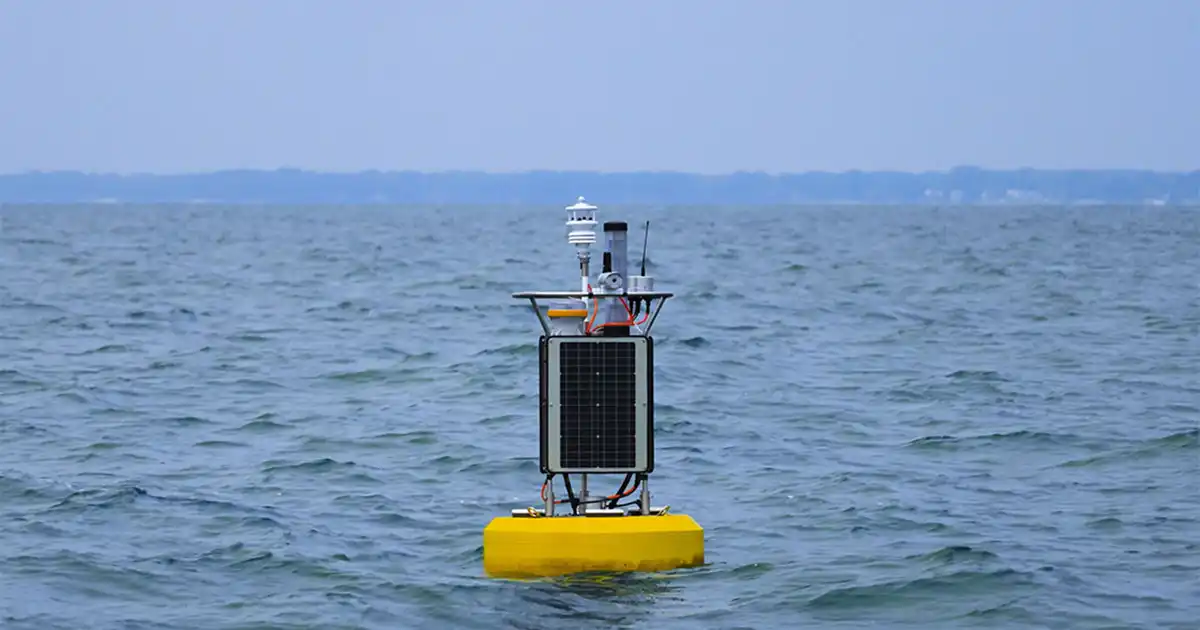
NexSens Technology buoy systems address these challenges by combining a rugged floating platform with configurable sensors, autonomous power, and real-time data access when combined with the X3 Data Logger. Paired with a user-customized sensor suite, the system can monitor conditions both above and below the water surface while transmitting measurements to users remotely.
Built for Offshore Monitoring
For offshore monitoring sites, the NexSens CB-1250 provides the foundation for large-scale offshore data collection. The durable hull is constructed from cross-linked polyethylene foam with a polyurea coating. The buoy also features a stainless steel instrument cage and three 71-watt solar panels. For saltwater deployments, a sacrificial zinc anode can be attached to the instrument cage to prevent corrosion. This combination provides a durable platform designed for years of service in demanding environments.
With a 48-inch diameter, the CB-1250 has 1,044 lb of net buoyancy, giving the platform substantial capacity for sensors, batteries, and data logging equipment. The 10.3-inch-diameter battery well provides space for custom electronics and up to four 28-Ah batteries.
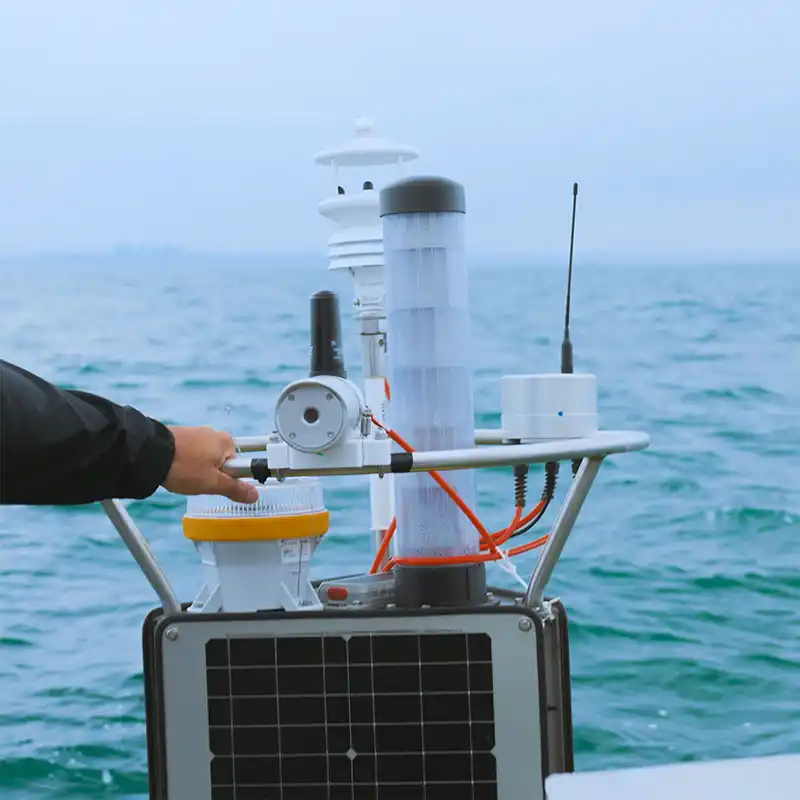
The CB-1250 was designed with customization in mind. Three 8-inch pass-through ports with NPT bottom threads for deployment pipes and custom mounts make sensor deployment and ongoing maintenance easy. The solar tower can accommodate weather stations and other topside instruments like the X3 Data Logger, which mounts to the solar tower ring. The system is highly customizable, allowing the CB-1250 to be configured around the specific monitoring requirements of a project.
Customizable Sensor Suite
A major advantage of a buoy-based monitoring system is the ability to combine several instruments on one platform. A typical offshore configuration might include a Gill MaxiMet Marine weather station, SeaView Systems SVS-603HR wave sensor, and YSI EXO2s multiparameter sonde.
The Gill MaxiMet Marine provides atmospheric measurements from a compact, low-power instrument designed specifically for marine applications. With no moving sensing components, the weather station was built to endure challenging offshore conditions.
The sensor can measure a variety of weather parameters, including air temperature, humidity, pressure, and wind. The integrated compass and optional GPS help provide buoy positioning data and calculate true wind. Altogether, the MaxiMet provides key climate data to support environmental research and navigation.
A SeaView Systems SVS-603HR measures significant wave height, wave period, wave direction, and heading, while also providing additional outputs such as maximum wave height, wave energy, displacement time series, and wave spectra. Its low power consumption and compact footprint make it well suited for integration into an autonomous buoy system.
For water-quality monitoring, the YSI EXO2s sonde supports a broad selection of digital smart sensors with six ports available for customization plus a central wiper that clears biofouling and debris. Common configurations for offshore monitoring systems include temperature, dissolved oxygen, pH, conductivity, saltwater total algae, fDOM, and turbidity.
Real-Time Access to Offshore Data
Because offshore monitoring sites are usually remote and field visits are dependent on weather and wave conditions, real-time data is essential for marine applications. Traveling to a buoy to retrieve data can be time-consuming and may expose personnel and equipment to challenging conditions. Real-time telemetry allows users to monitor measurements remotely, identify changing conditions, and respond to problems without waiting for the next maintenance visit.
The NexSens X3 Environmental Data Logger serves as the communications and data-management hub for the system. The compact logger is compatible with a wide range of environmental instruments from leading manufacturers, with three waterproof sensor ports for pairing water-quality sensors, weather stations, temperature strings, and other monitoring equipment. Its built-in sensor library simplifies sensor setup and configuration.
The X3 is housed in a sealed, marine-anodized aluminum enclosure designed for harsh environments, with waterproof UW connectors for sensor and power cables.
Telemetry options include 4G LTE cellular, Iridium satellite, or a combination of cellular and satellite communications, allowing the system to be matched to the infrastructure available at the deployment site. Once measurements are collected and transmitted, users can access them through the WQData LIVE web datacenter.
This combination of durable hardware, autonomous power, flexible sensor integration, and remote data access makes the CB-1250 and X3 a foundation for long-term offshore monitoring systems that can be configured around the environmental conditions and measurements most important to each project.
This feature appeared in environment coastal & offshore (eco) magazine’s 2026 issue IV. Read in the magazine here.