But the single-minded science team remains undeterred. They’re on a hunt.
The researchers from the Scottish Association for Marine Science (SAMS) in Oban are on Loch Etive, a sea loch often referred to as SAMS’ ‘outdoor lab’, given its proximity to the institute building.
Little Body, Big Nuisance
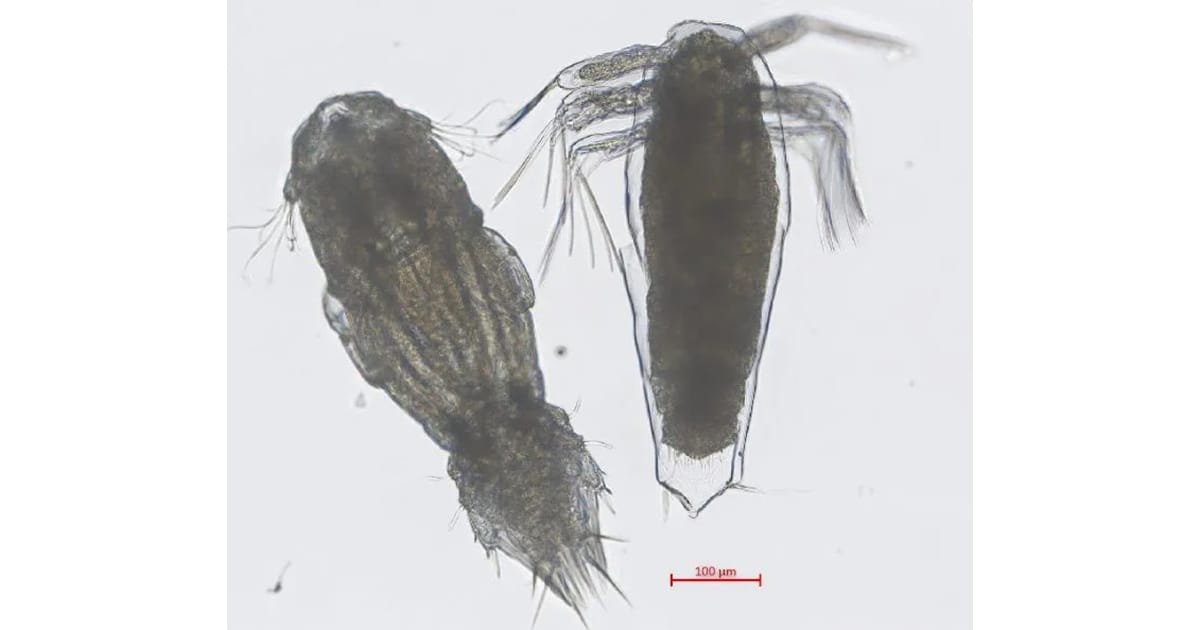
Conducting monthly excursions to the loch, they are hunting a tiny organism that is a big concern for the salmon farming industry and conservationists alike: the sea louse, Lepeophtheirus salmonis. This parasitic copepod poses a significant challenge to farmed salmon in major finfish aquaculture nations such as Scotland, Norway, and Canada. The organism attaches to the fins, gills, and body and feeds on the skin, mucus, and blood of the fish, potentially resulting in secondary infection and even death if not treated.
Fish farmers have used medicinal and physical treatments and cleaner fish such as wrasse in an attempt to tackle the problem and, more recently, are seeking to deploy semi-closed containment systems. These farm designs partially isolate farmed fish from the surrounding environment while still allowing some water exchange. In this system, water is drawn from the environment deep underneath the farm, filtered, and then discharged. The containment or well, often made of durable liners or solid walls, reduces interactions with wild fish and limits parasite exposure.
But current sea lice management techniques cost the salmon sector hundreds of millions of dollars worldwide, while there is currently limited knowledge on the life cycle and distribution of sea lice in the water column. The SAMS team has already found that sea lice are present at depths down to 30 meters—deeper than previously expected— suggesting there is still more to do in terms of informing mitigation strategies.
“Sea lice infection is arguably the biggest issue in Scottish aquaculture and, with the adoption of the new sea lice regulatory framework last year, the issue needs to be better understood across research, policy, regulatory, and industry sectors,” said SAMS Researcher Dr. Helena Reinardy.
“We need to develop better methods of monitoring and understanding sea lice in the water. Sea lice larvae are small and hidden in the diverse plankton ecosystem. They also look quite similar to other copepod larvae, so it is hard to tell them apart. We need new methods to rapidly monitor their numbers in the water and accurately assess where they are, in order to better inform models and understand the risk to wild salmon and salmon farms that they may infect.
“As well as being a welfare issue for farmed fish, we need to better understand sea lice larvae distribution in the water to assess potential impacts on the surrounding environment.”
The Scottish Government’s Marine Directorate and Scottish Environment Protection Agency are keen to develop methods for monitoring. Data on real-time presence and numbers of sea lice larvae in the water are also essential to help the modelers predict infection pressure and dispersal.
In-the-Field Operations
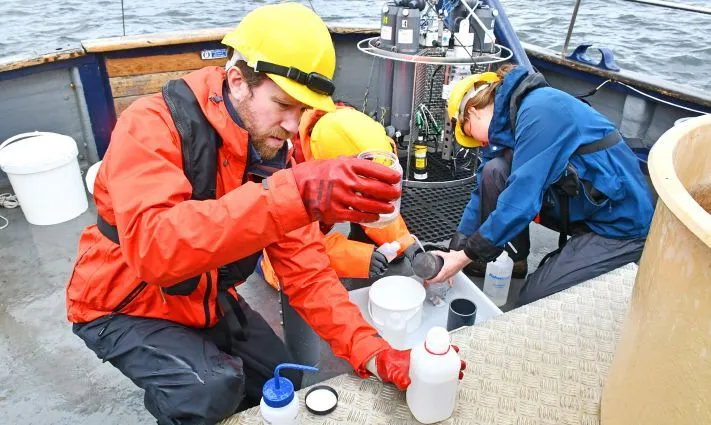
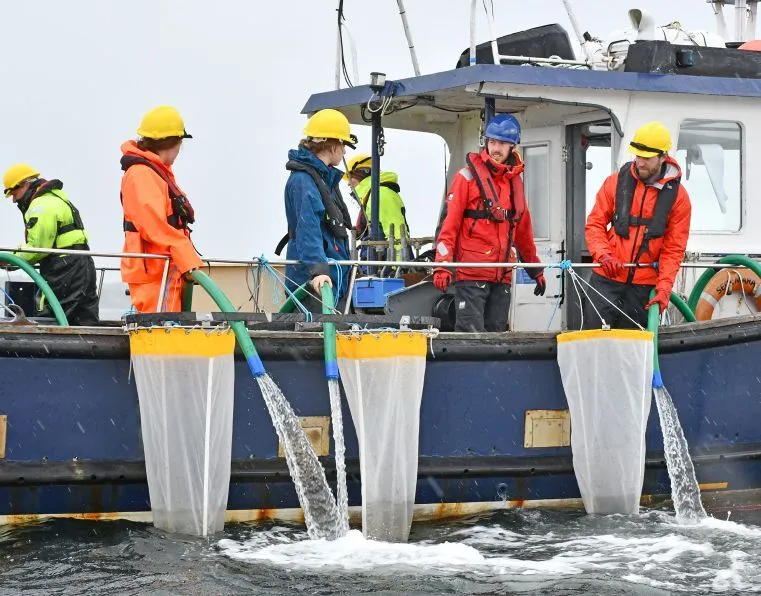
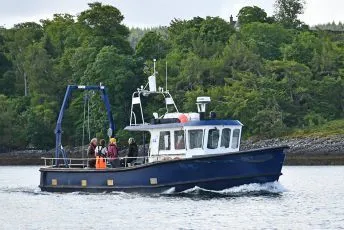
At sea, Dr. Reinardy and her colleagues are contending with predictably unpredictable Scottish weather as they set up their sampling system on Loch Etive. Three hoses, placed on the port side at set depths of 1, 12, and 20 meters, pump water into plankton nets positioned off the starboard side of MV Seol Mara. The samples are then hauled up and washed through sieves. The contents of the nets will help the team to understand the prevalence of sea lice at those depths.
Simultaneously, Oceanographer Dr. Andy Dale has a drifting set of instruments that follow the currents and circle the boat as they sample, measuring currents, temperature, salinity, and depth in the water nearby. Noting the speed of the currents and water temperature helps inform the sea conditions at the time of sampling.
On return to SAMS, the samples are further filtered and picked through under a microscope by taxonomists trained in identifying the small nauplii and copepodid larvae. These data are used to improve dispersal models and interrogated to better understand how their presence relates to the physical features of the water. How deep can they go?
Based on the water currents they were captured from, where might they come from, or go to?
Meanwhile, a sea lice hatchery in the SAMS aquarium produces hatched sea lice larvae, helping the scientists and students to understand the behavior, survival, and sensitivities of these ‘baby sea lice’.
It’s a comprehensive study, undertaken by a large group of scientists and students with a wide breadth of scientific expertise, but a crucial one given the current lack of knowledge.
SAMS Ecologist Dr. Kim Last said: “Sea lice are a huge problem for the salmon farming sector, and a lot of money has been spent on mitigating this fish welfare issue.
“There are moves towards more closed farming systems, but these systems will still need to source water from the sea. This makes it really important to understand the behavior of sea lice larvae in the wild, specifically when and where they occur in the water column, which is challenging given their rarity.
“The organisms we’re looking for are not that abundant in an otherwise very abundant plankton community; we need to sieve and process around 10 cubic meters of water to catch one or two sea louse larvae!”
This feature appeared in environment coastal & offshore (eco) magazine’s 2025 winter edition Fisheries & Aquaculture, to read more access the magazine here.