The idea began nearly a decade ago, when William & Mary’s Batten School of Coastal & Marine Sciences & Virginia Institute of Marine Science (VIMS) Professors Rom Lipcius and Rochelle Seitz commuted past the base.
“Every morning, I would drive past the Naval base and look at their expansive pier system. I thought, ‘this would be a perfect spot for an oyster sanctuary,’” recalled Lipcius.
He reached out to NWSY Natural Resources Manager Tom Olexa, who had a related concern: the eroding shoreline surrounding the base, especially the R3 Pier, which serves as a vital Navy supply line. Together, Olexa and Lipcius began shaping a project that would pair ecological restoration with military readiness.
They drew in colleagues to help—experts Scott Hardaway and Donna Milligan of the Batten School & VIMS Shoreline Studies Program and oyster reef specialist Russ Burke of Christopher Newport University.
The group secured early grants from the Chesapeake Bay Trust and Chesapeake Research Consortium to facilitate initial designs and permits. Pew Charitable Trusts later championed the work, paving the way for full REPI funding.
The project grew to encompass two centerpiece efforts: first, restoring Penniman Spit, a marsh-fringed landform in danger of eroding into the river, and second, installing intertidal and subtidal oyster reefs along the R3 Pier and Penniman Spit. Both strengthened base infrastructure while advancing Chesapeake Bay restoration goals.
Protecting Piers, Ensuring Readiness
The DoD’s REPI Program fosters partnerships that protect military installations while providing broader ecological and community benefits. At NWSY, that mission was clear.
“Number one is protecting our R3 Pier infrastructure,” said Olexa. “Anything we can do to prevent erosion along that pier directly supports military readiness.”
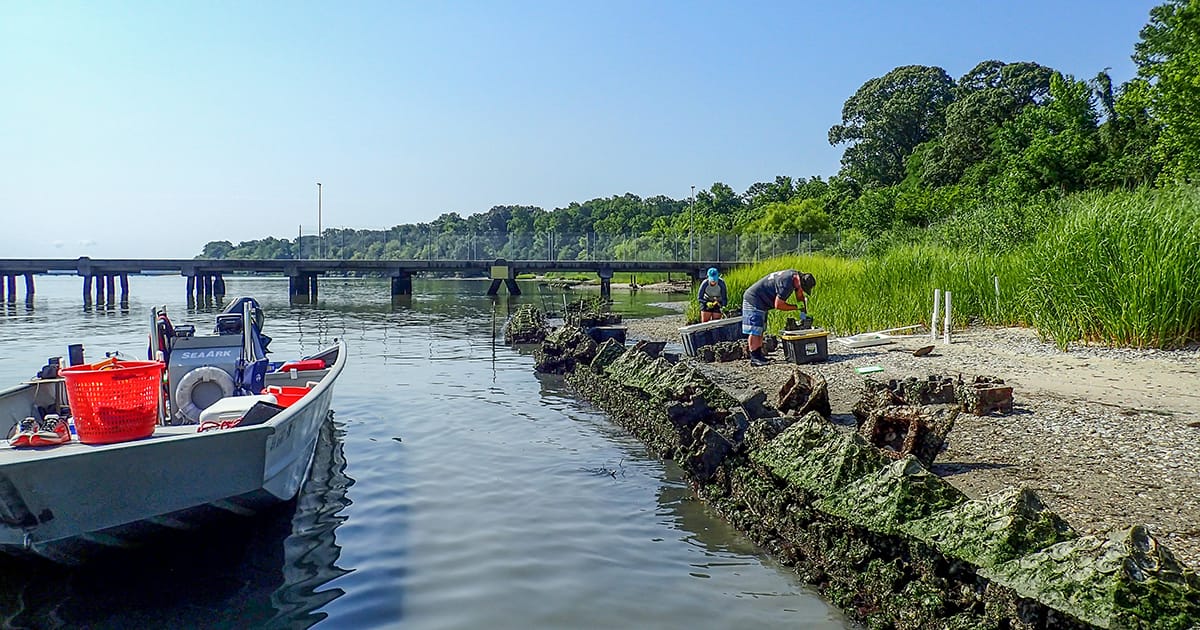
Seitz’s team first gathered ecological baseline data, then Burke installed an array of artificial oyster reefs intertidally along the pier’s shoreline and in adjoining shallow, subtidal waters.
“We installed a variety of shallow, intertidal reefs that dissipate wave energy and trap sediment for shoreline stability. Offshore reefs focus on oyster recruitment,” said Burke. “These were installed extensively around the R3 Pier and are also a prominent feature in the Penniman Spit design.”
For Seitz, the reefs are about more than oysters. “Like coral reefs, they create entire ecosystems. Mud crabs, blue crabs, fish—all find refuge there. Our monitoring shows these reefs boost biodiversity and secondary production across the food web.”
Hydrodynamic modeling confirmed the site’s value as an oyster sanctuary. “Our models showed larvae produced at these reefs will drift toward commercial harvest grounds, while a portion return to sustain the reefs themselves,” said Lipcius. “It’s like a savings account for oyster restoration.”
Rebuilding a Vanishing Landmark
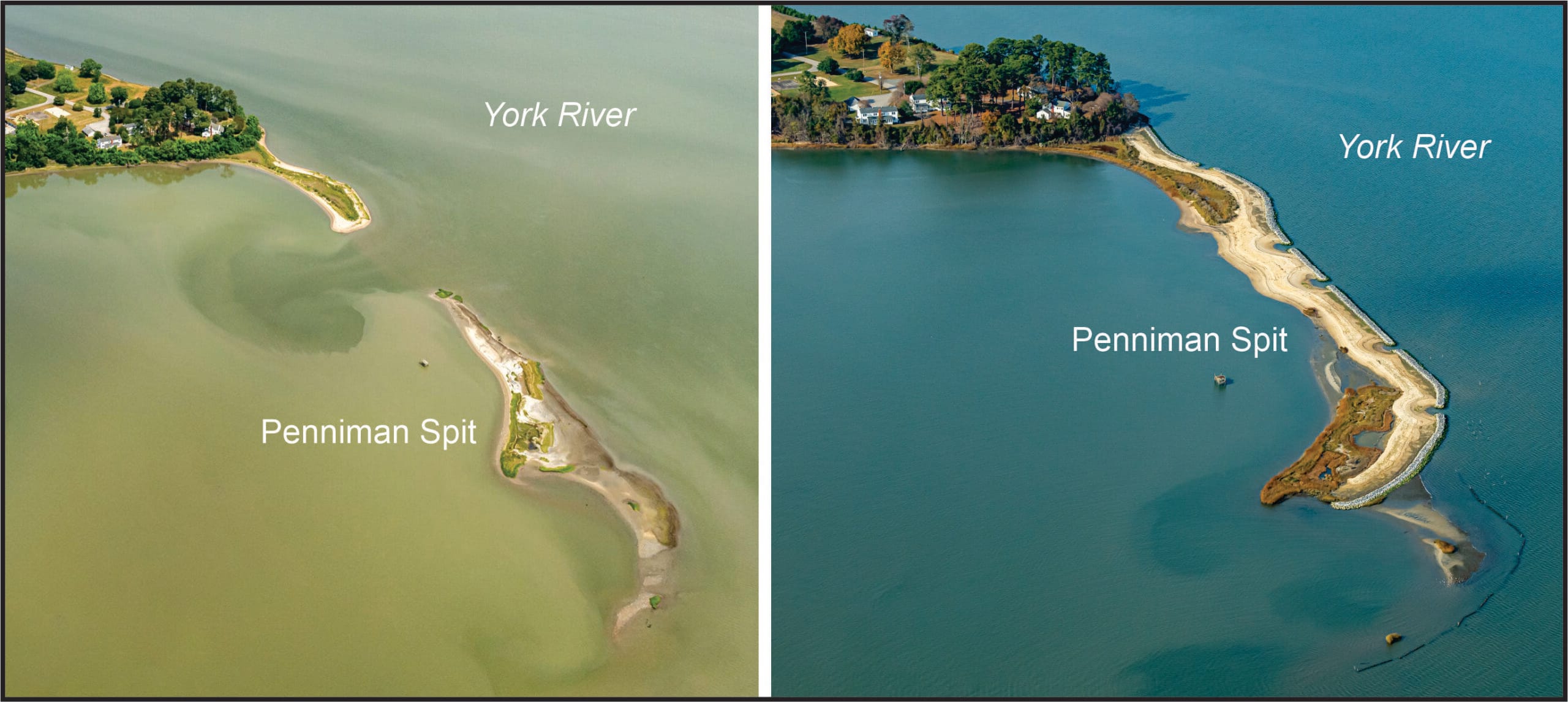
Penniman Spit once stretched more than 14 acres into the York River, protecting a unique ecosystem in Kings Creek and shielding the base’s shoreline. By 2019, storms and tides had carved a channel through its middle, shrinking it to less than two acres.
“Penniman Spit was disappearing before our eyes,” said Milligan. “Without it, not only would the shoreline be subject to erosion, all of the sediment and habitat it sheltered would get swept into the York River.”
Milligan and Hardaway designed a “hybrid living shoreline,” combining rock sills, 24,000 tons of sand, and more than 90,000 marsh grasses. The project restored 2.25 acres of new marsh, protected nearly five acres more, and stabilized almost 2,000 feet of shoreline.
“It’s cheaper to build a rock wall, but you don’t get the ecosystem services,” said Hardaway. “A hybrid design creates habitat as well as protection. Shellfish, particularly oysters, grow well on the rocks. Even gaps between boulders matter—they shelter crabs and juvenile fish while shielding vegetation behind them.”
Milligan and Hardaway have extensive experience in these types of designs, having worked for decades with local municipalities around Virginia’s coast. “Our work is designed for permanence and protection. Facing Nor’easters and hurricane surge, you need something that truly holds,” said Milligan.
The project not only rebuilt a natural shield but also will revive the spit’s role as a training and recreation site for the Navy. By far the largest and most expensive component of the project, the effort earned the Virginia Governor’s Environmental Excellence Award.
However, the work doesn’t end with construction. Penniman Spit, as well as the shoreline surrounding the R3 Pier, will be monitored to assess overall protection and resilience, ensuring funders and partners have evidence of the project’s benefits in terms of protecting base infrastructure and ecological impacts.
For Lipcius, the project’s success is personal as well as professional. “It was a dream come true,” he said. “To achieve an ecological goal like oyster restoration while rebuilding Penniman Spit and partnering with the military—it was more than I ever imagined.”
This feature appeared in environment coastal & offshore (eco) magazine’s 2026 issue I, to read more access the magazine here.