Researchers at St. Anthony Falls Laboratory (SAFL) at the University of Minnesota used a Nortek Signature 1000 ADCP and Vector velocimeter to investigate how the hydrodynamic phenomena generated by recreational powerboats impact the water column and lakebed and recommend best practices for boat operators. The researchers set out to create science-based guidance for where these boats can be safely operated to ensure minimal disturbance to the lakebed.
Testing Multiple Conditions
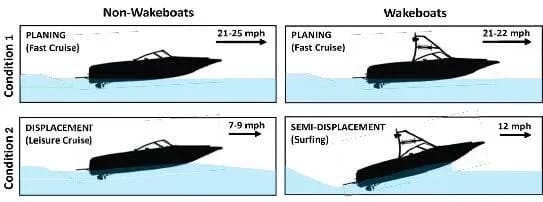
The researchers tested three popular types of recreational boats, broken down into wakeboats and non-wakeboats. Both boat types were tested under two conditions. For wakeboats, the two conditions were “planing” (fast cruising) and “semi-displacement mode,” i.e., “surfing mode.” This semi-displacement mode used by wakesurfers is what creates the larger, more powerful waves that lead to more environmental damage.
For non-wakeboats, the two conditions were “planing” and “displacement mode” (slow cruising). Non-wakeboats do not operate in semi-displacement mode, and are therefore less likely to cause damage.
Examining Lakebed Impacts
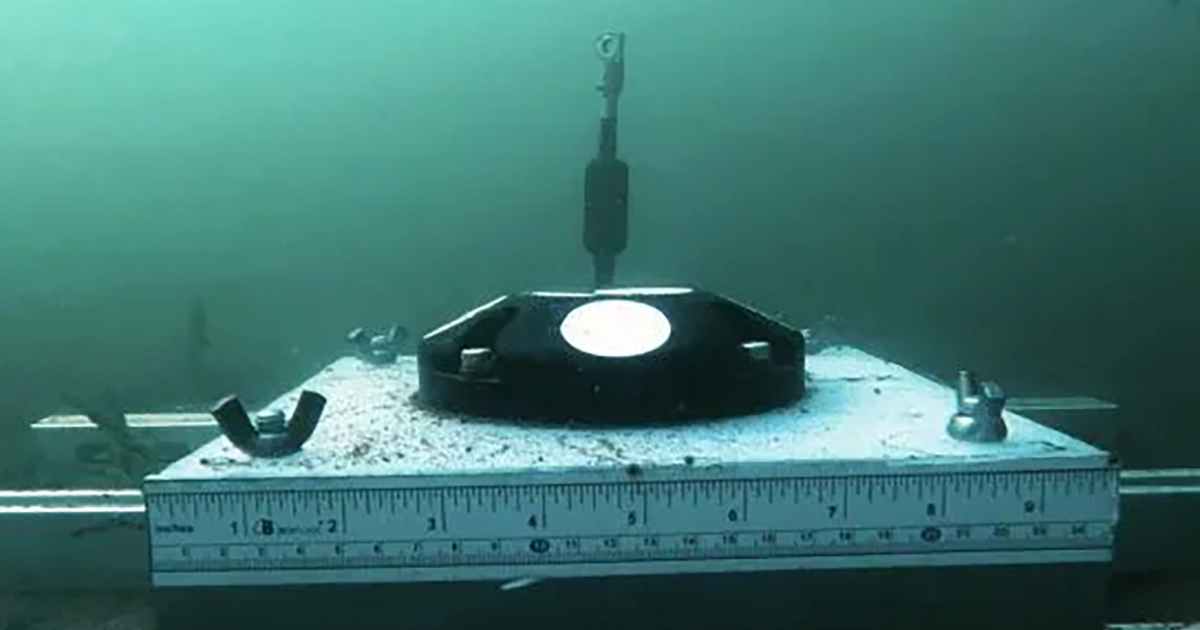
The researchers set up test sites in Lake Minnetonka, a popular lake for recreation about 15 miles west of Minneapolis. The sites were set up for each boat to drive in a straight line along a pre-set track, directly over an up-looking Nortek Signature 1000 ADCP and a down-looking Nortek Vector velocimeter, set up at depths between 9 and 27 ft across the two sites.
Red buoys were attached to the frames these sensors were deployed on, acting as “goalposts” for the boat driver to drive through, which ensured the boats were driven directly over the sensors on each pass.
The Signature 1000 ADCP is unique in its ability to not only measure current velocity profiles like a traditional ADCP but also capture echograms. This enabled the researchers to measure the water column velocities, as well as the extent of the boat’s exhaust bubbles and potential to re-suspend sediment.
The Signature was set to measure water velocities in “layers” only a few centimeters high, creating a fine-scale picture of the generated velocities throughout the water column. The team used the echogram from the Signature ADCP to investigate the bubble plume and sediment plumes created by the boats, and visualize the sediment kicked up by the boat off the lakebed.

“Having the ADCP be able to collect both velocities and echograms was beneficial,” said Andrew Riesgraf, Laboratory Research Scientist at SAFL and lead author of the study. “Most important was its ability to ‘look’ at the entire water column. This allowed us to look at the penetration depth of water velocities and re-suspend heights of sediment over time.”
The team additionally used a Nortek Vector velocimeter to measure water velocities just 4 inches off the lakebed. The Vector measures a sampling volume the size of a marble, but at a rapid speed (32 Hz). This provided insight into the potential for various lakebed sediment grain sizes to shear (move along the lakebed) or resuspend.
Data-Driven Insights
The researchers identified three main hydrodynamic phenomena created by the boats: an initial “bow pressure wave,” followed by the “stern pressure wave” created by rebounding water in the opposite direction, and finally “propeller wash,” the turbulent water behind the boat. Being able to measure and differentiate these three main phenomena generated by the boat’s movement is a key element of understanding their impacts on the lakebed.
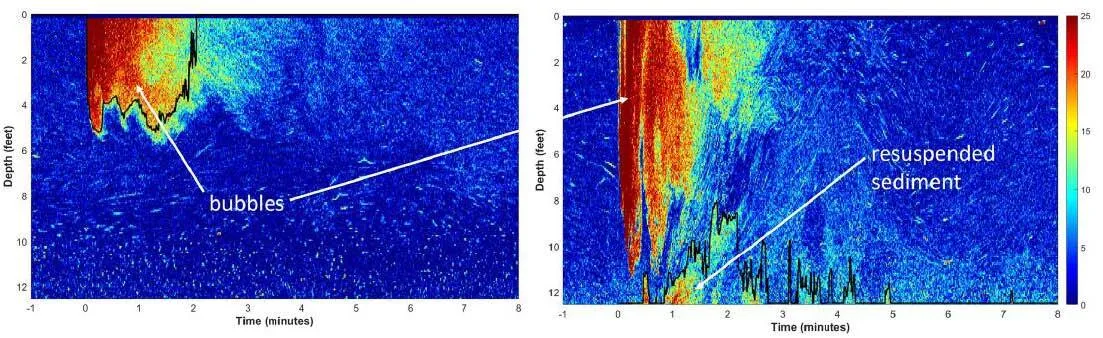
According to the study, the bow and stern waves are the primary phenomenon that initiates sediment movement, but are not sufficient to cause sediment suspension. However, the velocities generated by the transverse waves and propeller wash are large enough to resuspend and entrain the sediment into the water column. Propeller wash was found to directly cause shearing and uprooting of aquatic vegetation under certain conditions.
The researchers correlated information from the ADCP and GoPro footage with the type of hydrodynamic motion occurring. For example, ADCP data showed a series of oscillating current velocities, representing the transverse waves, for several minutes after the boat passed.
After a pass of a wakeboat in “surfing mode”, echograms and GoPro footage showed sediment resuspension up to 6–8 ft in the water column, which remained suspended for more than an hour after the pass. Sediment disturbances were most prominent at the shallower water sites, and wakeboats operating in “surfing mode” had the greatest impact on the lakebed.
Offering Recommendations
For recreational powerboats, the researchers recommend operating in 10 ft of water or more whenever possible, regardless of the mode of operation. For wakeboats, which were shown to have a greater impact on the lakebed in the study, they recommend that semi-displacement mode “surfing” should be reserved for water depths of 20 ft or more.
Riesgraf emphasizes the importance of being aware of the water depths that boat operators are traveling in and making conscious efforts to avoid areas that could be negatively impacted.
This study was funded by a crowdfunding campaign through the UMN Foundation as well as the Minnesota Environment and Natural Resources Trust Fund (ENRTF), as recommended by the Legislative-Citizen Commission on Minnesota Resources (LCCMR).
To see the full study and videos, visit: https://conservancy.umn.edu/items/87cdc769-e543-44b9-b3b9-8e28211ca2ea
This feature appeared in environment coastal & offshore (eco) magazine’s 2026 issue I, to read more access the magazine here.