
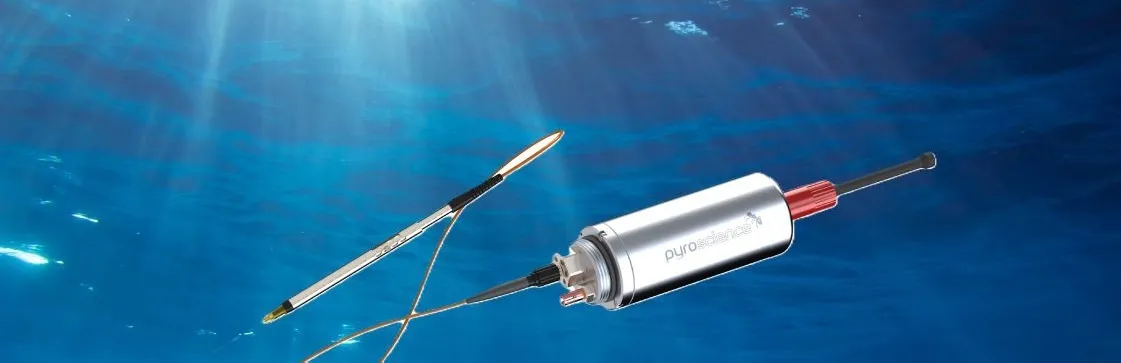
PyroScience’s underwater sensor systems based on the AquapHOx series include autonomous in-situ data collection capabilities, advanced optical sensing principles, and robust designs that withstand even biofouling conditions. The long-term APHOX loggers and real-time APHOX transmitters, initially rated down to 4,000 m water depth, support a wide array of applications in marine research and industry. We are pleased to announce the availability of new APHOX versions rated down to 6,000 m water depth in 2026.
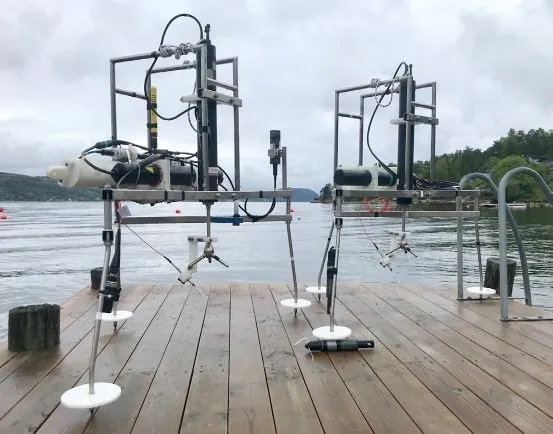
Marine sediments, which cover approximately 70% of Earth’s solid surface, play a key role in organic carbon cycling. It is essential to understand biogeochemical exchanges at the sediment-water interface to accurately measure aquatic ecosystem metabolism and carbon fluxes. The aquatic eddy covariance (AEC) technique has, over the past two decades, facilitated high-frequency, non-invasive measurements of benthic oxygen vertical fluxes.
Leveraging Minisensors
PyroScience’s renowned ultra-high-speed minisensors boast a response time of under 0.3 seconds, enabling micro-invasive and rapid monitoring of oxygen concentration changes. These sensors are compatible with the AquapHOx real-time transmitters, facilitating seamless integration into a variety of monitoring systems. They are ideal for integration with acoustic Doppler velocimeters (ADVs), such as the Nortek Vector, via our APHOX-TVECTOR cable. This facilitates synchronized high-frequency logging of oxygen and current velocities, enabling precise, synchronized AEC measurements. PyroScience’s Ultra-High Speed oxygen minisensors (e.g., OXR430-UHS-SUB) have already been successfully applied for AEC measurements in diverse ecosystems, including seagrass meadows, rocky reefs, and continental shelf sediments.
Recently, interest has grown in polymetallic nodules, which form complex deep-sea habitats and could be an important source of critical metals like nickel, cobalt, and manganese. Assessing baseline carbon cycling and evaluating impacts from potential mining and recovery necessitates the measurement of the benthic oxygen flux, which serves as a sensitive indicator of seafloor respiration and carbon cycling. The Aquatic Eddy Covariance method has the potential to offer a powerful way to measure this flux in situ and non-invasively; however, the method remains untested in such deep and oligotrophic settings. First measurements of benthic oxygen flux using AEC with AquapHOx-TX Deep Sea Transmitter and retractable ultra-high-speed oxygen minisensors (OXR430-UHS-SUB) were performed by researchers of the University of Southern Denmark at approximately 4,000 m depth. This setup proved to be robust and produced high-quality data. Evaluation of performance includes comparisons to fluxes measured using other more established methods, such as benthic chambers and sediment microprofilers.
Collaboration and Future Directions
The AquapHOx loggers and transmitters have been effectively used in diverse ocean habitats. PyroScience actively collaborates with universities, research institutions, and industry partners to enhance innovation, to expand the product portfolio and their applications in ocean waters, now even down to 6,000 m water depth.
This instrument spotlight was written by PyroScience in collaboration with Karl Attard from the University of Southern Denmark.
This spotlight was featured in the 2025-2026 Marine Instruments Buyers’ Guide, read more here.