
Tracing Carbon
DIC includes aqueous CO2, carbonic acid (H₂CO₃), bicarbonate (HCO₃⁻), and carbonate (CO₃²⁻). The two stable isotopes of carbon, ¹²C and ¹³C, are always present within this pool.
The relative abundance of these isotopes, expressed as δ¹³C (the ratio of ¹³C to ¹²C referred to a standard), provides:
- Carbon source attribution, for example, marine vs terrestrial
- Insights into biological processes that preferentially use lighter or heavier isotopes
- Characterization and mixing of different water masses
- Dissolution/precipitation of carbonate minerals (calcite/aragonite)
Together, δ¹³C measurements offer a powerful lens into how inorganic carbon crosses the air–water interface and cycles through aquatic systems.
Made for Precision
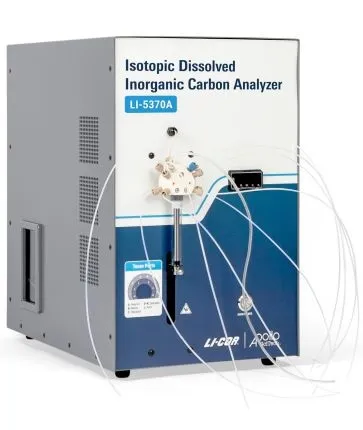
The LI-5370A delivers best-in-class δ¹³C measurement precision (0.02‰) and total DIC precision (0.1%). It is suitable for both land-based and shipboard laboratories and is typically configured for analysis of pre-collected samples. The system accommodates up to eight sample ports plus one DIC reference standard port for fully automated, unattended operation.
Measurement of total DIC and δ¹³C begins with acidification in a reactor, which releases all components of DIC as CO2 gas. A carrier gas then transports the evolved CO2 to a gas analyzer. The LI-5370A achieves its exceptional δ¹³C precision through laser-based spectroscopic detection using the LI-COR LI-7825 δ¹³C CO2 analyzer, which leverages Optical Feedback–Cavity Enhanced Absorption Spectroscopy (OF-CEAS).
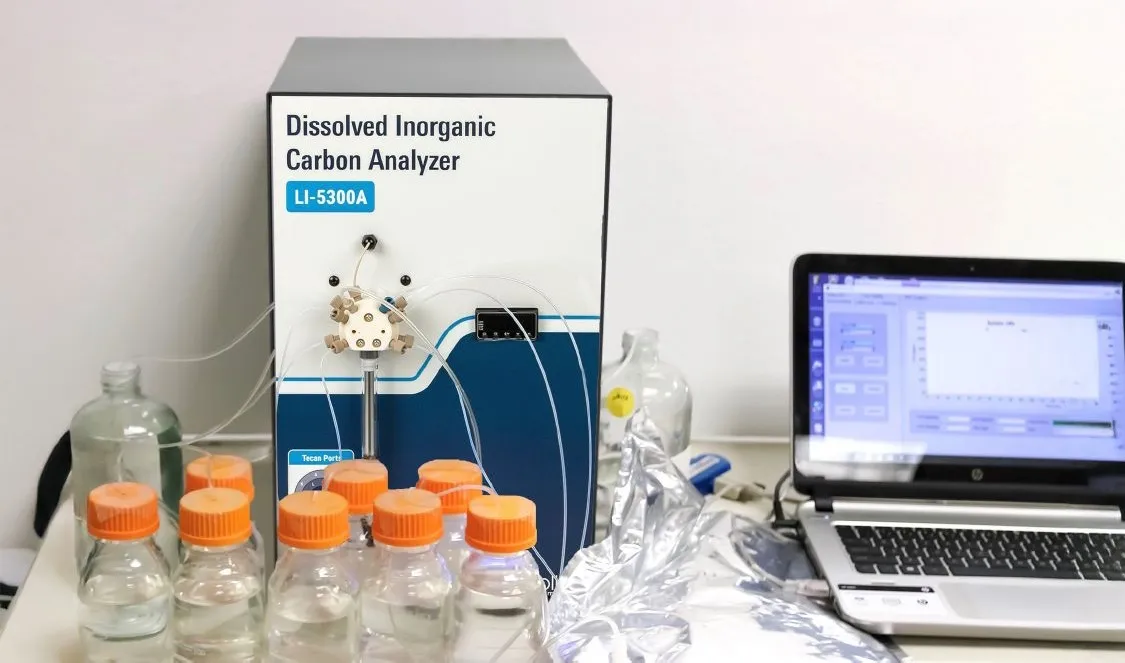
For applications requiring only total DIC, equivalent precision can be achieved with the LI5300A, which incorporates a non-isotopic OF-CEAS analyzer. Alternatively, pairing the system with a Non-Dispersive Infrared (NDIR) CO2 analyzer provides a more compact configuration with a modest trade-off in precision (0.15%).
This spotlight was featured in the 2025-2026 Marine Instruments Buyers’ Guide, read more here.