Nauticus ToolKITT™ is a vehicle-agnostic autonomy layer that handles robotic controls, sensor integration, simulation, and data analysis independent of the underlying hardware. Extending the software to third-party and legacy ROVs lets operators add autonomy as an upgrade path rather than a hardware purchase, positioning Nauticus Robotics as an autonomy-platform provider rather than strictly a vehicle manufacturer—a distinction the company frames as a better long-term business model for the industry as more of the world’s ROV fleet adopts a similar software layer at scale.
From Data Capture to Decision
A mission starts with data capture at the vehicle: sonar, high-resolution imagery, and sensor readings, depending on what the mission calls for. Nauticus ToolKITT™ processes that information in real time, classifying what the vehicle is seeing, flagging anomalies against expected conditions, and packaging the results into something an operator can act on immediately, rather than a technician reviewing hours of raw footage once the vehicle is back on deck. The value of that digitization depends on shortening the distance and time between data capture and decision-making; a well-organized dataset that still requires a week of manual review afterward has not solved the operator’s problem.
A Remote Operations Model
Since late 2025, Nauticus Robotics has run ongoing remote testing between an onshore team in Houston, Texas, and an Aquanaut deployed off Stuart, Florida. The program has validated the communications architecture, control interfaces, and human workflows needed to run autonomous subsea work from shore rather than from a vessel—addressing the cost structure that dominates subsea work, where getting people and vessels offshore drives much of the expense. An onshore team reliably operating and troubleshooting a vehicle hundreds of miles away, hour after hour, demonstrates not just a vehicle capability but a different cost structure for how the work gets done: the kind of reliability record operators look for before trusting autonomous deployment on a live asset.
From Inspection to Sensing
Nauticus Robotics has also signaled a shift toward supporting persistent ocean sensing infrastructure, applying the same platform to missions spanning weeks or months rather than single inspection visits. The core autonomy architecture carries over directly—the decision-making, sensor fusion, and vehicle-agnostic design don’t change. What changes is the endurance and reliability bar: a system built to perform well on a four-hour inspection mission has to prove something different when it is expected to maintain awareness of a stretch of seafloor for months without an unplanned failure.
Looking two to three years out, the company frames the bigger barrier to offshore automation as trust, not technology. Hardware and software in the space are advancing quickly, and what moves more slowly is operator confidence—built one successful mission and one reliability record at a time. Nauticus Robotics considers the remaining distance as much a cultural and commercial challenge as an engineering one.
To learn more, visit: https://nauticusrobotics.com/
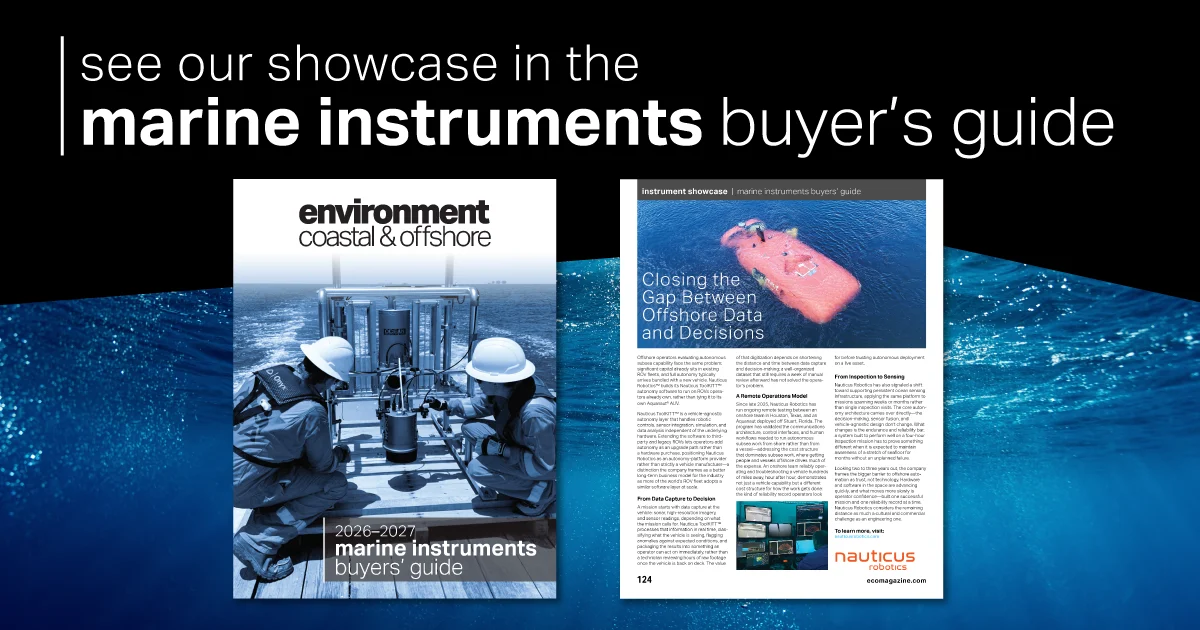
This spotlight was featured in the 2026-2027 Marine Instruments Buyers’ Guide. To read more, visit: https://digital.ecomagazine.com/eco-mibg-2026-2027/page-124