Transforming Sampling Techniques
McLane’s earliest instruments laid the groundwork for today’s eDNA sample collection strategies. Today, McLane offers four eDNA collection instruments: the Remote Access Sampler (RAS), Phytoplankton and Particle Sampler (PPS), Robotic Cartridge Sampling Instrument (RoCSI), and the Suspended Particulate Rosette Sampler (SuPR). Known for reliably capturing and preserving genetic material in the ocean, these instruments are engineered to perform under the most demanding conditions. As autonomous eDNA sampling technology continues to transform how researchers study marine biodiversity, McLane’s instruments are helping to open new pathways for understanding ecosystems at scales previously out of reach using manual collection methods.
McLane’s RAS was first developed in the 1990s and remains a cornerstone of unattended moored sampling technology today. Originally designed as the first demonstration of autonomous bulk water sampling in the ocean, the RAS has continued to evolve and is now a trusted platform for time-series studies, genetic material collection, and eDNA applications worldwide. Another McLane instrument, the PPS, collects 24 samples onto 47 mm filters at volumes up to 20 liters per sample. On-board in-situ preservation ensures that data points are captured and “frozen in time” for time-series studies and biodiversity monitoring.
Leaning into Collaboration
More recently, utilizing their expertise in technology transfers, McLane expanded their eDNA, particle, and water sampler line with the RoCSI and the SuPR. The RoCSI, a product of a technology transfer partnership with the National Oceanography Centre (NOC) Innovations team in Southampton, UK, performs autonomous, high-count, in-situ eDNA sample collection for depths down to 6,000 meters. With a compact size and standard and moored configurations, RoCSI can be deployed autonomously on vehicles, installed on bottom landers, positioned via ship winch, and used in shipboard labs. The 6,000-meter depth rating, a unique feature among current eDNA sampler offerings, provides access to communities that are rarely observed and often impossible to study directly.

The SuPR, an instrument produced via a technology transfer partnership with the Woods Hole Oceanographic Institution (WHOI), collects 14 high-volume samples onto 142 mm membrane filters. SuPR can achieve up to 2,000 liters per sample (depending on filter porosity). With such high-volume collection, researchers can build a much more complete biodiversity profile, from abundant microbes to rare, ecologically important species.
Beyond eDNA samplers, McLane continues to advance a full suite of samplers that have become benchmarks for long-term, autonomous oceanographic research. At the heart of every McLane instrument is a commitment to reliability, precision, and partnership with the global research community. By combining decades of engineering expertise with a dedication to customer support, McLane ensures that their instruments not only meet today’s scientific challenges but also empower discoveries for generations to come.
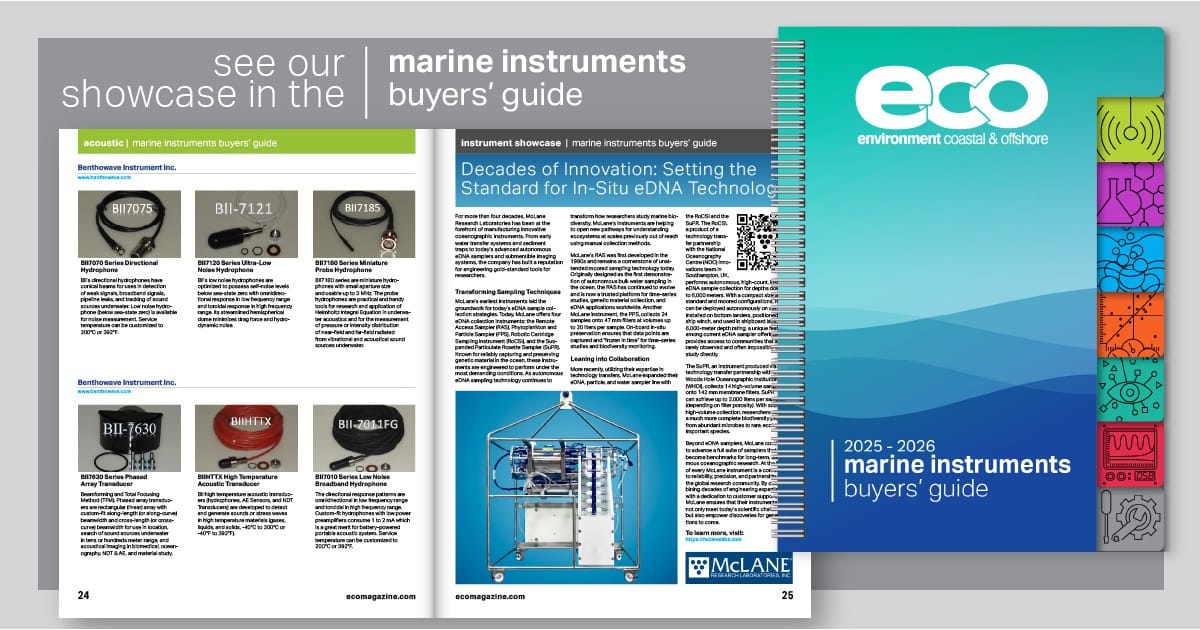
This spotlight was featured in the 2025-2026 Marine Instruments Buyers’ Guide, read more here.