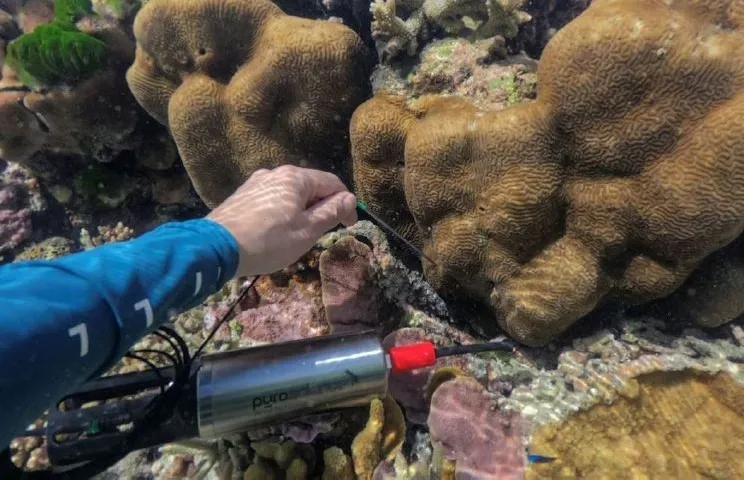
PyroScience’s underwater sensor platforms empower users with autonomous collection of in-situ data, leveraging sophisticated optical sensing mechanisms and sturdily designed units built to endure tough underwater settings. These features support a wide range of applications in marine research and various industries.
Versatile Product Portfolio
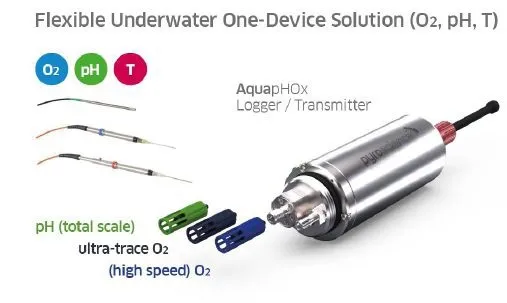
The AquapHOx meters and PICO-OEM modules are engineered for effortless integration with independent observational tools such as ADCPs, buoys, gliders, AUVs, and CTDs. Loggers in the portfolio can function independently, while transmitters need an external data logger and power source to deliver real-time readouts. When equipped with oxygen or total scale pH sensor caps, AquapHOx meters can also be deployed for flow-through analysis in pumped systems, including FerryBox setups, using the APHOX- FTC screw-on underwater flow cell.
With plug-and-play interchangeability stemming from multiple sensor head types, the AquapHOx series comprises six different models to address both coastal and deep-sea monitoring demands. Devices for shallow waters—such as AquapHOx®-L-pH and AquapHOx®-L-O2 loggers, and AquapHOx®-T-pH and AquapHOx®-T-O2 transmitters—are rated up to 100 m depth and specialize in either pH or oxygen measurement. Deepsea models—AquapHOx®-LX and AquapHOx®-TX—are suitable for operations at depth reaching 4,000 m and from 2026 down to 6,000 m. Only one sensor head can be attached at a time, but a single deep-ocean device can be alternately configured for oxygen or total scale pH readings. Every AquapHOx meter is fitted with a rapid-response temperature sensor for automatic compensation of both pH and oxygen measurements.
PyroScience’s PICO-OEM product range includes the PICO-O2-SUB and PICO-PHSUB models, designed for integration into custom underwater housings and subject to pressure testing. They rely on third-party temperature sensors to adjust chemo-optical readings and support a broad selection of optical sensor heads catering to varied concentration ranges and response requirements.
Optical pH Measurement
The PHCAP-PK8T-SUB optical pH sensor cap is crafted for precise detection of total scale pH in ocean environments. Thanks to its sturdy design, maintenance is simplified, as caps are easily replaced. Employing REDFLASH optical technology, the sensor dispenses with reference electrodes, reducing the impact of high ionic strength—making it exceptionally suitable for use in seawater.
To address biofouling, PyroScience has introduced a new pH sensor cap model, PHCAPPK8T-AF-SUB, featuring an innovative anti-fouling layer. Additional copper alloy-based protective accessories, such as APHOX-CAGE-AF and APHOX-CAP-AF, extend operational durability for extended underwater deployment.
Oxygen Sensing
PyroScience’s marine sensor systems provide reliable ocean data essential for environmental evaluations and promoting responsible industry practices. These technologies support a vast array of research and operational monitoring—such as observing oxygen minimum zones (OMZs) and detecting changes near offshore facilities.
Their extensive selection of oxygen sensors encompasses a variety of formats, measurement ranges, and response times. Full-range oxygen sensor caps, OXCAP-AFSUB, equipped with protective cages, are designed for versatility in oceanographic research, long-term deployments, and monitoring tasks. The ultra-trace sensor, UTROXCAP-SUB, is precisely engineered for detecting very low oxygen levels in OMZs or during deoxygenation events, which are becoming more frequent due to environmental change.
Fast and ultra-fast sensor variants enable high-speed water column profiling. The retractable fiber oxygen minisensors deliver micro-invasive, near-instantaneous tracking of oxygen fluctuations, a critical functionality for measuring benthic oxygen fluxes, such as those observed in aquatic eddy covariance (AEC) studies.
This spotlight was featured in the 2025-2026 Marine Instruments Buyers’ Guide, read more here.