
As it turns out, when you breathe out, you expel a lot more than just hot air. It also happens to be the same for cetaceans—dolphins, whales, and porpoises. Alongside the more well-known analytes, carbon dioxide, hormones, proteins, and DNA are also expelled into the atmosphere during exhalation. Interestingly enough, those analytes can be indicators of health.
Indicators of Health
Historically, many of the tests to determine the health of a cetacean require a physical tissue or blood sample. While physical sampling can be easier in a semi-controlled environment, such as an aquarium, this is often not the case in the wild. Expanding on the sampling methods, Dr. Romano shared, “We have relied on blood as a sample for revealing whale health. Blood is the gold standard. Just like we all go to the doctors for a check-up, and a blood sample is taken, we learn all about whale health from a blood sample.
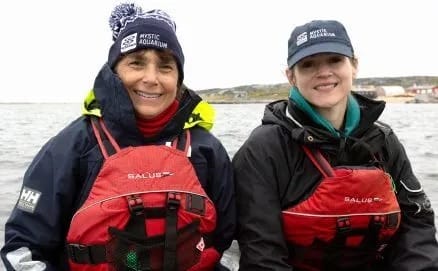
“However, getting a blood sample from a wild whale is not feasible unless it’s temporarily handled, which has the potential to change some blood parameters. Our research team at Mystic Aquarium is developing innovative technologies to assess health using whale breath, skin, and feces, which can be adapted for sampling wild whales.”
The analytes that are expelled by a beluga whale’s breath—or “blow”— can be harnessed to determine the health of the individual. The hormones, proteins, gene expression, and microbiome of a beluga’s blow can be analyzed to infer stress, disease, reproductive status, and more.
The researchers leveraged the more controlled environment of the aquarium to develop novel sampling methods.
“At the aquarium, our whales were trained to exhale into a dish, which we could then take to the lab and develop all kinds of tests. From there, we were able to show that we can determine the sex of the whale from its breath, its stress, metabolic and reproductive status, as well as all the microbes present, how well the immune system is working, what genes and proteins are being expressed, and the stock identity of the whale,” Dr. Thompson explained.
In addition to leveraging the more controlled environment of the aquarium to develop novel sampling methods, the researchers had to develop most of the technologies themselves to study the whale’s immune system. For example, reagents and assays available for human and mammalian tests may not always be suitable for analysis of whale samples.
Dr. Thompson shared, “We have developed and continue to develop a ‘toolbox’ of whalespecific reagents that enable us to assess how well their immune system is functioning or whether they have disease.”
Into the Wild
Every summer, the Churchill River estuary in Manitoba, Canada, welcomes thousands of beluga whales to its shallow warm waters where whales come to feed, calve, molt, and play.
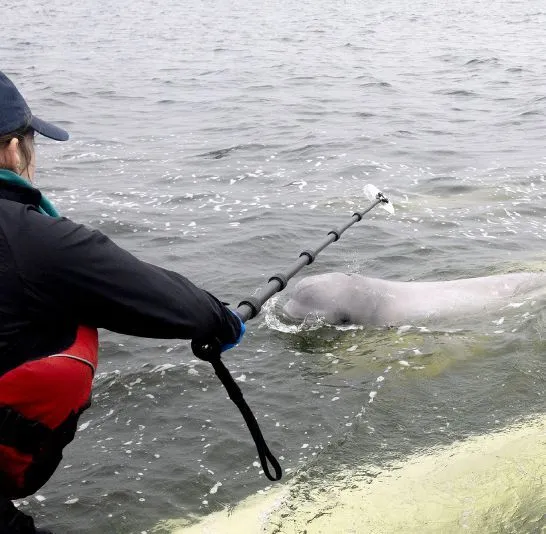
For the first time, in the summer of 2025, Dr. Romano and her colleague, Dr. Thompson, successfully collected over 80 non-invasive breath samples from beluga whales in the Churchill River in Manitoba, Canada.
“This was the first time we carried out breath sampling like this in the wild—so we didn’t know what to expect, and it wasn’t without its challenges,” shared Dr. Thompson. “Sometimes whales were focused on other things and weren’t close enough for sampling, other times the whale’s breath wasn’t large enough to actually see it on the collection plate.”
While the IUCN classifies beluga whales as a species of “less concern”, specific populations around the globe have faced significant population decline—like the population found in the Cook Inlet, Alaska, which has declined by 75% since 1979. Research, like that being carried out at the Mystic Aquarium, is helping to improve our understanding of population dynamics and inform conservation policy.
Creating a Foundation
The researchers would be remiss to not credit the aquarium for making this science achievable.
“This work was only possible by ground truthing the technology with the trained whales at the Aquarium. This is a prime example of how the aquarium allows us to learn as much as we can from our whales in a controlled environment, helping us understand and conserve wild belugas, especially amid rapid environmental change and endangered beluga populations,” added Dr. Romano.
Looking to the future, the researchers are enthusiastic to leverage the data collected in 2025 as a baseline for monitoring and to expand sampling methods.
“We are hoping to photo-ID each whale we take a breath sample from, and so are gearing up to see if we can make that happen. We found that some breath samples collected this past summer did not contain enough material for the tests we wanted. From that information, we are honing our process to use the optimal type of test and to better preserve test samples on the boat,” Dr. Romano continued.
“We can also see paths to adapting this sampling method for other whale species and for integrating other technologies, like uncrewed aerial vehicles (UAVs), to sample in remote or hard-to-access locations.”
This feature appeared in environment coastal & offshore (eco) magazine’s 2026 issue I, to read more access the magazine here.