A dispersant monitoring plan is only as strong as the people and equipment that can carry it out on the water. In March 2026, that idea was put to the test offshore Louisiana, where CSA supported MSRC in a Surface Dispersant Monitoring (SDM) exercise directed by MMA.
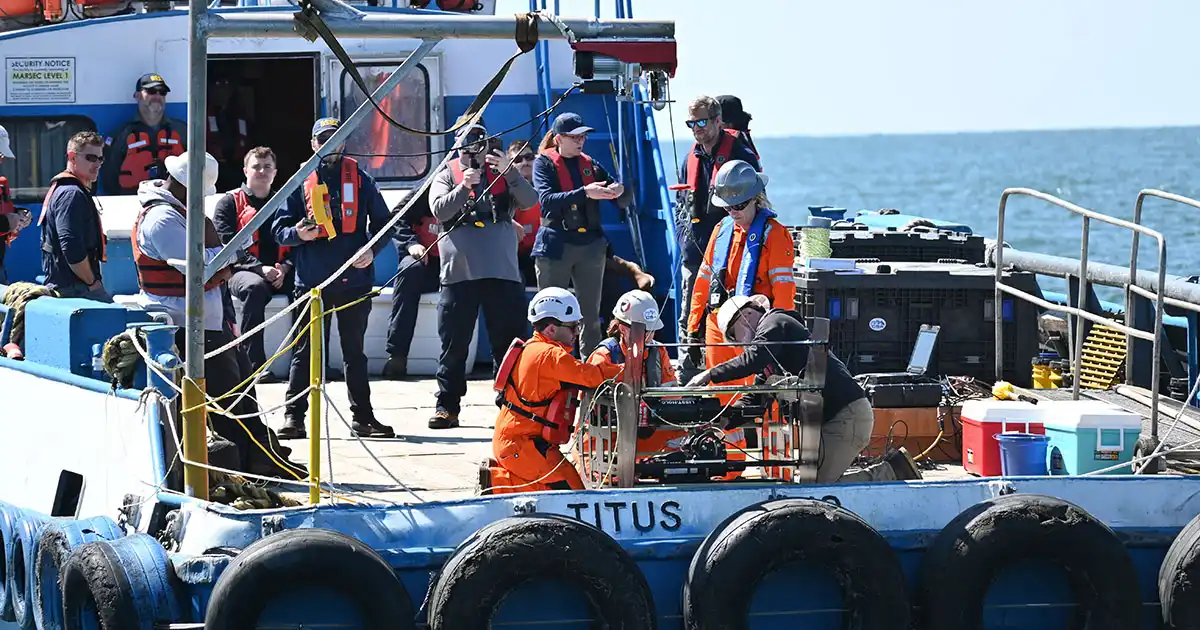
Working from the back deck of the Motor Vessel Titus, CSA scientists prepared, deployed, and operated specialized SDM equipment in real offshore conditions. The MMA identified the exercise as an important opportunity to validate equipment and response capabilities and to strengthen preparedness for dispersant monitoring operations in the event of an accidental oil discharge in which surface dispersant use is employed as a response tactic. For the partners, it was a chance to show that those capabilities hold up beyond the planning stage.
Why surface monitoring matters now
The exercise marked a milestone in implementing the requirements for monitoring during dispersant use cited in Subpart J of the National Contingency Plan. EPA’s Subpart J monitoring rule, effective in 2022 under 40 CFR §300.913, introduced specific environmental monitoring requirements, including measuring and reporting in situ droplet size distribution, pH, fluorescence, dissolved oxygen concentration, and other characteristics.
Meeting these requirements takes purpose-built tools. CSA developed SDM equipment to MSRC specifications and, since 2024, has supported MSRC in keeping it in a deployment-ready state. The March exercise was the opportunity to prove that readiness at sea.
From the dock to the water column
CSA’s role began well before the vessel left the dock. The team worked with the MMA and MSRC on planning and technical coordination, prepared and tested the monitoring equipment, and provided the scientific and operational personnel for the offshore field effort.
Once on site, CSA personnel deployed the SDM systems from the vessel and conducted water column sampling and in situ monitoring using both stationary and towed approaches. Specialized sensors and sampling equipment collected field measurements and water samples, demonstrating that the SDM system can operate as an integrated offshore monitoring capability rather than a collection of individual instruments.
Partnership in practice
The exercise brought together MSRC’s response capabilities and CSA’s scientific and technical expertise in a single coordinated offshore effort. The MMA emphasized that exercises like this are crucial for testing readiness, validating equipment performance, and confirming that response organizations can implement their plans and operate specialized equipment when called upon.
CSA’s involvement ran end to end, from equipment maintenance and testing through mobilization, field operations, and data collection. That continuity is the point: response readiness depends not only on having specialized equipment, but on sustaining the technical knowledge, procedures, and qualified personnel needed to put it to work.
Ready before it’s needed
For CSA, the exercise was a pivotal demonstration of how sustained preparation and industry partnership can turn regulatory requirements into practical response capability. The best time to learn how a monitoring system performs offshore is before a spill. Moving from equipment readiness to a successful offshore deployment showed the value of testing response capabilities well before an actual incident calls for them.
This feature appeared in environment coastal & offshore (eco) magazine’s 2026 issue IV. Read in the magazine here.