
During these projects, seafloor dredging is common, resulting in increased turbidity as sediment is disturbed. These particulates can settle outside construction areas and bury benthic organisms, such as corals.
Increased turbidity can also trigger a variety of other water quality issues, including temperature fluctuations, reduced availability of photosynthetically active radiation in deeper waters, and declines in dissolved oxygen.
These variations can prove harmful for vulnerable coastal habitats, and as a result, many offshore developments are required to measure and monitor turbidity to help inform ongoing operations. To ensure the most timely and appropriate interventions, real-time data is key.
A Robust System
NexSens Technology offers flexible monitoring solutions for offshore monitoring projects, with scalable and easy-to-deploy platforms that are designed to fit project needs.
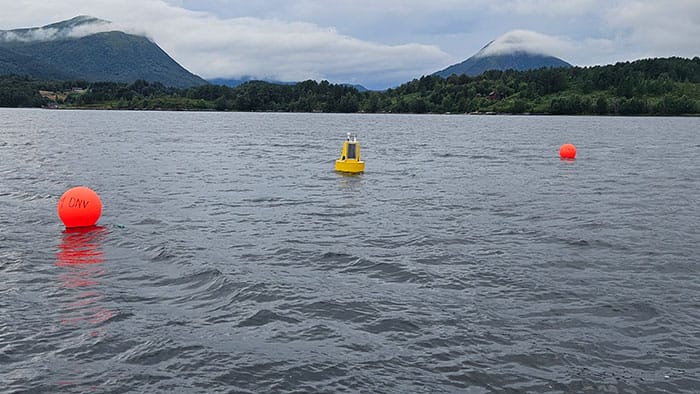
The XB-200 Data Buoy weighs in at about 70 lbs with a 30-inch diameter, making it easy to deploy and maintain from small boats. The buoy hull is constructed of UV-stabilized polyethylene and filled with closed-cell polyurethane foam, ensuring the system will stay afloat even if pierced.
With three onboard 15-watt solar panels and an integrated SLA rechargeable battery, the buoy is self-powered, with sufficient reserve capacity for additional sensor and data logger integration.
Issue II The X3 Data Logger pairs seamlessly with the XB-200 and mounts inside the solar tower. The logger has three telemetry options to choose from: Wi-Fi, cellular, and Iridium satellite, enabling real-time data viewing via the WQData LIVE Web Datacenter.
The X3 is constructed out of marine anodized aluminum, and with extreme operating temperature ranges of -40°C to 70°C, these systems can be deployed nearly anywhere, including saltwater applications.
The logger comes pre-equipped with a sensor library that allows for easy integration of popular environmental sensors, such as multiparameter water quality sondes, weather stations, GPS receivers, acoustic Doppler current profilers, and many others.
When paired with the NX260 Turbidity Sensor, the XB-200 system is an ideal turbidity monitoring solution. With a range of 0–1,000 FNU, the sensor supports one-, two-, and three-point calibration.
The sensor’s titanium body resists corrosion and features a built-in wiper to keep the lens free of debris, providing consistent data, even in marine environments.
The XB-200 system offers a compact and cost-effective solution that can be easily moved between sites during expansive and long-term monitoring projects.
Despite its small size, the system can easily be scaled up by adding a wave sensor, acoustic Doppler current profiler, weather station, or additional water quality sensors.
Flexible and Scalable Solutions
Issue II NexSens also offers both larger and smaller buoy platforms, which allow for projects to be scaled up or down as needed.
The large CB-series buoys offer increased power, buoyancy, and freeboard for customizing sensor suits and electronics. Increased solar charging potential allows for the integration of more power-hungry setups.
In contrast, the smaller CB-75 data buoy is lighter, weighing just under 40 lbs, which makes moving the system within a project site much easier. With three integrated 4-watt solar panels, the buoy still generates enough power to support an onboard logger and water quality sensor.
While NexSens manufactures its own data-logging solutions, the systems are highly customizable and can support a variety of electronics, ranging from acoustic receivers to remotely operated vehicle docking stations.
Data-Informed Operations
These systems provide critical data to construction project managers, keeping them informed of conditions at any site. With user-enabled alerts, WQData LIVE will notify users when thresholds are exceeded, allowing for timely pauses in construction, giving the ecosystem time to recover.
Users can also enable alerts to be notified when water quality conditions have stabilized, and construction can resume.
These quick response times enabled by NexSens systems help mitigate harm to the surrounding ecosystem, protecting important coastal resources that may be impacted by construction.
As offshore construction projects grow larger in size and ambition, durable and responsive monitoring systems will prove essential to balancing infrastructure development with marine environmental conservation.
To learn about NexSens solutions, visit: https://www.nexsens.com/
This feature appeared in environment coastal & offshore (eco) magazine’s 2026 issue II. Read in the magazine here.