Brazilian-Led Team Finds Ancient Coral Atoll and Thriving Ecosystems in Romanche Fracture Zone

Dozens of thriving coral and sponge gardens and a 5-million-year-old submerged relict coral atoll are among the striking finds from an expedition to the Romanche Fracture Zone, an area targeted for international marine protection.

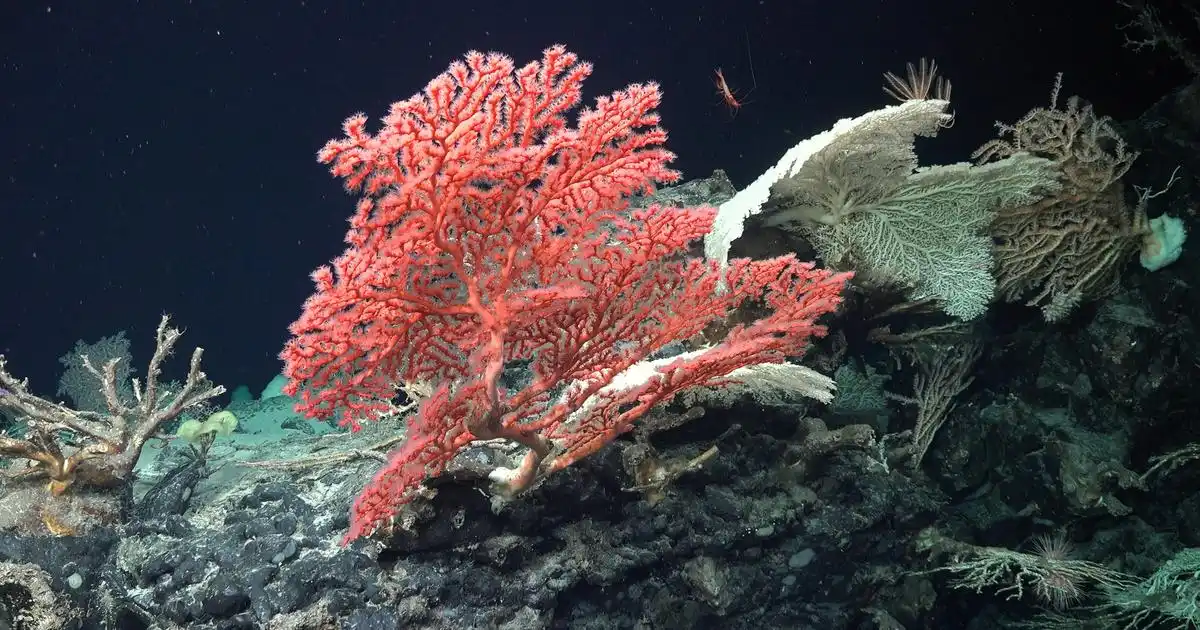
A community of cold-water corals and sponges thrives at a depth of 1,683 meters in the equatorial Atlantic Ocean’s Romanche Fracture Zone. Sessile, or immobile, organisms such as sponges and corals grow only millimeters per year and can live for centuries, with some corals documented during the expedition dating back 1,000 years. Across four distinct regions of the 950-kilometer transform fault, a Brazilian-led international science team captured the first visual evidence of ancient sponge gardens, rare zoanthid meadows and a 5-million-year-old sunken coral atoll. This evidence supports potential marine protections under the High Seas Treaty. (Image credit: Schmidt Ocean Institute)

Scientists on a 35-day expedition that concluded last month aboard Schmidt Ocean Institute’s research vessel Falkor (too) to the Romanche Fracture Zone in the equatorial mid-Atlantic discovered a 5-million-year-old sunken coral atoll, the top of which is 900 meters below the sea surface. The finding confirms a 30-year-old hypothesis that there were once coral atolls in the middle of the Atlantic, a region where they do not exist today. A bustling deep-sea coral garden now sits atop the prehistoric atoll.

A community of cold-water corals and sponges thrives at a depth of 1,683 meters in the equatorial Atlantic Ocean’s Romanche Fracture Zone. Sessile, or immobile, organisms such as sponges and corals grow only millimeters per year and can live for centuries, with some corals documented during the expedition dating back 1,000 years. Across four distinct regions of the 950-kilometer transform fault, a Brazilian-led international science team captured the first visual evidence of ancient sponge gardens, rare zoanthid meadows, and a 5-million-year-old sunken coral atoll. This evidence supports potential marine protections under the High Seas Treaty. Credit: ROV SuBastian / Schmidt Ocean Institute

The Brazilian-led team also gathered the first visual evidence of dozens of thriving, vulnerable marine ecosystems in the fracture zone, an area long thought to harbor abundant deep-sea life. The team discovered ancient sponge gardens, 1,000-year-old cold-water corals, rare zoanthid meadows (an animal related to anemones and corals), and squids and octopuses across four distinct regions from depths ranging from 600 to 4,000 meters.
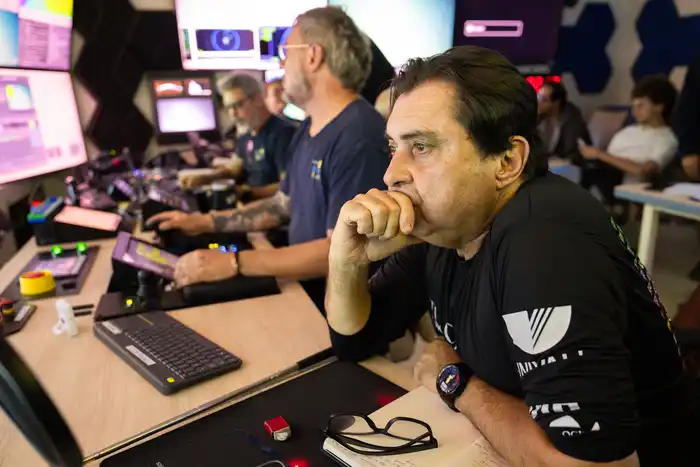
Expedition Chief Scientist Dr. Jose Angel Perez, an oceanographer and professor at Brazil's Universidade do Vale do Itajaí, monitors the first dive of the remotely operated vehicle SuBastian from Mission Control aboard the Schmidt Ocean Institute's research vessel Falkor (too) in the Romanche Fracture Zone. Perez led the 35-day expedition that documented an ancient submerged coral atoll and thriving deep-sea ecosystems to support international marine protection under the High Seas Treaty. (Image credit: Misha Vallejo Prut, Schmidt Ocean Institute)
Expedition Chief Scientist Dr. Jose Angel Perez, an oceanographer and professor at Brazil’s Universidade do Vale do Itajaí, monitors the first dive of the remotely operated vehicle SuBastian from Mission Control aboard the Schmidt Ocean Institute’s research vessel Falkor (too) in the Romanche Fracture Zone. Perez led the 35-day expedition that documented an ancient submerged coral atoll and thriving deep-sea ecosystems to support international marine protection under the High Seas Treaty. (Image credit: Misha Vallejo Prut, Schmidt Ocean Institute)

“We produced the first scientific evidence confirming the ecological and biological uniqueness of this region,” said the expedition’s Chief Scientist, Dr. Jose Angel Perez, a professor and oceanographer from the Universidade do Vale do Itajaí, Brazil. “Our data strengthens the importance of the Romanche Fracture Zone as an area to be considered for protection under the recently ratified High Seas Treaty.”

The expedition team first pinpointed the ancient coral atoll using the mapping capabilities of R/V Falkor (too) and the Autonomous Underwater Vehicle (AUV), The Childlike Empress. Then they used the Remotely Operated Vehicle (ROV) SuBastian to investigate the seafloor with high-definition cameras. The sunken atoll is 300 meters tall (nearly the height of the Eiffel Tower) and composed of fossilized coral. It is cemented atop a volcanically formed ridge that rises 4,100 meters above the seafloor.
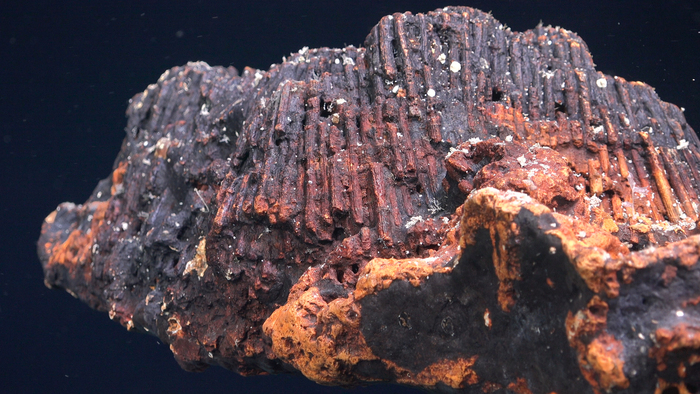
The science team examined footage of a geological sample from a 5-million-year-old sunken coral atoll in the equatorial Atlantic Ocean's Romanche Fracture Zone. The fragment is a fossil from shallow-water coral, proving that the region was once a shallow reef. The submerged atoll's peak is 900 meters below the sea surface. The structure of the sunken island is ancient coral, forming a 300-meter-tall platform, nearly the height of the Eiffel Tower, located on a volcanic ridge rising 4,100 meters off the seafloor. Led by Brazilian scientists, the international team documented a bustling ecosystem of deep-water corals thriving on the prehistoric structure. (Image credit: Schmidt Ocean Institute)
The science team examined footage of a geological sample from a 5-million-year-old sunken coral atoll in the equatorial Atlantic Ocean’s Romanche Fracture Zone. The fragment is a fossil from shallow-water coral, proving that the region was once a shallow reef. The submerged atoll’s peak is 900 meters below the sea surface. The structure of the sunken island is ancient coral, forming a 300-meter-tall platform, nearly the height of the Eiffel Tower, located on a volcanic ridge rising 4,100 meters off the seafloor. Led by Brazilian scientists, the international team documented a bustling ecosystem of deep-water corals thriving on the prehistoric structure. (Image credit: Schmidt Ocean Institute)

The Romanche Fracture Zone is the longest geological fault in the Atlantic Ocean. Characterized by deep underwater valleys and steep slopes rising thousands of meters above the seafloor, it crosses the equator and lies in the middle of the Atlantic Ocean. It serves as a corridor where North Atlantic Deep Water and Antarctic Bottom Water mix. Additionally, surface conditions support frequent phytoplankton blooms that eventually die and sink, providing food for deeper ecosystems.

Scientists have long suspected that this area was a biodiversity hotspot, but no previous expeditions to the region used an ROV to visualize the seafloor and document the animals that live in the Romanche Fracture Zone.
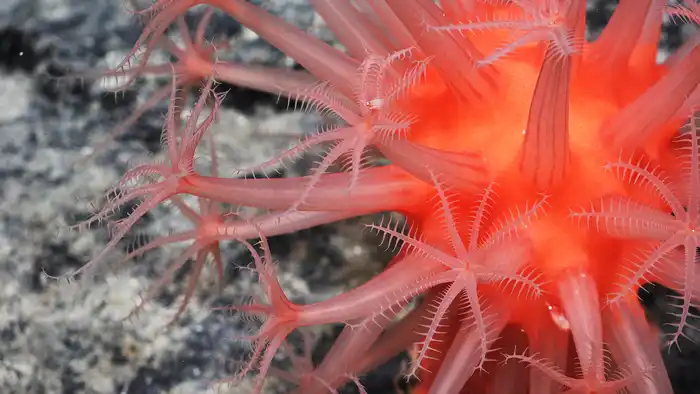
A deep-sea mushroom soft coral of the genus Anthomastus was recorded at a depth of 2,827 meters in the equatorial Atlantic Ocean's Romanche Fracture Zone during remotely operated vehicle (ROV) operations. The 950-kilometer transform fault zone along the Mid-Atlantic Ridge serves as a vital corridor where North Atlantic Deep Water and Antarctic Bottom Water mix between the eastern and western Atlantic basins, fueling abundant sea life. The Brazilian-led international team captured the first visual evidence of vulnerable marine ecosystems in the region. (Image credit: Schmidt Ocean Institute)
A deep-sea mushroom soft coral of the genus Anthomastus was recorded at a depth of 2,827 meters in the equatorial Atlantic Ocean’s Romanche Fracture Zone during remotely operated vehicle (ROV) operations. The 950-kilometer transform fault zone along the Mid-Atlantic Ridge serves as a vital corridor where North Atlantic Deep Water and Antarctic Bottom Water mix between the eastern and western Atlantic basins, fueling abundant sea life. The Brazilian-led international team captured the first visual evidence of vulnerable marine ecosystems in the region. (Image credit: Schmidt Ocean Institute)

One of the rare discoveries was a sponge and coral garden at a depth of 4,300 meters, deeper than the scientists expected to find large groups of these organisms. At these depths, the ocean generally has less available food and lacks the essential minerals sponges and corals need to thrive. At 1,200 meters, they found another ecosystem that, while common in shallow waters, is rarely observed in the deep sea—thousands of tiny light-pink zoanthids carpeting the seafloor, covering an area the size of a soccer field.
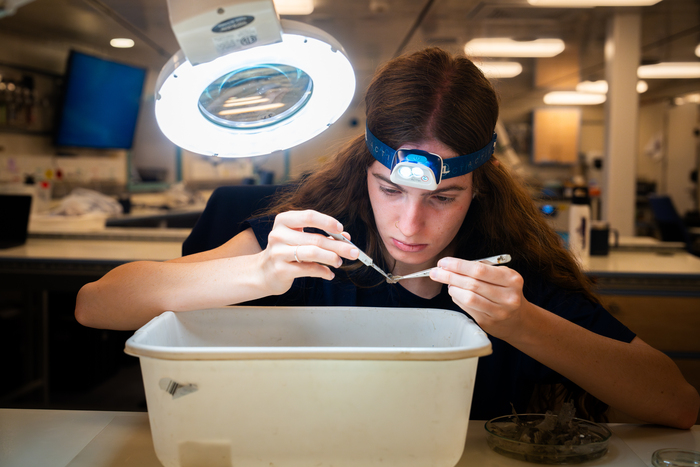
Gabriela Maurício de Alencar Filgueiras, an undergraduate student at the University of São Paulo's Oceanographic Institute, examines a deep-sea biological specimen in the Main Lab aboard the Schmidt Ocean Institute's research vessel Falkor (too). The 35-day expedition, led by Brazilian scientists, documented vulnerable marine ecosystems in the equatorial mid-Atlantic, and the scientists suspect there are likely new species amongst their samples. (Image credit: Schmidt Ocean Institute)
Gabriela Maurício de Alencar Filgueiras, an undergraduate student at the University of São Paulo’s Oceanographic Institute, examines a deep-sea biological specimen in the Main Lab aboard the Schmidt Ocean Institute’s research vessel Falkor (too). The 35-day expedition, led by Brazilian scientists, documented vulnerable marine ecosystems in the equatorial mid-Atlantic, and the scientists suspect there are likely new species amongst their samples. (Image credit: Schmidt Ocean Institute)

“Everywhere we looked, we saw stories emerging,” said Dr. Paulo Sumida, a professor at the University of São Paulo. “While there are big stories like sponges living at depths that far exceed our expectations, there were also small ones that are just as important—like little animals hiding in the mud or dangling from coral branches. Every animal living in these ecosystems plays a vital role that we want to understand.”

The scientists suspect there are likely new species amongst their samples. The amount of data collected during the expedition could amount to decades of research, said Perez.

“Finding thriving deep-sea ecosystems atop a prehistoric coral atoll is an extraordinary reminder that our ocean still holds monumental secrets,” said Dr. Jyotika Virmani, Executive Director of the Schmidt Ocean Institute. “We are proud to have equipped this Brazilian-led team of scientists with the advanced marine technology they needed to uncover a hidden chapter of Earth’s history and gather the data required to protect these amazing habitats.”
latest edition

From Arctic sea ice to the North Sea to the waters offshore Louisiana, applied marine science is looking beneath the surface, testing which new observing technologies earn the trust needed for wider adoption, and what it takes to turn ambitious science plans into safe and reliable work practices in marine environments.

got marine science news?

Send us your latest corporate news, blogs, or press releases

Search