Islands face a mix of pressures made worse by climate change, biodiversity loss, and pollution. Many depend on imported fuel and goods, struggle to manage their waste, and rely heavily on tourism, while their coasts face extreme weather, rising seas, ocean acidification, and degraded habitats. Gotland has lost about 65% of its natural wetlands since the 18th and 19th centuries, Orkney’s European oyster reefs have collapsed, and sargassum seaweed from the Great Atlantic Sargassum Belt is swamping Caribbean coasts and now starting to reach the islands of Macaronesia. Few islands have the technical or financial capacity to respond alone, and promising nature-based solutions often stall when research funding ends because they cannot yet attract investment.
Isla Bonita’s answer is to put island authorities at the center, with the aim of making the ocean and waters the island communities’ best allies. On each island, a Living Lab brings the island’s authorities, fishers, businesses, researchers, schools, investors, and residents around one table to shape the local demonstration and co-create a long-term Mission roadmap: a whole-island plan to restore its seas and waters, and a plan to fund it. The authorities taking part include the Government of the Canary Islands; the Azores Regional Secretariat for the Sea and Fisheries; the Regno di Nettuno Marine Protected Area in Ischia; the Sicilian Region’s Department of the Environment; the Municipality of Thira and the Blue Municipalities Network in Greece; Malta’s Water Services Corporation and WasteServ; the Regional Municipality of Bornholm and the Port of Rønne; and Region Gotland and the County Administrative Board of Gotland. In Gotland and Malta, public bodies lead the demonstrations themselves: Region Gotland and Xjenza Malta.
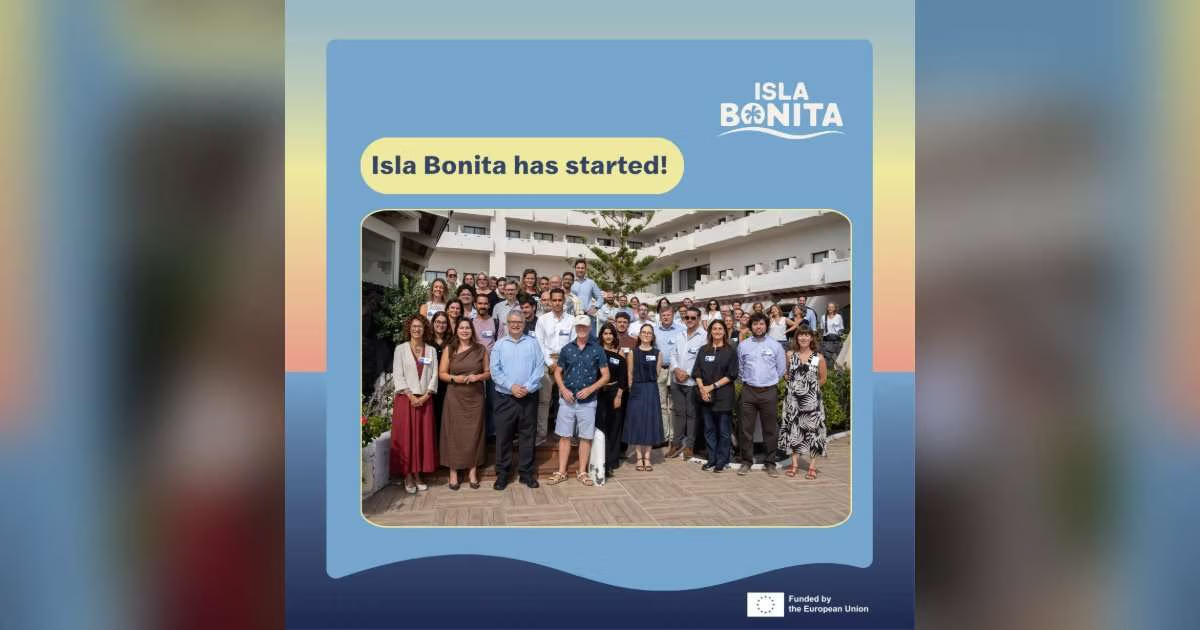
Gordon Dalton, Isla Bonita Project Coordinator at PLOCAN, said at the kick-off: “Isla Bonita is a unique Mission Ocean project built around the needs of nine islands in three sea basins: the Atlantic-Arctic, the Baltic and North Sea, and the Mediterranean. Our consortium brings together three kinds of expertise: technical specialists, local and regional authorities, and business and policy experts. Our aim is to replicate and upscale these nine demonstrations. The long-term goal and impact of Isla Bonita is to help solve Europe’s ocean problems and achieve the Mission Ocean 2030 Goals, by reducing marine pollution and restoring marine biodiversity, while strengthening Europe’s blue economy.”
Nine Islands, Nine Demonstrations
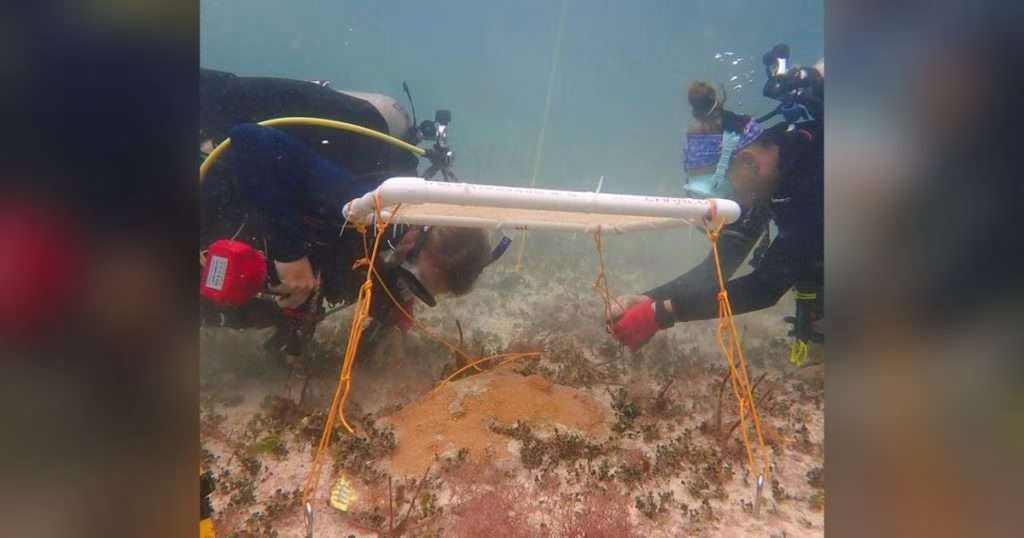
IslandWhat the Demo will doLed byWorking withAtlantic-Arctic Basin lead: AIR CentreLa Palma, SpainA 309 kWp floating solar plant with desalination for the AcuiPalma fish farm in the port of Tazacorte, set to be the first qualified full-scale floating solar demonstrator in exposed coastal waters: 0.5 GWh a year and 30–50 m³ of fresh water a dayOcean SunGovernment of the Canary Islands, AcuiPalma, Neodyne, La Palma Research CentreGuadeloupe, FranceSargassum seaweed captured at sea, held in an ocean storage farm and turned into biostimulants and biochar for local farmers: 3,000+ tonnes removed a yearSeafieldsUniversité des Antilles, CLS, RubisCO2Azores, PortugalAn AI route planner for whale-watching boats in one of the world’s leading whale-watching destinations, tested with three operators: 10%+ fuel savings and 10% less underwater noiseblueOASISAzores Regional Secretariat for the Sea and Fisheries, University of the AzoresMediterranean Basin lead: CNRIschia, Italy18 artificial structures to restore mesophotic and deep-sea habitats, including black coral; corals caught by accident by local fishers are replanted, and lost fishing gear is turned into fuel for the fishersCNRRegno di Nettuno Marine Protected Area, Stazione Zoologica Anton Dohrn, Università Politecnica delle Marche, FederpescaSantorini, GreeceA Plastic Lab, clean-ups, and litter monitoring on an island that uses an estimated 70,000 plastic bottles a day: 1,000+ citizens involved, 2+ tonnes of fishing nets kept out of the sea and recycledImpact Hub LabsMunicipality of Thira, Blue Municipalities Network, AegeanRebreath, National Institute of Chemistry (Slovenia)MaltaMicroalgae photobioreactors treating urban wastewater and landfill leachate with 20% less energy, producing water for irrigationXjenza MaltaWater Services Corporation, WasteServ Malta, University of Malta, Bluemater, CCMARBaltic and North Sea Basin lead: SUBMARINER NetworkOrkney, United KingdomThree types of oyster reef built from scallop shell waste, to take the oyster population from almost zero to 100,000 in four years; 400+ lost creels recovered and reusedHeriot-Watt UniversityOrkney Fisheries Association and local fishersBornholm, Denmark40 “biohut” fish nurseries in the ports of Rønne and Hasle and restored spawning grounds for perch and pike, aiming for 30% more juvenile fish around the biohuts and 20% more young perch and pikeDTURegional Municipality of Bornholm, Port of Rønne, IvandetGotland, SwedenRestoration from land to sea: 20,000 m² of wetland, 2 km of streams with fish passages, and 500 m+ of coastline habitat (reed marsh and seagrass)Region GotlandCounty Administrative Board of Gotland, Uppsala University, IVL, Sportfiskarna
At a press conference during the kick-off in La Palma, home to the project’s floating solar demonstration, PLOCAN chief executive José Joaquín Hernández underlined that the project is being led “from here, from the island of La Palma”, and that it will develop real solutions in each of the island regions involved.
“We are talking about a project worth €16.2 million, funded by the European Union, involving 16 countries, 51 institutions and nine European island regions in the Atlantic, the Mediterranean and the Baltic and North Sea, all working together to develop real solutions—solutions tailored to each of those regions,” said José Joaquín Hernández, Chief Executive, PLOCAN.
The island’s government, the Cabildo de La Palma, welcomed the project. Its Councilor for the Environment, Mónica Gómez Curiel, said: “The Canary Islands have a deep connection with the sea. Our ocean is part of our identity, our economy and our territory. That is why the fact that our island is part of this European project, and that Tazacorte is part of it, is an opportunity that we will particularly value. Isla Bonita is based on an idea that we wholeheartedly share, namely that the ocean must be an ally to our island community. As islands, we face very specific challenges, such as waste management, the energy transition, the protection of our marine ecosystems and the need to move towards a more sustainable blue economy. We know that these challenges cannot be tackled in isolation. We need cooperation, knowledge and, above all, we need solutions to be developed in consultation with those who live and work in our territories.”
Elba Bueno, CEO of the Cluster Marítimo de Canarias, which organized the meeting, said: “Isla Bonita is a large-scale European project that places the Canary Islands at the heart of ocean restoration, the energy transition and climate resilience. It is particularly important that a project of this nature is coordinated from the Canary Islands and that one of its main demonstration projects is being carried out on the island of La Palma.”
“Technological solutions alone are not enough. For innovation to have a real impact on the region, it must involve businesses, public authorities, knowledge centers and all the stakeholders who will make it possible for this innovation to be implemented and, above all, to be sustained.”
On the role of the Living Lab, she said: “At the Canary Islands Maritime Cluster, we will help ensure that this demonstration is not simply carried out in the region, but built together with it. The Living Lab must serve to listen, assess needs, incorporate knowledge and forge connections between those who develop a technological project, those who can apply and use it, and even those who can bring it to market.”
AcuiPalma, the Tazacorte fish farm that will use solar power and fresh water, is the Demo’s lead customer. Its CEO, Freddy Medina, emphasized the importance of research, innovation, and development “so that we can continue to improve and achieve a better and more sustainable future for everyone”, adding: “This project is a very interesting and important opportunity for us to take research into practice, into the reality in which we work.”
Isla Bonita is designed to outlast its five years. Mission roadmaps with tailored funding plans will be co-developed for 18 islands: the nine Demo islands and nine replication islands, where the Demo teams will act as mentors. The replication islands include the wider Canary Islands, Martinique, São Miguel in the Azores, Capraia, the Cyclades, Shetland, Møn, and Anglesey, with Madeira also under consideration. A permanent Mission Ocean Accelerator Hub, based at PLOCAN in Gran Canaria and online, will help island authorities design the finance for their roadmaps and help the companies behind the solutions become investable, linking them to the EU’s BlueInvest platform through Bpifrance and to investors at a brokerage event. The solutions will be packaged into a toolbox for island restoration, which the project aims to see used by at least 18 islands by 2030, and lessons from the islands will feed policy briefs for regional, national, and EU decision-makers. Monitoring data will be shared openly through EMODnet, Copernicus, and the EU’s Digital Twin of the Ocean.
With the kick-off behind it, the project now moves from planning to preparation. In the coming months, the Living Labs will be set up with the island authorities and local stakeholders brought on board. The Demo teams will plan their sites, begin the permit process, and collect baseline data, and all nine teams will agree a shared approach so that results can be compared across the three basins. The first demonstrations at sea will follow once permits are in place. Progress will be shared along the way on the project’s LinkedIn page and, once it is live, on the Isla Bonita website.