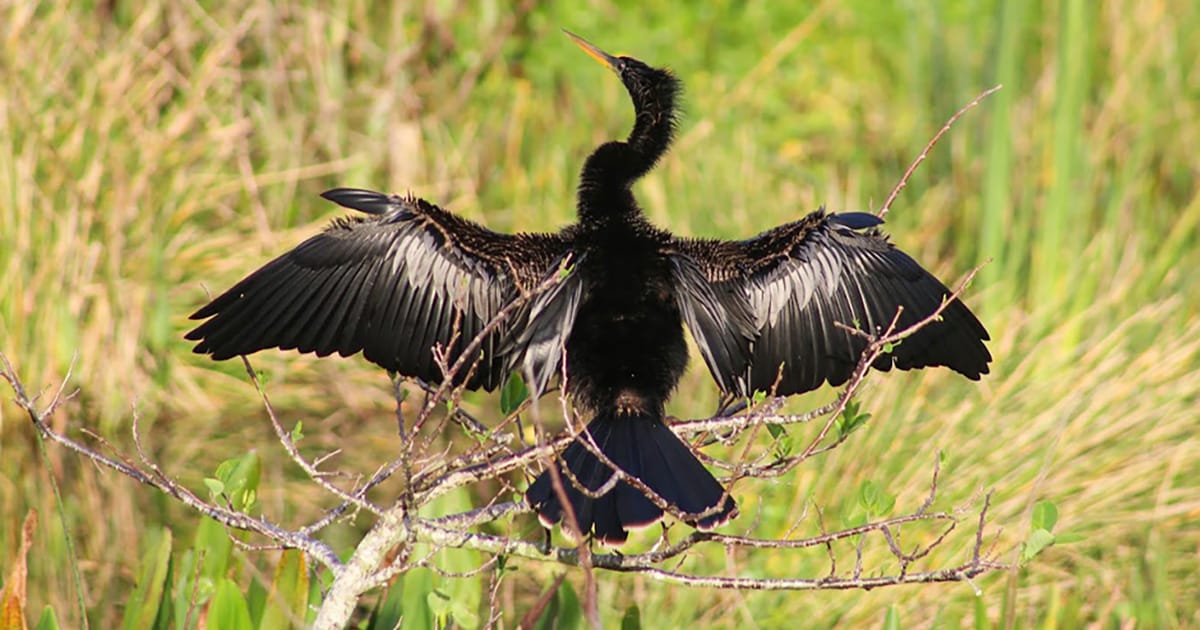
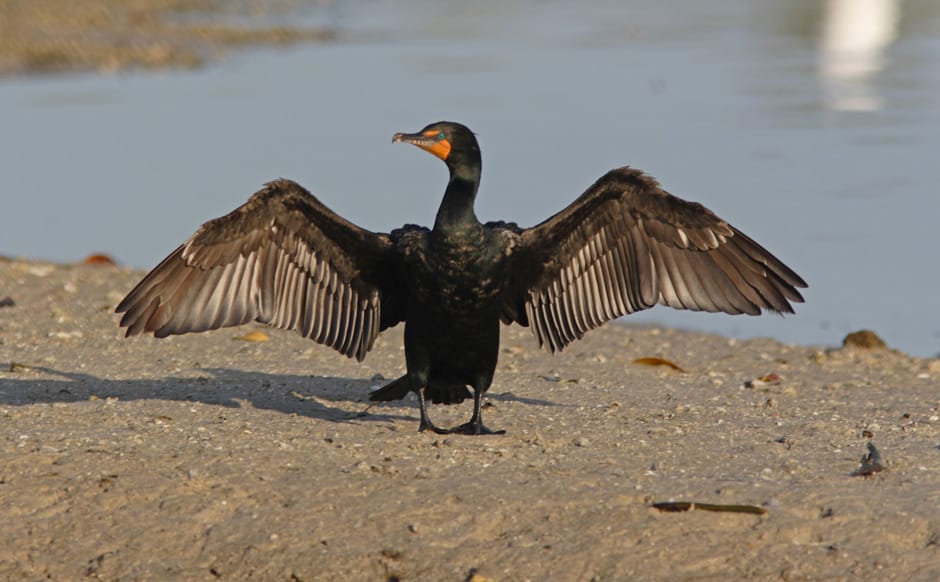
However, it turns out the anhinga and the double-crested cormorant are quite different, according to new research from the University of Miami.
While both birds propel themselves forward in the water with their feet, the anhinga and the double-crested cormorant have distinct physiologies and hunting behaviors, said Jeff White, a recent biology doctoral graduate. White led a small team from the Department of Biology in the College of Arts and Sciences that spent months observing, sampling, and analyzing the anhinga and cormorant to learn more about these species. Published recently in the Journal of Comparative Physiology B, the study offers new insight into the two species and follows up on research led by former University biologist Oscar “Bud” Owre, who also was the first Maytag Chair of Ornithology.
“You see these birds everywhere in South Florida, and if you’re in the Everglades, these species are probably among the first you’ll see—often sitting around with their wings spread out to dry,” said Kevin McCracken, the first James A. Kushlan Chair in Waterbird Biology and Conservation, as well as a co-author on the study. “They both must hold their breath to dive, so we observed how each of these species convert their oxygen stores into energy in the swimming and flying muscles.”
McCracken’s lab studies the physiology and diving behaviors of waterbirds, which typically include ducks and other diving birds. White was interested in anhingas and cormorants because they fall in between deep-diving birds, like penguins, and shallow divers, which include ducks. Generally, anhingas and cormorants dive for up to two minutes at the most and feast on fish, but unlike other species, such as ducks, they fully wet their plumage. After dives, these species patiently dry their feathers by holding their wings outstretched.
“The more I dug into the possibilities, the more I realized that we know surprisingly little about these species, and especially anhingas,” said White, who is now a postdoctoral research associate at the Cornell University College of Veterinary Medicine.
But he quickly realized the two species forage in very different ways.
Cormorants are much more active swimmers and divers, quickly pursuing larger fish for prey—often in deeper water and frequently in the ocean. The research indicates that they also consume more oxygen to do this. Meanwhile, anhingas are more sedentary and lie in wait in shallower waters for small fish to swim by them, as do other ambush predators, therefore saving more of their oxygen and energy. There are also differences in their flight techniques and muscles—while the cormorant is a strong flier, the anhinga is less so and spends parts of its time in the air soaring and gliding.
White also wanted to determine if there were major distinctions in the two species’ physiology. While most seabirds either store oxygen in their blood or their muscles, both cormorant and anhingas’ bodies use a combination of these techniques, he added.
“Regardless of how you’re diving, these birds have a finite amount of oxygen, so we wanted to understand how effectively they are using that oxygen,” White said. “Cormorants have a really large muscle in their leg and are able to really prioritize storage of oxygen in their leg muscles.”
Meanwhile, anhingas are able to produce energy with less oxygen in their body, White said. They also have a pretty low metabolism and do not require much oxygen to generate energy. In addition, anhingas do not have to swim to stay underwater because their bodies are able to achieve neutral buoyancy, which means they do not sink or float while submerged in water.
“They are the only aquatic bird I know of that can sit underwater without having to swim to stay in place,” added White. “And their diving physiology is unique, so this makes anhingas a very different diving bird than anything else we have studied.”
White hopes to study the anhinga more to understand their unique capabilities further.
Both McCracken and White said that understanding the oxygen transport of anhingas and cormorants could also serve as a window into alternate types of metabolism, or the process where nutrients are converted into energy in the body.
McCracken also said that the study has broad relevance to the fields of exercise physiology, cardiovascular health, nutrition, and metabolism.
“There might be benefits to understanding how other species can generate energy without oxygen,” White added.