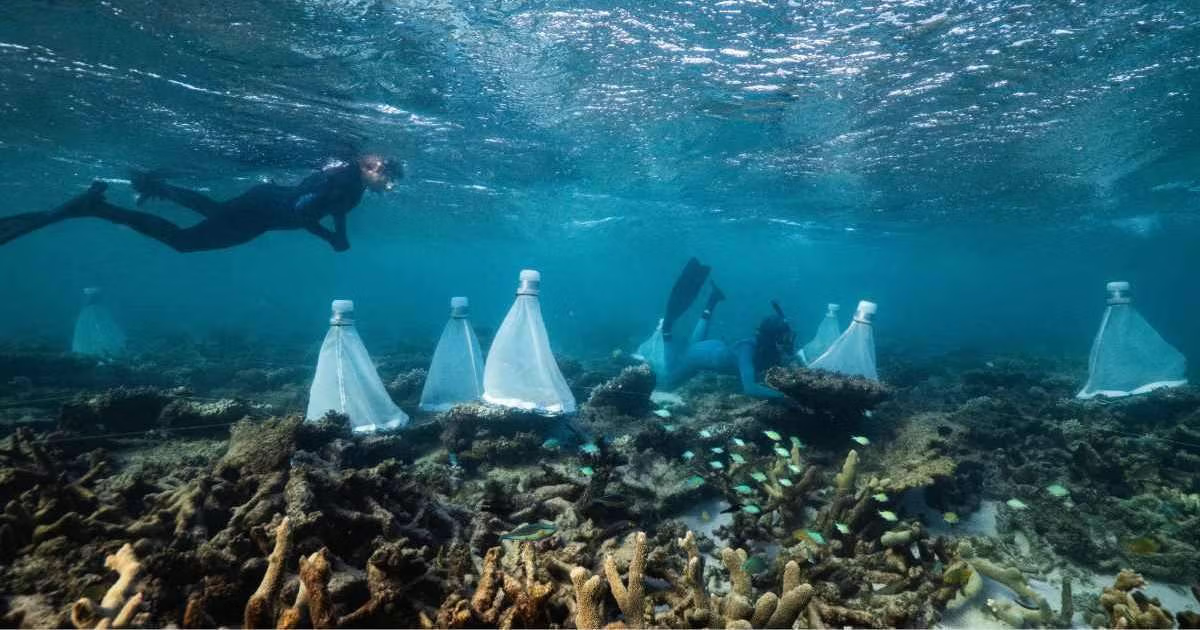
However, with our vast coastline home to an exceptionally diverse range of coral habitats, from cool to temperate, subtropical and tropical, WA also serves as a natural laboratory for ecological climate studies.
It’s this unique feature that the WA Reef Regen Roadmap—released this week—hopes to capitalize on.
The Roadmap, managed by the Western Australian Marine Science Institution (WAMSI), provides a program framework for a long-term, multi-year program of coral regeneration activities in WA, trialing different approaches at locations around WA to support coral recovery and survival.
Funded by the government and generous philanthropic donors, the WA Reef Regen Program brings together world-class science and technology, community stewardship and Traditional Owner leadership.
The first project—the Nyinggulu Coral Larval Enhancement Trial—got underway earlier this year.
“The WA Reef Regen Program is ambitious, bringing together the best science available and partnering with researchers and institutions, Traditional Owners and the community, to tackle the climate-related issues facing WA’s reefs,” said WAMSI CEO Luke Twomey.
Dr. Twomey said the time to act is now.
“As marine heatwaves hit more frequently, reefs are not getting enough time to recover in between impacts. This is bad for everyone. For the communities that live by the reefs, the tourists and economies that rely on our reefs, and for our environment, of which reefs are a critical part,” he said.
“We need to be clear that the only thing that will reduce marine heatwaves is a global cut in emissions.
“However, while we wait for global consensus and action on climate emissions, what we can do is advance coral regeneration science, to give our reefs a helping hand to recover and respond to our changing climate.
“By building on what is known and working together, we can deliver bigger, faster innovations rather than taking singular uncoordinated approaches.”
WAMSI Research Director Dr. Jenny Shaw said the learnings from the WA Reef Regen Program will be applicable for reefs around the world.
“We have a unique reef ecosystem here in WA, representing so many different types of reefs. This means that the insights we learn on coral regeneration techniques in Western Australia can guide future interventions globally across other vulnerable reef systems,” Dr. Shaw said.
Dr. Twomey said the Program’s biggest ambition was to shift from research and pilot trials into successfully scaling coral regeneration activities to deliver the greatest impact.
“How to scale coral regeneration has been one of the most difficult aspects of coral science. If we can crack how to successfully do that, then WA’s contribution to reef health worldwide will be very significant,” he said.
Dr. Twomey said future projects will be assessed for Program funding.
The Nyinggulu Coral Larval Enhancement Trial was delivered in collaboration with Southern Cross University, the Department of Biodiversity, Conservation and Attractions, CSIRO, the Australian Institute of Marine Science, Traditional Owners and local businesses, in Exmouth and Coral Bay.
Minister for the Environment, Climate Resilience Hon. Matthew Swinbourn MLC said: “We know that our natural environment is already experiencing the impacts of climate change, and this is no less true for our coral reefs. It is crucial that we look for ways to make them more resilient in the face of a higher probability of more frequent and severe marine heatwaves and bleaching events.
“The WA Reef Regen Program is critical in developing the means to protect the future of Western Australia’s famous reefs in the event of heatwaves and bleaching events, and it will increase expertise in coral reef regeneration across scientists, researchers, Traditional Owners and local communities.
“It’s exciting to see this kind of innovative program being led right here in WA, looking for ways to support the long-term health of our incredible reefs, for better environmental, social, community and economic outcomes.”
Angela Wright, Bennett Foundation spokesperson, said: “WA’s coral reefs are a remarkable part of this state’s natural heritage, and this roadmap represents exactly the kind of long-term, science-led support they need in order to thrive for generations to come.
“With ocean temperatures trending upwards, and reefs needing every advantage science can give them, the work of healing sea country has never mattered more.
“The Angela Wright Bennett Foundation is proud to stand alongside the State Government, backing WAMSI and its partners as this important work moves from roadmap to reality.”
Sam Moyle, Director of the Jock Clough Marine Foundation, said: “Western Australia is home to one of the world’s most unique marine environments, and it’s facing real change. The Jock Clough Marine Foundation is proud to support the WA Reef Regen Program alongside the Angela Wright Bennett Foundation, WAMSI, and the WA Government, so future generations can continue to enjoy the reefs we’ve been fortunate to know.”