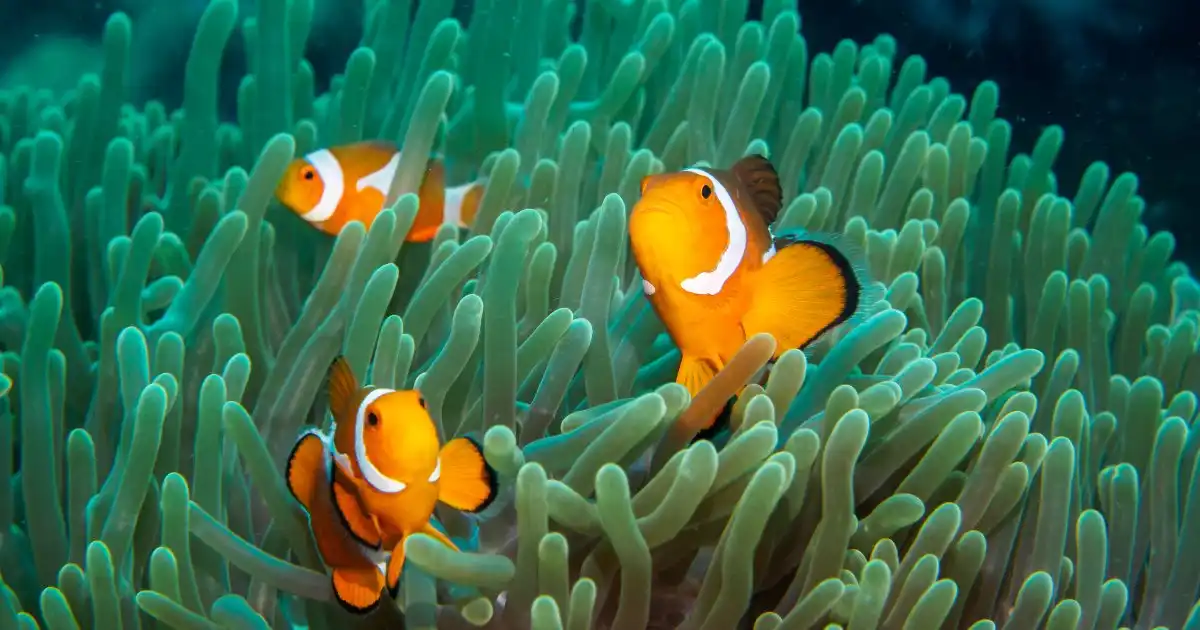
Led by Newcastle University and published in the journal Royal Society Open Science, the study explores how clownfish behavior changed during the 4th Global Bleaching Event. During this event, the clownfish experienced a heatwave, and their anemone partners bleached, meaning they lost their symbiotic algae, a stress response to elevated temperatures.
The results indicate that while elevated temperatures only had a small effect on clownfish behavior, the bleaching response of the anemone altered how the animals spent their time. Bleaching led to more defensive behaviors, which could benefit the host anemone, and aggression between group members increased.
A group of Newcastle University students, led by Ph.D. candidate Fletcher Noble, measured fish behavior from video recordings made during a marine heatwave in Kimbe Bay, Papua New Guinea, that lasted from March to July 2023. These were made during the most extensive and intensive mass coral bleaching event in recorded history, spanning from 2023 to mid-2025 and known as the 4th Global Coral Bleaching Event.
The team analyzed five behavioral categories: maintenance and defense, which help the anemone partner; and aggressive, neutral, and submissive behaviors, which maintain the fishes’ social group.
Their findings show that bleaching did not alter the large amount of maintenance behaviors towards the anemone that clownfish displayed, such as aeration and cleaning, while defense behaviors increased. This emphasizes the crucial role of the mutualism between anemonefishes and anemones, where each partner depends on the other for defense against predators and nutrients. The aeration and defense done by clownfish during bleaching events may be important for anemones to recover from bleaching.
The potential trade-off, however, is that social cohesion may suffer in times of stress. Bleaching was linked to a 215% increase in aggressive behavior between members of the clownfish social group.
Study lead author, Fletcher Noble, a Ph.D. researcher at Newcastle University’s School of Natural and Environmental Sciences, said: “This research is one of the first to examine in detail how different types of clownfish behavior change under bleaching conditions in the fish’s natural environment. We revealed that clownfish are prioritizing defending and maintaining their homes and securing their dominant position in the group during periods of environmental stress. In the future, we can examine these behaviors in even greater detail and explore how this may be helping the anemone recover from bleaching.”
Anemone Bleaching and Heat Stress
Anemone bleaching occurs due to the loss of symbiotic algae and may turn the animal pale, white, or translucent. It’s caused by increased stress, such as higher water temperatures and sun radiation.
In this study, while some of the host anemones bleached and lost symbiotic algae, others did not, allowing the researchers to estimate the effects of heat stress separate from the indirect effects through stressed mutualistic partners.
The study demonstrates that bleaching impacts behavior more than thermal stress, with heat stress having no impact on the activity of clownfish, remaining stable as temperature dropped throughout the heatwave.
The research was featured in Blue Planet III, the highly anticipated return of BBC Studios Natural History Unit’s landmark ocean series narrated by Sir David Attenborough.
Study senior author, Dr. Theresa Rueger, Senior Lecturer in Tropical Marine Sciences, School of Natural and Environmental Sciences, Newcastle University, added: “As human activities continue to change ecosystems around the world, it is crucial to understand how species adapt their behavior to cope with environmental stress and habitat loss, since changing behaviors is animals’ first line of defense. The results show how important it is to consider interactions between different animal species, and particularly mutualisms, where both species benefit, when researching the effects of environmental change.”