
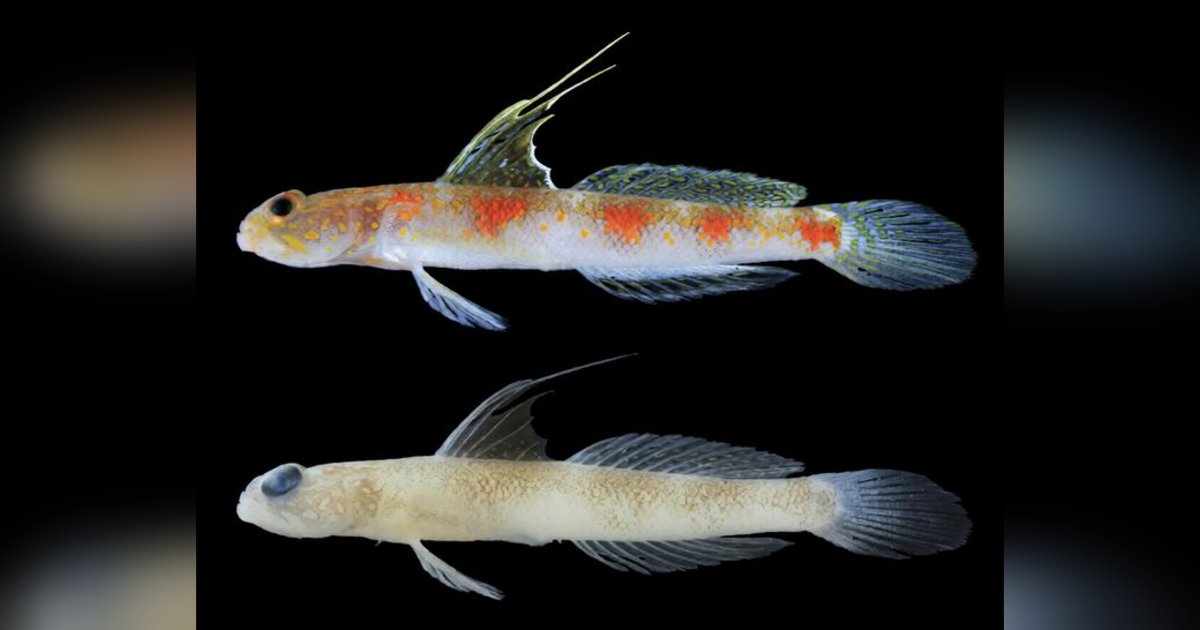
Published in the open-access journal ZooKeys, a team led by Kunto Wibowo of the Museum Zoologicum Bogoriense, part of Indonesia’s National Research and Innovation Agency (BRIN), has formally described Tomiyamichthys oriens sp. nov., a small reef fish characterized by radiant orange blotches along its flanks and a pair of elegant filaments trailing from the first dorsal fin of males.
The two specimens on which the description is based, a male and a female each measuring roughly 35.5 mm in length, were first brought to the researchers’ attention by the ornamental fish exporter CV Cahaya Baru, having been collected from sandy shallows off Banyuwangi. Both are now housed at the Museum Zoologicum Bogoriense in Bogor.
The name oriens is where this discovery really shines. It is a Latin participle meaning “east” or “the rising sun,” chosen for two reasons. Firstly, it evokes the fish’s own vivid orange markings, said to recall the hues of a sunrise. Secondly, it honors the species’ place of origin: Banyuwangi sits at the easternmost tip of Java and is popularly known throughout Indonesia as “The Sunrise of Java.” The authors have given the fish the English common name Oriens Shrimpgoby.
Tomiyamichthys oriens belongs to a genus of shrimp-associated gobies found across the tropical Indo-Pacific, from the Red Sea to Fiji. Its closest known relative is T. hyacinthinus, a species only recently described from southern Japan. The two share a rare combination of features within the genus: nine segmented rays in both the dorsal and anal fins, and, in males, two elongated filamentous spines on the first dorsal fin.
Despite this resemblance, the Indonesian fish can be told apart by a suite of subtle differences, including its number of pectoral fin rays, branched caudal fin rays, longitudinal scale rows, and gill rakers, as well as finer details of its color pattern. Genetic analysis of the mitochondrial COI gene reinforced the case for a distinct species, revealing a divergence of 3.1% between the Indonesian and Japanese fish.
The discovery adds to an already remarkable tally for Indonesia, which sits at the heart of the Coral Triangle and now hosts 13 recognized species of Tomiyamichthys, more than any other country. According to local fishermen consulted during the study, the new species favors sandy bottoms in shallow coastal water, though its relationship with the burrowing alpheid shrimps typically associated with the genus has yet to be directly observed in the wild.
The description brings the total number of valid Tomiyamichthys species worldwide to 21, underscoring how much remains to be learned about the small reef fishes that share Indonesia’s waters with its shrimp partners.
“It is always exciting to discover a species that is new to science. We hope this finding will inspire further exploration of Indonesia’s fish biodiversity, where many small and overlooked species are likely still awaiting discovery,” says lead researcher Kunto Wibowo.