Researchers discovered that climatic warming is driving reduced nutrient availability affecting the food available to zooplankton—and that the “winners” in this scenario were the species who could efficiently feed and survive on very small particles.
As zooplankton form the foundation of the marine food chain, the shift in energy transfer could have far-reaching consequences—driving a domino effect set to affect fish populations, fish size, and fisheries productivity.
It is the first time—made possible through the 35 years of evidence in the combined datasets—that scientists have been able to uncover the exact mechanisms driving such sweeping shifts.
Microalgae, which are plant-like plankton—including phytoplankton and mixoplankton—photosynthesize, producing more than 50% of the Earth’s oxygen on the planet, while also absorbing and locking away carbon, regulating global climate.
Zooplankton—animal-like plankton—are equally vital. Sometimes described as the “cows of the sea,” zooplankton eat plant-like plankton and are a key link in the food chain, converting the carbon fixed by photosynthesis into essential food for consumers higher in the food chain such as fish.
But for decades, scientists have observed widespread declines in some key zooplankton groups, particularly copepods, across parts of the North-East Atlantic.
Despite being such small organisms, the role of zooplankton is so immense in the marine food chain that their declines are projected to amplify into much larger declines in their consumers—from fish, to marine mammals, to birds.
This leads to a widespread effect, felt not only by the wider marine food web, but also by humans; affecting commercially important fish stocks—and the communities and livelihoods that depend on them.
Understanding what is driving these changes has therefore become an urgent priority, prompting PML scientists to turn to more than 35 years of data—from two very different sources—to try to reveal answers.
The research, led by PML’s Dr. Karen Tait, combined 35 years of traditional zooplankton microscope records with 11 years of environmental DNA (eDNA) data from seawater samples collected at PML’s L4 monitoring site, approximately six nautical miles south of Plymouth, UK.
Both datasets have been generated through PML’s own long-term observations as part of the Western Channel Observatory.
Published in Nature’s Communications Biology, the study, titled “eDNA and microscopy reveal traits underlying long-term zooplankton community change,” marks one of the most comprehensive comparisons of traditional and molecular monitoring methods ever undertaken.
Dr. Tait, who specializes in molecular biology and eDNA analysis, worked with colleagues across PML to combine the microscopy data alongside eDNA data, collected by PML in a parallel data set, since 2012.
The findings confirm significant shifts in the structure of the plankton community and provide new insights into the mechanisms driving these changes, discovering that long-term winners and losers could largely be distinguished by how they feed, in response to declining nutrient availability.
Authors discovered a remarkable correlation between feeding styles and survival.
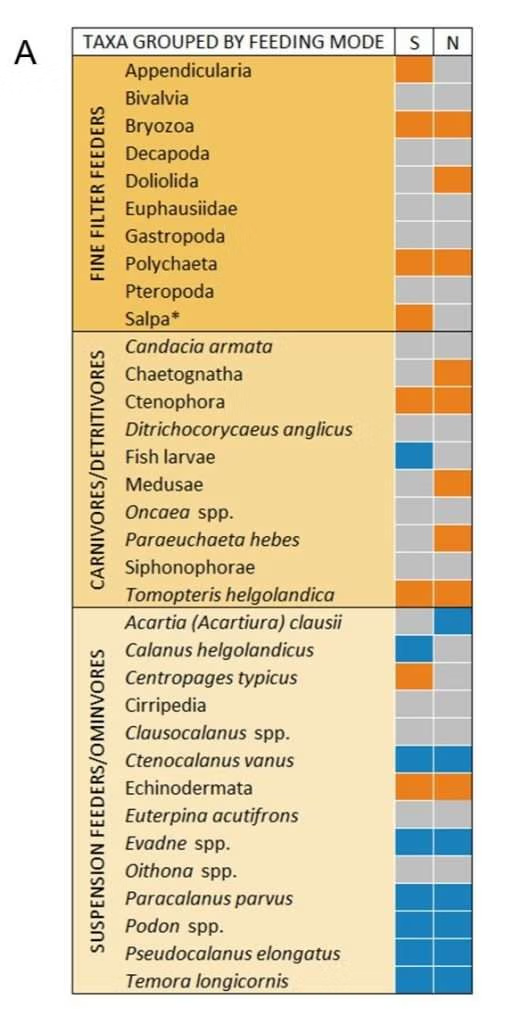
Species that have declined in recent decades are suspension-feeding copepods and other omnivorous grazers—that rely on relatively large phytoplankton. In contrast, species increasing in abundance are often fine filter feeders capable of exploiting much smaller particles.
Below: The ‘winners’ and ‘losers’ of climate change: Long-term changes in zooplankton functional composition during stratified and non-stratified periods. Orange = significant increase over time; blue = significant decrease over time; Grey = no significant trend.
Below: Long-term changes in zooplankton functional composition during stratified and non-stratified periods. B, C Summary responses of functional groups. Fine filter feeders increased during stratification, while suspension feeders/omnivores declined.
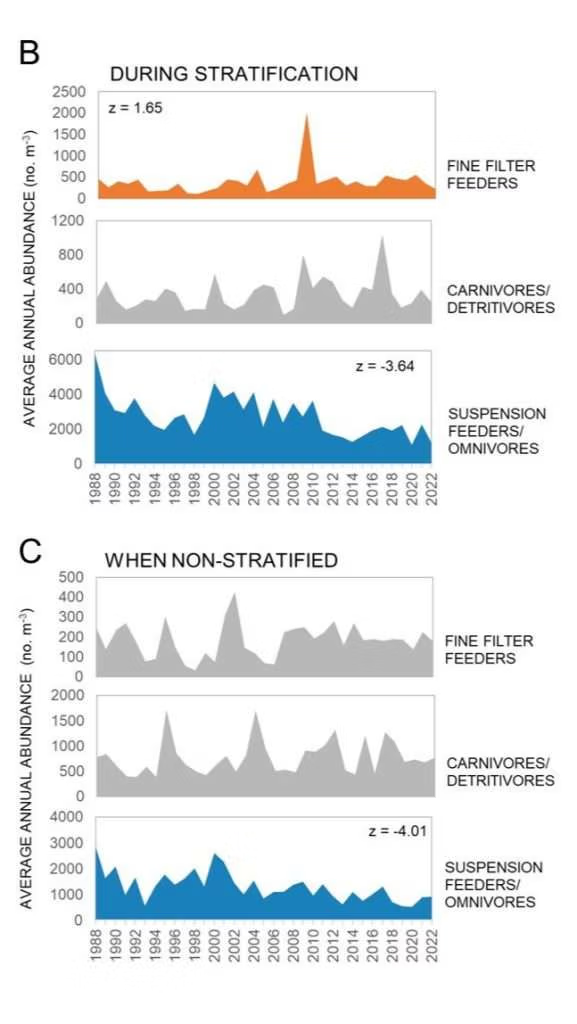
This pattern mirrors long-term changes at Station L4, where declining nutrient availability has favored smaller phytoplankton and mixoplankton.
As a result, the ecosystem appears to be reorganizing—from an ecosystem dominated by larger phytoplankton and the copepods that feed on them, to one dominated by much smaller microalgae and the consumers that can efficiently eat and survive on such small particles.
Dr. Karen Tait, Microbial Ecologist at PML, and lead author of the study, commented on the significance of this restructure:
“Our findings suggest that changes in the smallest components of the food web are cascading upwards and influencing which zooplankton thrive—and which decline. The ‘winning’ and ‘losing’ groups are defined mainly by their feeding method.
“This is a response to the shift towards smaller phytoplankton and reduced nutrient supply—favoring organisms that can efficiently feed on very small particles.
“Plankton are often described as ‘sentinels of change’—and act as an early warning sign to us of things to come. These huge shifts will result in a domino effect on the wider marine food web, and indeed, us as humans.
“This shift could have far-reaching consequences: reducing the quality of food available to marine life, affecting fish size and populations, changing fisheries productivity, and even altering how much carbon sinks into the deep ocean.”
The study concluded that climate change is responsible for altering the physical and chemical conditions of the ocean, including nutrient availability and the seasonal stratification of the water column.