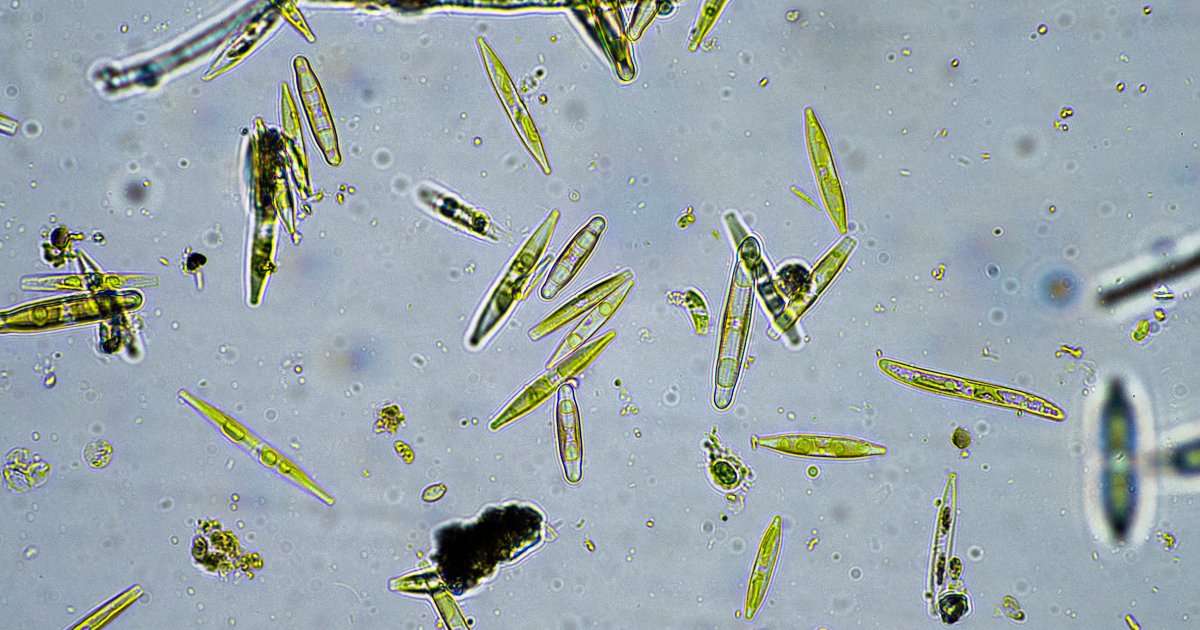
A new study published in Marine Ecology used high-tech methods to test common microalgal species to assess how various stressors, including acidification from excessive carbon dioxide (CO2) levels, affect absorption of trace metals and therefore undermine their overall health and role in Earth’s carbon cycling.
Although microscopic, the single-celled algae diatoms that live in oceans, lakes, rivers, and even damp soil are among the most important organisms on Earth, as they produce a significant portion of oxygen in the atmosphere.
Diatoms account for 40%–50% of primary production in oceans, and they contribute to organic carbon being exported to the deep ocean by fixing CO2 from near-surface waters, says senior author Professor Sophie Leterme, director of the ARC Industry Transformation Training Centre for Biofilm Research and Innovation at Flinders University’s College of Science and Engineering.
“We showed that changes in the ocean pH can affect the growth, abundance and elemental composition of these diatoms,” said Professor Leterme. “We need to investigate how these changes interplay between various trace elements and can lead to broader ecological impacts, such as disruption to marine food webs, reduced carbon and silicon export, and increased microbial and nutrient activity.”
Rising carbon emissions affect pH levels in seawater, which can alter planktonic algae’s absorption of trace elements including iron, zinc, and cadmium, which are essential for inorganic carbon acquisition.
The dissolution of CO2 into the ocean has already induced a global drop in pH of 0.1 units since the end of the Industrial Revolution, and values are expected to drop another 0.3–0.6 units by the end of this century.
Diatom species are great bio-indicators, often used to assess water quality and boost understanding of how ongoing ocean acidification and rising water temperatures downgrade their physiology and functioning—which have important consequences for the future of oceans.
The Flinders researchers say a better understanding of how these complex processes work in seawater will help find solutions, including the development of novel biofilms to reduce shipping pollution in harbors.
Using seawater samples collected in South Australia’s Gulf St Vincent and from the CSIRO algae collection, the researchers’ highly sensitive neutron activation analysis was used in experimental setups on the species Thalassiosira pseudonana and Nitzschia navis-varingica.
The experiments, supported by ANSTO expertise, showed how trace metal uptake by marine diatoms could be applied to other marine organisms’ absorption of a wide range of other elements in the environment.
“While a higher abundance and growth of diatoms might be beneficial to reduce carbon dioxide levels, the impact of lower concentrations of major and trace elements in the environment is not well understood.”
The research article—’The impact of ocean acidification on the sorption of trace metals by diatoms‘ (2026) by Sophie C Leterme, Tamar Jamieson, Alessandra Mazzoli, Angus Hambrook, Rachel S Popelka-Filcoff, John Bennett, and Attila Stopic—has been published in Marine Ecology (Wiley). DOI: 10.1111/maec.70112.
Also see a new article published in the Australian Journal of Maritime and Ocean Affairs—’Australia’s changing oceans: Building knowledge for actionable outcomes‘ DOI: 10.1080/18366503.2026.2710564.