Eight locations worldwide and one central research question: That is the idea behind GAME. For the 24th time, master’s students in the GEOMAR program are collaborating to investigate an ecological issue. “A win-win situation for everyone,” said project leader Dr. Mark Lenz. “We combine research and teaching. The results provide new scientific insights. At the same time, the students experience the entire research process.”
Sessile marine animals such as corals, sponges, and barnacles remain in one place as adults. Before that, they drift with the current as larvae for days or weeks—until they settle. “And where they settle is the one crucial decision of their lives,” emphasized Dr. Lenz. When choosing a location, the larvae are guided by various factors, such as light conditions or the nature of the substrate. “Whether the acoustic environment also plays a role has hardly been studied so far,” explains the ecologist.
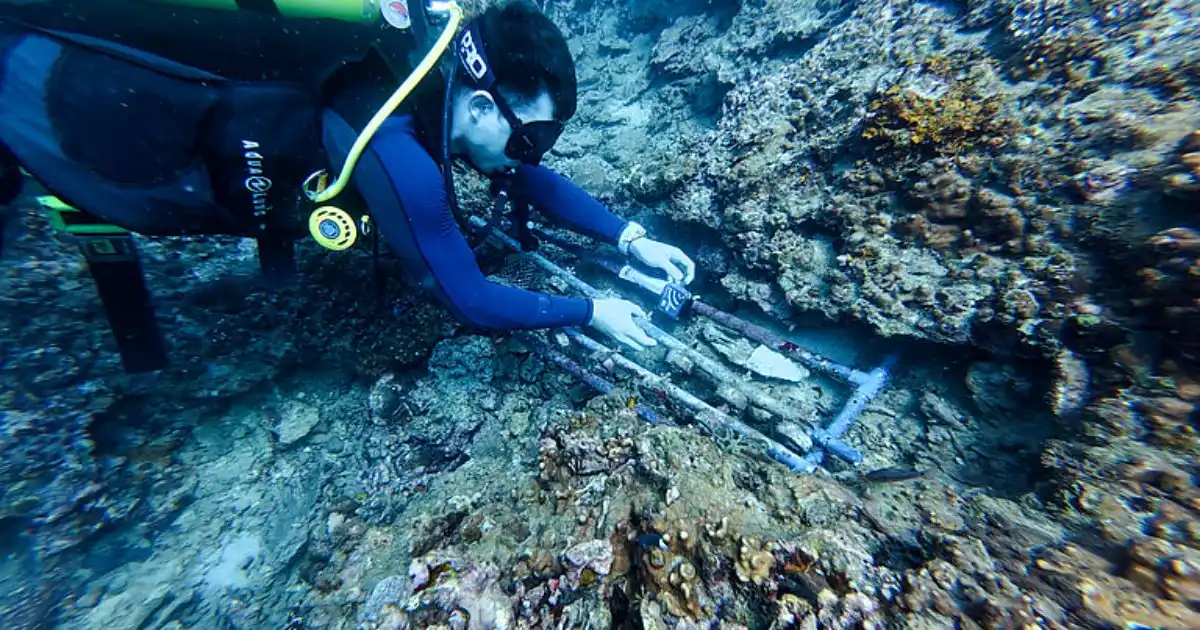
To investigate this question, the students conducted experiments in Chile, Wales, Finland, Spain, Madeira, Malaysia, Japan, and the Philippines. First, they used underwater microphones—known as hydrophones—to record natural background sounds—for example, in a bladderwrack bed in Finland and in a coral reef in the Philippines. They then played back the recordings or boat noise through underwater speakers. Around the speakers, they attached PVC colonization plates. Similar constructions with silent dummy speakers were used as a control group. After two to three months, they examined which organisms had colonized the plates.
Initial results show that underwater noise can have a significant impact on the colonization of marine organisms. “Interestingly, the effects went in both directions,” explained project leader Dr. Mark Lenz. The organisms studied reacted differently to boat noise: Barnacle settlement often decreased, while blue mussel settlement at another site appeared to increase. This is precisely why GAME’s international research approach is important: Comparing different marine regions shows how varied the responses to the same influences can be.
These findings could be relevant for marine conservation. This is because natural soundscapes serve ecological functions and can be masked by human-made noise. Its protection could therefore be given greater consideration in the future.
For six months, Konstantin Buchholz from the University of Freiburg and Jonalyn Jame Catedrilla from the University of the Philippines conducted joint research off the coast of Bolinao in the Philippines. They had met at the GAME kick-off workshop in Kiel in March. In Bolinao, they largely organized their daily research activities on their own: In the mornings, they checked their experimental setups while snorkeling; in the afternoons, they worked in the lab. “Above all, we learned to conduct research independently,” said Buchholz.
Back in Kiel, the two are analyzing their results, which they can then use for their master’s theses. In addition to scientific training, GAME also supports students in their career planning. Workshops on science communication and career planning round out the program.
For Buchholz, his outlook on his professional future has already changed: “In the past, I was pretty sure I didn’t want to pursue a Ph.D. But I’m enjoying analyzing the results so much that I’m already looking for Ph.D. positions in Germany.” Catedrilla can also imagine a career in research, but doesn’t want to commit to anything just yet: “I love doing research and discovering new things. At the same time, I’m also open to other career paths.”