
Supported by NOAA’s Global Ocean Monitoring and Observing Program (GOMO), this new partnership is part of the international Ships of Opportunity Program and expands the Surface Ocean CO2 Network (SOCONET), which aims to collect critical ocean and atmospheric data in near-real time and will effectively provide data in some of the most sparsely sampled and remote areas of the open ocean.
The global ocean acts as the Earth’s largest carbon sink, accumulating an estimated 8 billion metric tons of atmospheric CO2 each year as part of the natural carbon cycle. However, an increase in the ocean’s accumulation of carbon leads to more acidic waters, impacting vital fisheries, coral reef frameworks, and entire ecosystems, making it essential to quantify and monitor the ocean’s cycling of carbon.
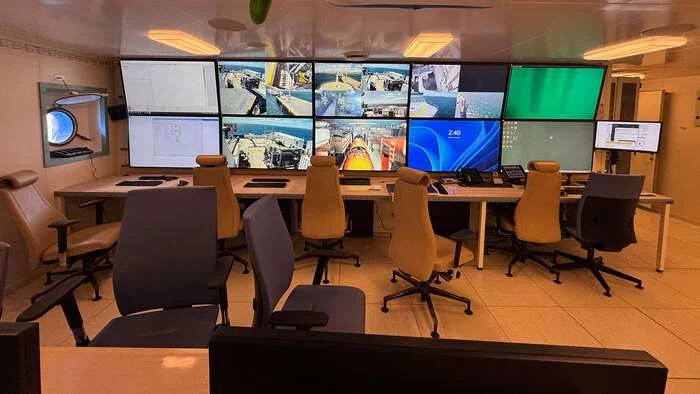
While international efforts like the Global Ocean Ship-based Investigations Program (GO-SHIP) and Argo program aim to investigate the accumulation of carbon within the ocean interior, the Ships of Opportunity focuses on the air-sea gas exchange at the surface—i.e., the marine boundary layer.
Cruiseliners, NOAA vessels, cargo ships, sailboats, and moorings all comprise the Ships of Opportunity network, constantly collecting new data and assessing the surface ocean’s uptake of carbon. However, the South Atlantic has long been a gap as fewer vessels traverse the region.
Schmidt Ocean Institute’s oceangoing vessel R/V Falkor (too) is set to perform a variety of cruises in the South Atlantic over the next several years to investigate complex biogeochemical processes that fuel ecosystems in some of the most remote regions of the Atlantic.
The Underway pCO2 System newly installed on the RV Falkor (too) enables scientists at NOAA and the SOI to monitor differences in the partial pressure of carbon dioxide (pCO2) between the atmosphere and surface ocean while the vessel is at sea—with the data being transmitted in near-real time.
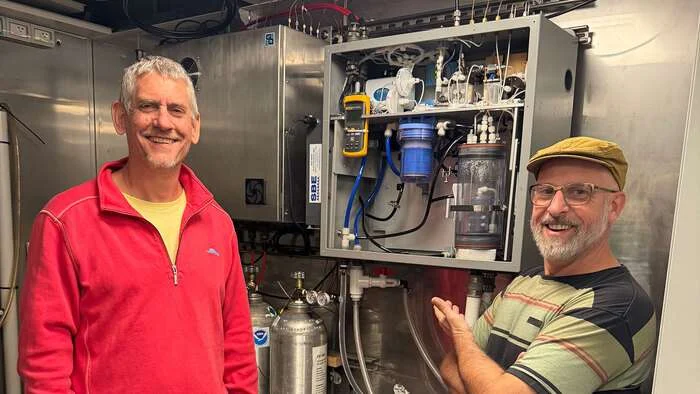
Data from these underway systems is rigorously quality-controlled by scientists with AOML’s Ocean Carbon Cycling team before being integrated into the Surface Ocean CO2 Atlas (SOCAT)—an international repository of millions of surface ocean pCO2 data leveraged by renowned research institutions on the global stage.
“Ships of opportunity, whether they be research vessels, cruise ships, or merchant vessels, perform an essential service to science by providing a platform where high-quality scientific measurements can be made,” explained Denis Pierrot, Principal Investigator with AOML’s Ocean Carbon Cycle Group.
With the new partnership between AOML and the Schmidt Ocean Institute, the data collected onboard the R/V Falkor (too) begins to close an essential gap in assessing the ocean’s uptake of carbon in the South Atlantic. At a more local level, the data will provide crucial information that will help scientists understand and mitigate the effects of anthropogenic carbon on natural resources and ecosystems.
This story was written by Chris Malanuk for Observations, Ocean Chemistry and Ecosystems, Research Partnerships: https://www.aoml.noaa.gov/a-new-collaboration-to-investigate-the-oceans-natural-accumulation-of-carbon/