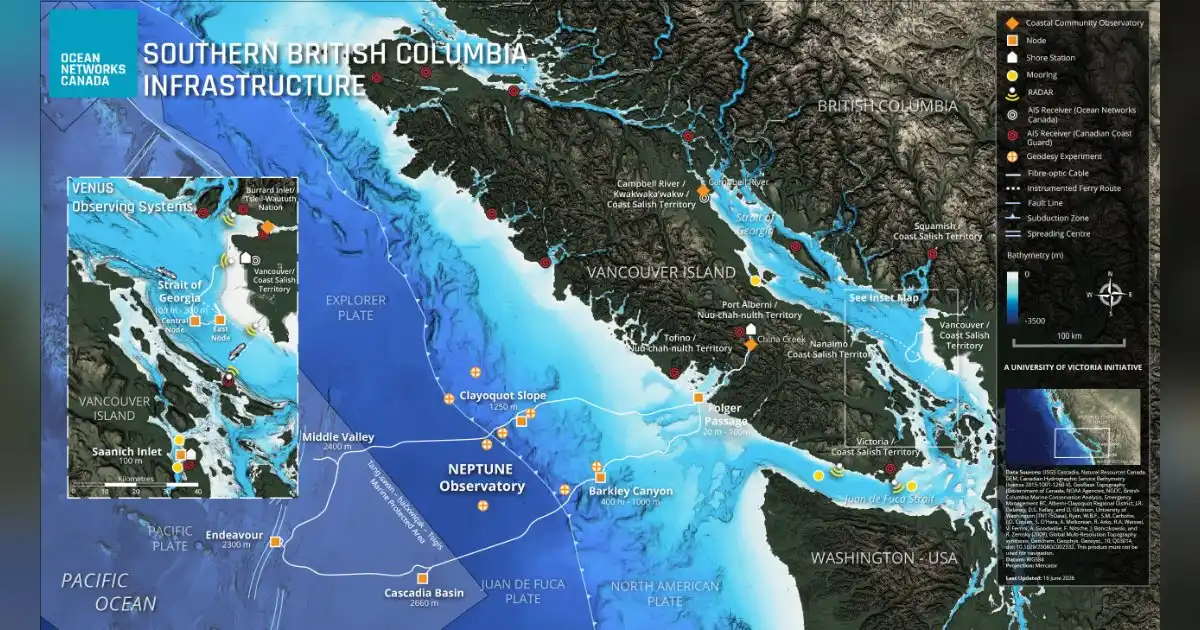
ONC, a University of Victoria initiative, operates two cabled Pacific Ocean seafloor major observatories: the 850-kilometer NEPTUNE observatory offshore Vancouver Island with five main research sites located at depths of up to 2.6 kilometers, and the inshore VENUS observatory in the Salish Sea, with sensors at depths up to 300 meters.
A new record-high temperature of 8.21 C was recorded at NEPTUNE’s Barkley Canyon Upper Slope—sitting 400 meters below the surface—earlier this month on November 8. This is 2.49 C above the site’s long-term average and 0.89 C warmer than the previous record, which was set in 2019. Monitoring began in 2009. Temperatures remain elevated, running about 1.6 C above normal in mid-November.
A deeper NEPTUNE site, Clayoquot Slope, located more than 1,200 meters below the surface, is also recording temperatures significantly above average.
“What makes these observations important is that we’re seeing significant warming not just at the surface, but hundreds of meters below it,” said Jay Cullen, ONC’s interim president and CEO. “We will be monitoring these conditions closely over the coming months, as warmer ocean temperatures can have important implications for marine ecosystems and ocean health.”
Since late summer, ONC’s NEPTUNE Observatory sites, located from 400 to 1,250 meters depth, have recorded the warmest seasonal temperatures yet. The exception is ONC’s deepest site, Cascadia Basin, at 2,650 meters, where temperatures remain within usual ranges.
Warmer-than-average conditions are also being observed at inshore sites. The Strait of Georgia has been experiencing warmer-than-average temperatures throughout 2026, according to data from ONC’s VENUS observatory. Additional warming associated with El Niño could add to these already elevated conditions, increasing stress on marine ecosystems.
“Since the start of 2026, the VENUS observatory has shown temperatures consistently higher than we’ve previously observed. And this was before any El Niño effects started to appear,” said Jordan Watson, ONC’s science director.
“The compounding of such conditions in a location known for migrating salmon, spawning herring populations, iconic marine mammals, makes it critical for us to understand how these conditions may affect the ecosystems that support the region’s fisheries, tourism, and overall cultural identity.”
View the NEPTUNE and VENUS long-time-series and live data, including ocean temperature and oxygen, on the ONC data dashboard.
Data from ONC’s expansive array of seafloor sensors on the three coasts of Canada and the Southern Ocean are available to researchers and interested public around the world through ONC’s Oceans 3.0 portal.