In the western North Pacific, changes in ocean temperatures, circulation patterns, and sea-ice cover are causing changes in phytoplankton ecosystem structure. However, how contributions of different microscopic food sources to zooplankton vary across these regions, remain poorly understood.
To address this gap, a research team led by Professor Kyung-Hoon Shin from the Department of Marine Science and Convergent Technology at Hanyang University in South Korea analyzed the cosmopolitan calanoid copepod Calanus spp., a zooplankton that is a key source of food for fishes and sea birds, making it an ideal indicator of basal resource composition and nitrogen pathways.
“Our objective was to quantify how nutrient sources and primary-producer communities shape zooplankton diets and nitrogen transfer pathways across the dynamic western North Pacific,” explained Prof. Shin. “To this end, we utilized a new dual-isotope approach for estimating the diet of Calanus.” Their study was made available online in Volume 12, Issue 38 of Science Advances on September 18, 2026.
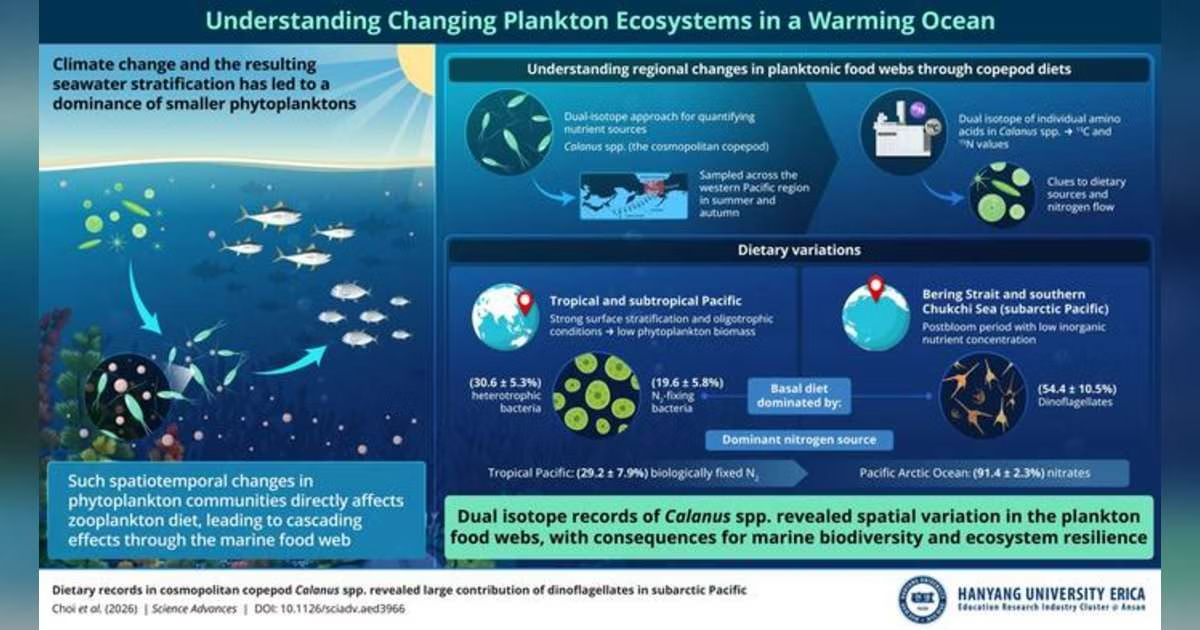
The researchers sampled Calanus across the western North Pacific during summer and autumn, covering a broad region from tropical and subtropical waters, the subarctic Pacific, to the Bering Strait and southern Chukchi Sea in the Pacific Arctic Ocean. They analyzed carbon and nitrogen isotope ratios in essential amino acids from Calanus spp. tissue. These chemical signatures helped them estimate the contributions of different basal food sources and investigate the nitrogen sources supporting microalgae.
The results revealed notable geographical variations in basal diets of the copepods. In tropical and subtropical Pacific, which have strong surface stratification and low phytoplankton amounts, N2-fixing bacteria and heterotrophic bacteria accounted for 19.6 ± 5.8% and 30.6 ± 5.3%, respectively, of the basal diet. Further north, in regions of the subarctic Pacific, the contribution of N2-fixing bacteria and heterotrophic bacteria decreased, while those of eukaryotic microalgae, such as diatoms and dinoflagellates, increased. Notably, in the Bering Strait and Chukchi Sea, dinoflagellates made up more than half (54.4 ± 10.5%) of the basal diet, while the total eukaryotic microalgae contribution rose to approximately 80%.
The researchers also found that the estimated contribution of dinoflagellates was strongly correlated with the protist contribution inferred from nitrogen isotope ratios. N2 sources supporting microalgae also varied regionally: biologically fixed N2 was more dominant in the tropical Pacific, accounting for 29.2 ± 7.9% of the nitrogen source, while nitrates were the primary source in the Pacific Arctic Ocean, accounting for an estimated 91.4 ± 2.3%.
“Our results demonstrate that combining carbon and nitrogen isotope ratios in Calanus spp. is a robust framework for understanding dietary records,” remarks Prof. Shin. “Importantly, our study shows how warming-driven changes in stratification and nutrient dynamics are reshaping planktonic food webs. This will have cascading consequences for marine biodiversity, biogeochemical cycling, and ecosystem resilience.”
In summary, this study offers an innovative method to track dietary sources of zooplankton, establishing a foundation for investigating how climate change may affect marine food webs.