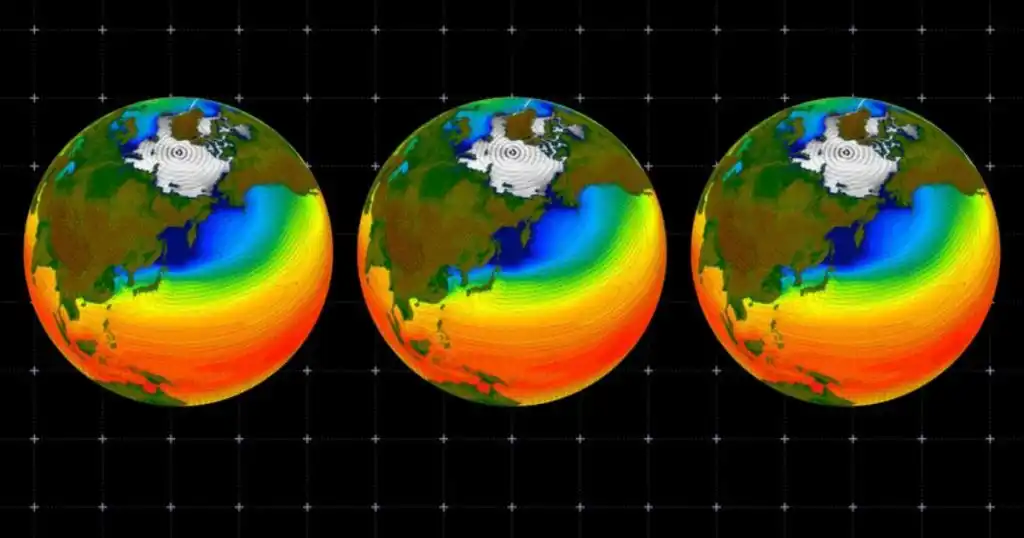
The study, published November 12 in Science, draws on more than 30 years of measurements of atmospheric oxygen and carbon dioxide (CO2) collected at remote sites by the Scripps O2 Program. The findings provide some of the strongest observational evidence to date on how the planet’s carbon sinks have changed over time, and they point to potential shortcomings in the models used to project future climate. The sinks have offset roughly half of the emissions from the burning of fossil fuels, leading to slower atmospheric CO2 growth and reducing warming.
“Without the land and ocean absorbing half the CO2 from fossil fuel emissions, we would be living on a very different planet,” said Scripps Project Scientist Eric Morgan, lead author of the study. “But these sinks can’t be observed directly. Figuring out exactly how much they have absorbed, and how they have changed over time, is a central goal of carbon cycle research.”
Insights from Atmospheric Measurements
Scientists have known since the early 1960s that fossil fuel burning is causing a rise in atmospheric CO2. The same process causes atmospheric oxygen levels to decline, as the burning of fuels like coal, gas, and oil consumes oxygen in addition to producing CO2. On land, photosynthesis drives the land sink and releases oxygen while plants consume CO2. In the ocean, CO2 is taken up primarily through reactions in seawater that have no effect on oxygen.
The Scripps O2 Program has been collecting regular air samples from sites around the world for more than 30 years, shipping them back to Scripps, and measuring the amount of oxygen and CO2 in each. Based on the long-term trends in both oxygen and CO2 from these records, the researchers were able to tell how much CO2 went into the ocean versus into land ecosystems.
The researchers found that the ocean absorbed an average of 2.8 billion metric tons (petagrams) of CO2 per year from 1990 to 2019, accounting for about 35% of fossil fuel emissions over that period. The ocean sink grew at a rate of 0.63 billion metric tons of carbon per year each decade. While beneficial for slowing the CO2 rise, the absorption of CO2 has negative consequences for the ocean, including lowering the pH of the ocean in a process known as ocean acidification.
The net land sink, by contrast, showed no notable long-term growth. Land ecosystems took up an average of one billion metric tons of carbon per year from 1990 to 2019, about 13% of fossil emissions, but with large swings in strength from decade to decade. The land sink peaked in the decade centered on 2009 and has generally declined since.
That result is at odds with many computer models of CO2 absorption on land. Those suggest that a natural land sink has grown as rising CO2 and nitrogen fertilize plant growth. For these models to be correct, carbon emissions from deforestation and other land-use change would have had to rise enough to cancel that growth, yet current estimates show those emissions declining.
“It was very surprising to see how the net land sink has not kept pace with rising CO2 levels,” said Morgan. “Our data underscore that the land sink may be pretty fragile.”
Even though the ocean sink has grown stronger in recent decades, there are reasons why it could become less effective in the future. Warmer waters are not able to hold as much CO2, and warmer surface waters are less efficient at mixing into the deep ocean, which has the beneficial effect of locking the CO2 away from the atmosphere for many hundreds of years.
“It’s not easy to keep these kinds of measurements going year after year, but the payoff for improving our understanding of the carbon cycle is huge,” said Ralph Keeling, a professor of geosciences at Scripps and co-author of the study.
The study notes that accurately representing these sinks is key to informing the global response to climate change, since the climate models describe the emissions reduction pathways needed to meet a temperature target.
A Record Decades in the Making
The Scripps O2 Program was founded by Keeling in 1989 to measure changes in the amount of oxygen in the atmosphere, and today maintains measurements from 10 sampling sites on a transect along the Pacific from the high Arctic to the South Pole. The program is a companion to the Keeling Curve, the record of atmospheric CO2 begun at Mauna Loa by Charles David Keeling in 1958.
The study was supported by the US National Science Foundation, the National Oceanic and Atmospheric Administration, and Schmidt Sciences, with additional support for the University of Exeter co-authors provided by the European Union’s OceanICU and UK Research and Innovation.
Additional co-authors of the study include Yuming Jin from the National Center for Atmospheric Research, now at UC Santa Barbara; Elena Kozlova and Andrew J. Watson from the University of Exeter; Andrew C. Manning from the Rochester Institute of Technology; Sönke Zaehle from the Max Planck Institute for Biogeochemistry; Yasunori Tohjima from the National Institute for Environmental Studies in Japan; and Xin Lan from the NOAA Global Monitoring Laboratory and CIRES, University of Colorado Boulder.