According to a paper appearing 12 November 2015 in PeerJ, “Water management decisions for the estuary should incorporate understanding of the role of salinity on bivalve diversity, abundance, and ecosystem function.”
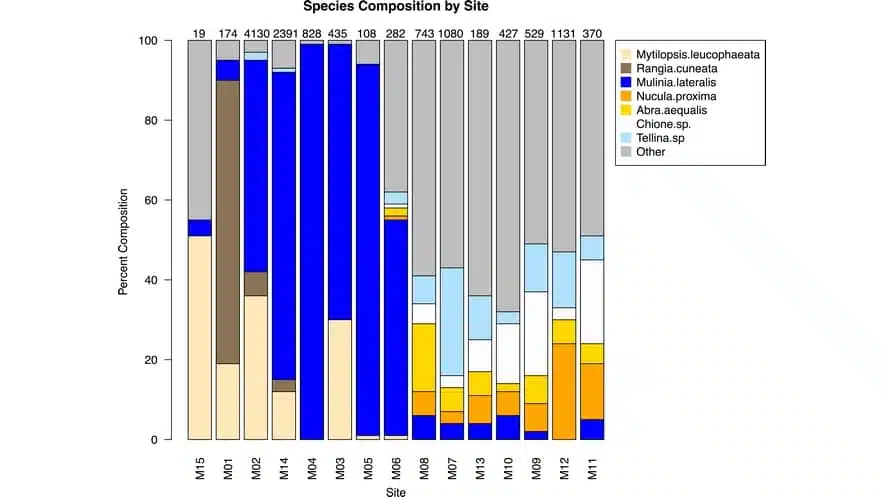
The study sampled the community composition of bivalves in the waters quarterly for ten years. Over 38,000 bivalves of 137 taxa were collected and identified. The researchers, led by C. Seabird McKeon, “utilized this data, along with sediment samples and environmental measurements gathered concurrently, to assess the community composition, distribution, and ecological drivers” of the bivalves. The strongest influence across the fifteen sites was salinity, with diversity greatest in the higher saline sites, populations most abundant in medium salinity, and lower abundance and diversity at lower salinity sites.
The St. Lucie Estuary and southern Indian River Lagoon (SLE-IRL), located in southeastern Florida, is a part of one of the largest and most diverse estuarine systems in North America. The authors state that, “ The manipulation of salinity in this ecosystem will have predictable, detectable consequences on the bivalve community.”
They conclude that “Management strategies for sediment composition and other issues affecting the IRL-SLE need to be paired with salinity control, as one without the other will likely be ineffective in shifting community diversity and overall lagoon health.”
To read the original paper, click here.