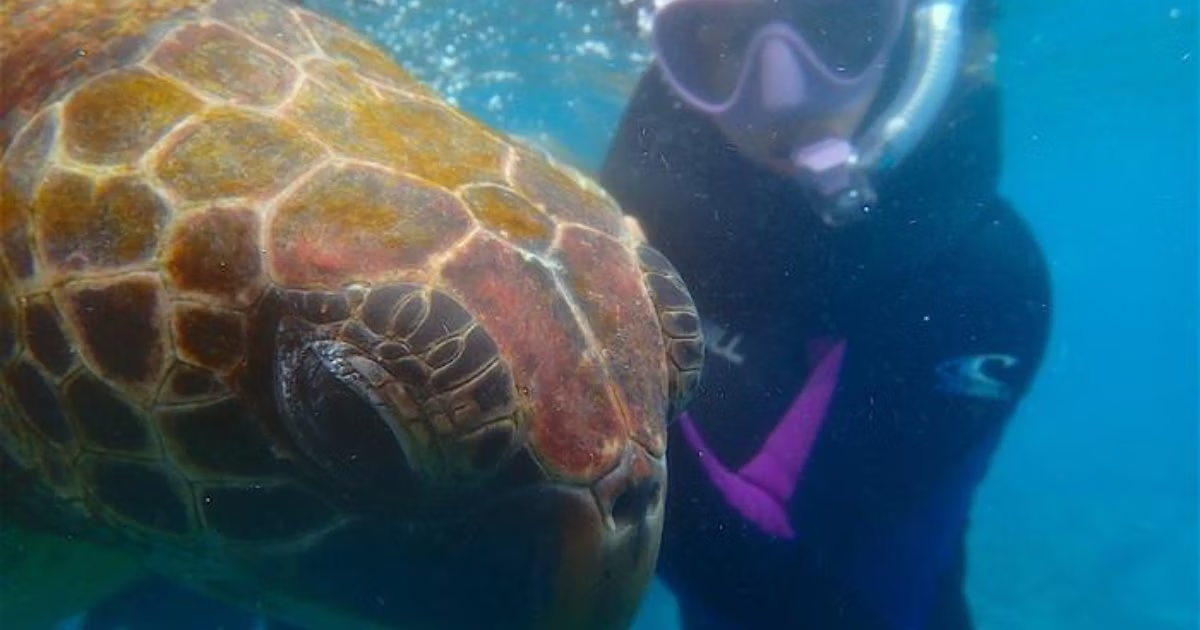
“Here we show that ‘yellow-morph’ green sea turtles—one of two genetically distinct forms—occupy individual foraging areas which span one or more islands in the Galápagos. We expected them to migrate to distant beaches in the western Pacific to reproduce, yet interestingly, none of our satellite-tagged turtles even left the Galápagos Marine Reserve over the three years of our study,” said Dr. John W Rowe, a professor at Alma College in the United States and the corresponding author of a new study in Frontiers in Amphibian and Reptile Science.
Black and Yellow
Green sea turtles are unique among the seven living species in being mainly vegetarian. Hatchlings start life as omnivores, but once fully grown, their diet consists of seagrasses and algae. Yellow-morph green sea turtles roam the western Pacific Ocean’s tropical and subtropical latitudes, while black-morphs live in the eastern Pacific west of the Americas below southern California. The only known waters in the world where these two coexist is around the Galápagos, where they intermingle and happily feed on the same species of marine plants. However, yellow morphs tend to grow faster than black morphs when young, which suggests that uncharacterized physiological differences do exist.
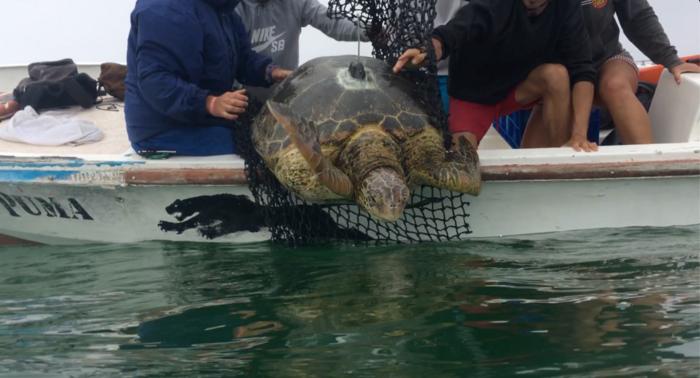
Rowe and colleagues set out to study the yellow morph’s habitat preferences, range, and movements between islands within the 198,000 sq km of the Galápagos Marine Reserve. In 2015, they gently caught seven adult males and two adult females in the shallow waters off four islands. They gave them nicknames and fitted them with electronic tags that sent ‘pings’ to the low-orbit Argos satellite network. The scientists tracked their charges for up to 418 days, typically until the tags fell off or stopped transmitting.
Overall, the turtles preferred to stay in shallow coastal waters, although occasionally they ventured up to 25 km offshore. Five of the nine animals stayed mostly in the vicinity of a single island during the study period, while Bernardo and Sara traveled between the islands of Isabela and San Cristóbal. Leandro trekked between Isabela and Española, while Ainoa displayed the most wanderlust: originally tagged off San Cristóbal, she subsequently moved to Santa Cruz and later to Isabela. Interestingly, such movement between islands was only seen during the cooler months from April to October. The mean size of a single turtle’s home range was 1,498 sq km, but this varied greatly among individuals.
The Turtle Moves (but not Much)
The authors concluded that yellow-morph green turtles in the Galápagos are remarkably stay-at-home. However, they warned that the study was only a snapshot in time, so that periodic long-distance dispersal may have been missed.
“Since female yellow-morph green sea turtles are not known to lay eggs on the beaches of the Galápagos, we believe that they will eventually leave the area to return to their natal beaches in the western Pacific. In contrast, some female black-morph green turtles do nest in the Galápagos: depending on the individual, those may be year-round residents in the archipelago, travel to other nearby oceanic islands, or even to feeding grounds off Central and South America,” said coauthor Dr. Juan Pablo Muñoz Pérez, a professor at the Universidad San Francisco de Quito in Ecuador.
The scientists also emphasized the importance of conserving pristine coastal and between-island routes that the turtles use within these islands.
“Since individual turtles may rely on waters around multiple islands, the quality of habitat that is available for foraging should be maintained intact across all islands, and not allowed to degrade anywhere,” said Rowe.