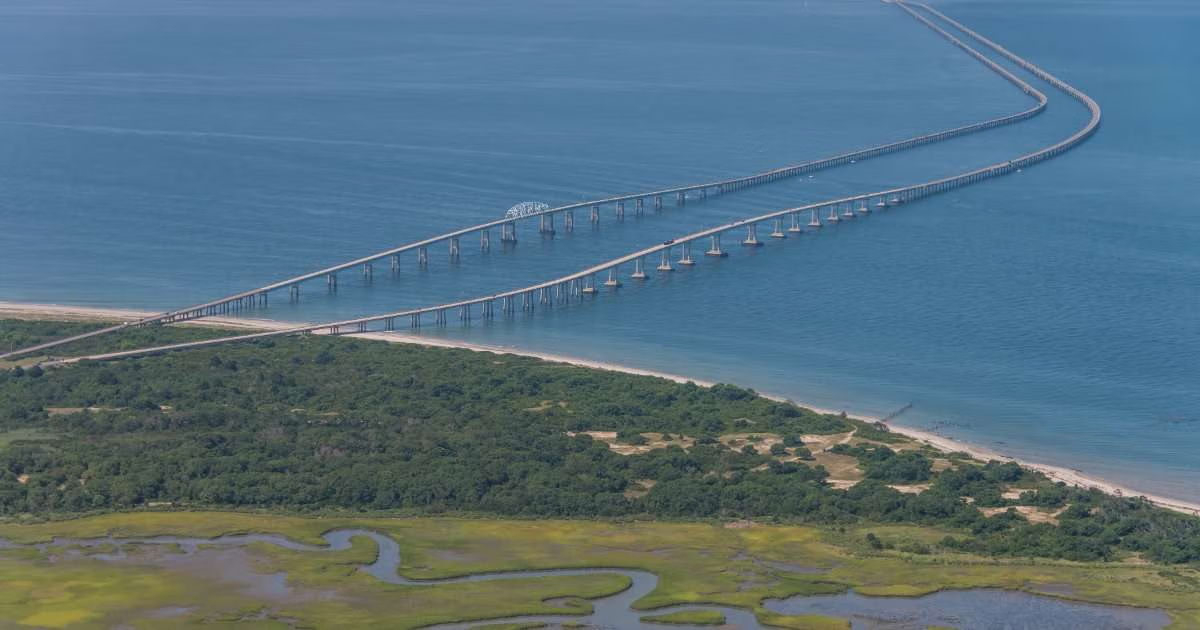
The order, titled “Providing Meaningful Water Quality Improvements Through Collaboration and Oversight of Federal Support,” rescinds Executive Order 13508, in effect for 17 years, which the administration says lacked clarity on implementation and was cited by some jurisdictions to justify stormwater management fees, commonly called “rain taxes,” that imposed hundreds of dollars in annual costs on residents and small businesses with little measurable benefit to the Bay. The order notes that watershed jurisdictions (New York, Pennsylvania, Maryland, Virginia, the District of Columbia, Delaware, and West Virginia) have collectively met 100 percent of their sediment-reduction goal, 90 percent of their phosphorus-reduction goal, and 57 percent of their nitrogen-reduction goal as of 2025, progress it says remains consistent with the 2025 revised Chesapeake Bay Watershed Agreement.
The revocation follows other recent White House water and environmental actions, including orders addressing California water resources and federal grantmaking oversight, and reflects a broader push to tie environmental funding to measurable outcomes rather than blanket compliance mandates.
The order cites 2026 findings from researchers at the College of William & Mary, the Virginia Institute of Marine Science, FlowWest, and the University of Maryland Center for Environmental Science, who projected the Bay’s annual dead zone would rank among the smallest since 1985, about 31 percent below the long-term average.
Under Section 3, the Secretary of War, the Secretary of the Interior, the Secretary of Agriculture, the Secretary of Commerce, the Secretary of Homeland Security, and the Administrator of the Environmental Protection Agency (EPA) must assess their agencies’ current support for Bay health and redirect fiscal and personnel resources toward direct, on-the-ground projects in areas of highest need, prioritizing funding tied to measurable water-quality progress over activities that do not generate it.
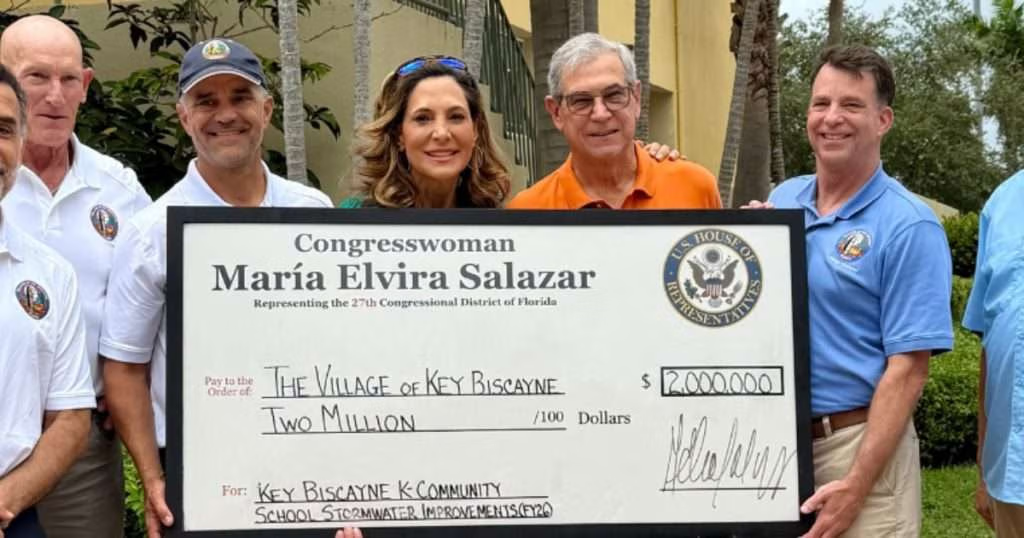
The EPA is separately directed to coordinate with Maryland, Virginia, Pennsylvania, Delaware, New York, and West Virginia, and the District of Columbia, to assess the financial burden stormwater management fees place on residents, explore alternatives that do not raise costs, and encourage jurisdictions to repeal or rescind those fees. Going forward, strategies under the order must be grounded in objective metrics, empirical data, and documented performance indicators, such as reductions in sediment, phosphorus, and nitrogen loads, rather than compliance-based mandates. The order sets no additional implementation deadlines and takes effect subject to existing law and available appropriations.