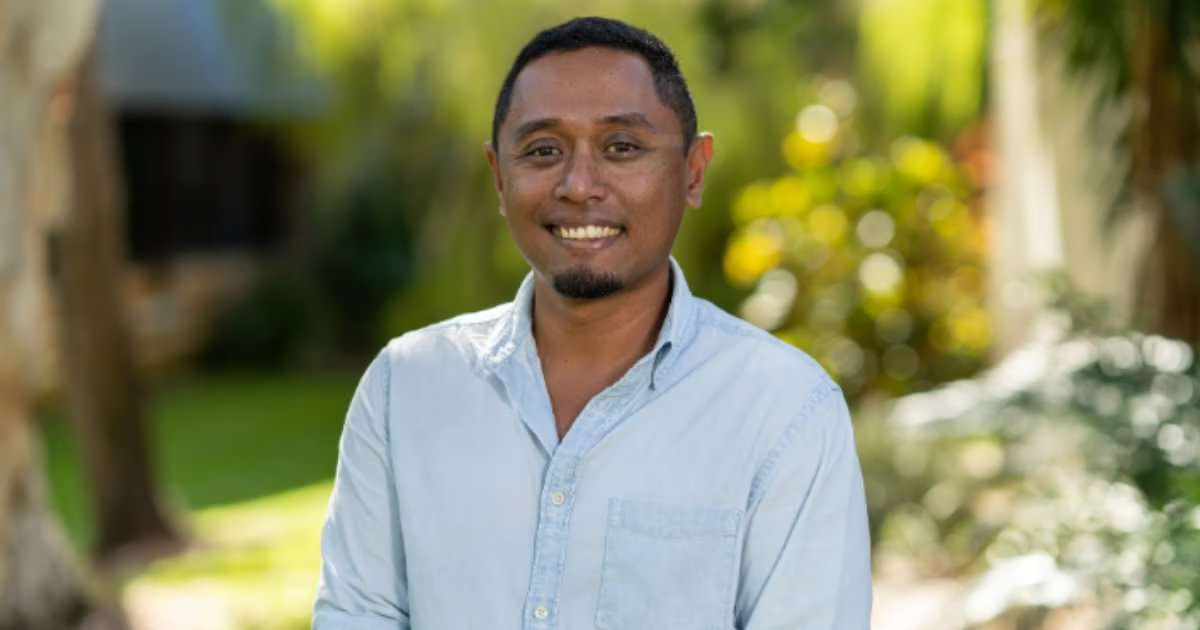
Dr. Abdul Wahab is at the forefront of efforts to help coral reefs survive climate change, working with global and Australian collaborators to develop and trial methods and technologies that take advantage of coral reproduction to scale up interventions.
He is also heavily involved in training technicians from other marine science organizations to use new technology like AIMS’ ReefSeed unit—a containerized coral aquaculture system which can be set up in remote areas to produce millions of coral spat for reef seeding.
“I am very humbled to make it to the TIME 100 Next list. It was quite a surprise—I had no idea I’d been nominated,” he said.
Dr. Abdul Wahab, who moved from Singapore to Australia in 2006 to pursue a degree in Aquaculture at James Cook University, has enjoyed a varied career in marine science, working with macroalgae, assessing dredging impacts on filter-feeding communities, mapping marine habitats in remote areas, and studying sea sponge ecology and reproduction. He’s also one of only a handful of AIMS scientists to have worked at every major AIMS site, beginning his career in Perth before transferring to Darwin and now working in Townsville.
He admits it’s been a roundabout journey to coral reef restoration, but a fulfilling one.
“Sponges ultimately led me to corals, and understanding reproduction in both is an ongoing passion,” he said.
“I love coral spawning season and working with coral larvae. For centuries, corals were thought to be plants or even rocks rather than animals. But when you see their tiny larvae swimming around in an incredible array of colors like reds, yellows, and pastel shades, suddenly it becomes obvious that these are animals—and it gives you a completely different perspective on corals.
“Sponges are ancient animals with fascinating biology and some surprisingly complex behaviors. Their larvae, for example, are highly responsive to light—moving towards it when they are first released, then switching direction and moving away from it several hours later. They can also be a little more scientist-friendly than corals: most species spawn during the day, which certainly makes studying their reproductive behavior easier.”
His expertise on reproduction was at the forefront of developments across the research and development phase of the Reef Restoration and Adaptation Program, where he helped to hone techniques in AIMS’s coral aquaculture facility—the National Sea Simulator—to scale up the production of young corals for deployment onto coral reefs.
Collaboration is very important to Dr. Abdul Wahab, not just for his own team of scientists and technicians at AIMS, but also with engineers and organizations around the world.
Working across disciplines, he has been instrumental in the development and rollout of the ReefSeed units, currently being used in the Maldives and the Great Barrier Reef, and which are about to be launched in the Pacific. He has also been involved in knowledge sharing and training of students and collaborators, including Traditional Owner groups, on coral reproduction and how to use different technologies for coral propagation.
“I like the variety of the work—I’ve been adaptable over the years,” he said.
His advice to young marine scientists is: “Stay true to your values but remain open and adaptable to where new opportunities might take you. Stay curious, keep asking the difficult questions, and use science to help develop solutions for the challenges of the future.”
Dr. Abdul Wahab’s immediate future will see him attend a workshop on applied innovations in scaling reef restoration in the Dominican Republic and making it back to Australia in time for the second Great Barrier Reef mass coral spawning event, due to begin in late November.
Dr. Abdul Wahab’s entry on the TIME100 Next list, alongside the full list of rising stars, is available here.