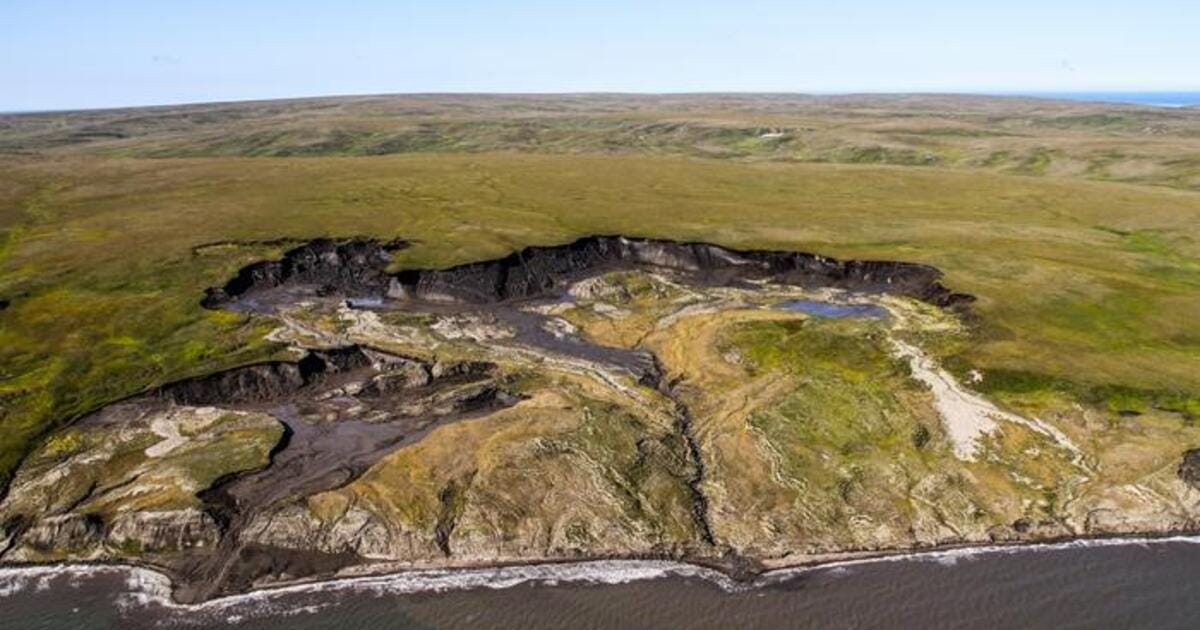
Arctic terrestrial permafrost ecosystems store around 1,300 gigatonnes of carbon from organic sources, such as the remains of plants. Sediments in oceans and river deltas contain a further 400 gigatonnes. Global warming, however, is taking its toll on this natural freezer: temperatures in the Arctic are rising faster than anywhere else on our planet, with the result that permafrost in the region is thawing rapidly. The carbon stored here can then enter the Arctic Ocean via rivers and eroding coastlines. “Consequently, up to 0.02 gigatonnes are entering the sea each year, and according to forecasts, this outflow could rise by 70 to 150 percent by the year 2100,” said Dr. Manuel Ruben, lead author of the study from the Alfred Wegener Institute, Helmholtz Centre for Polar and Marine Research (AWI). “However, how much of this is released back into the atmosphere as a greenhouse gas and how much is stored in the seabed has, until now, been largely unknown.” Yet, this knowledge is essential for assessing the climate impact of thawing permafrost.
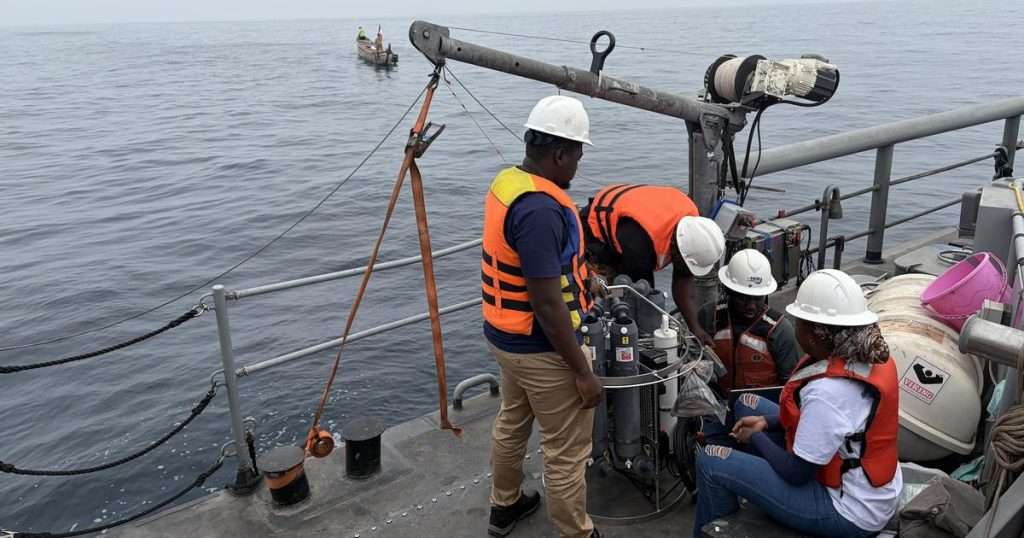
To get to the bottom of this unknown, the researchers retrieved and analyzed sediment cores taken at various intervals off the coast of the Canadian island of Herschel Island. The cores contain deposits spanning around 50 years. Analysis of the sediments revealed something surprising: “Although the sea here carries away huge quantities of organic carbon from the coast, surprisingly little of it ends up in the ocean’s active carbon cycle,” said Manuel Ruben. “Microorganisms convert around ten percent of the organic carbon from the sediments into gases, which rise into the water and can then enter our atmosphere.” The major share, however, is stored in the seabed.
In conducting their analysis, the researchers first examined the composition of the sediment cores in detail and also investigated how rapidly permafrost deposits accumulate on the seabed. To this end, they measured how much inorganic dissolved carbon accumulates in tiny cavities within the sediment layers—known as pore water. This provides an indication of how much CO2 microorganisms have ‘exhaled’ after ‘digesting’ the organic carbon. The isotopic composition of the pore water provides insights into which organic material from which source has been broken down. “Carbon isotopes represent our atomic indicators that can identify the food source of the microorganisms,” said Prof. Gesine Mollenhauer, a geochemist at the AWI and co-spokesperson for the ‘The Ocean Floor – Earth’s Unexplored Interface‘ cluster of Excellence. “The 13C isotope, for example, tells us whether they have consumed carbon from land or from the sea. By way of the 14C isotope, we were able to determine whether the single-celled organisms preferred old organic carbon from permafrost or fresh organic carbon from algae remains.”
One explanation for this lies in the eating habits of these tiny organisms: “The sediment is home to ‘gourmet’ bacteria that apparently prefer fresh carbon stemming from, for example, more recent algal remains over the ‘old’ carbon from permafrost deposits,” explained Gesine Mollenhauer. This suggests that the organic carbon entering the sea from land contributes less to the amount of greenhouse gases in the atmosphere than originally feared. “However, we do need further research here. This is because some of the organic carbon from the permafrost may already have been broken down before it reaches the seabed.”
In addition to the impact of land-ocean carbon transport on atmospheric greenhouse gas levels, further effects are possible. For instance, this transport influences the biogeochemistry of coastal waters, which also play an important role in providing food for the local population. This is because the sediments alter the amount of sunlight available: on the one hand, the freshly broken-off fragments cloud the coastal ocean, while on the other hand, the organic carbon they contain discolors the water as it dissolves into it. Single-celled organisms such as algae, however, need light to convert this into biomass and oxygen. This primary production, in turn, forms the foundation for marine life such as fish, crustaceans, and seals. The researchers aim to investigate these complex interrelationships, among other things, as part of the international ‘Arctic Pulse’ campaign planned for 2027. Through coordinated measurement campaigns aboard the Polarstern research icebreaker, using the AWI’s research aircraft and on land, they will investigate how rapid environmental change is altering ecosystems in the Arctic.
“Our study shows, more precisely than ever before, how much carbon is safely stored in the seabed—and just how much of the decomposed material actually originates from the old permafrost,” said Manuel Ruben. “This provides an important foundation for climate models that can predict the consequences of permafrost thawing for the global climate.”