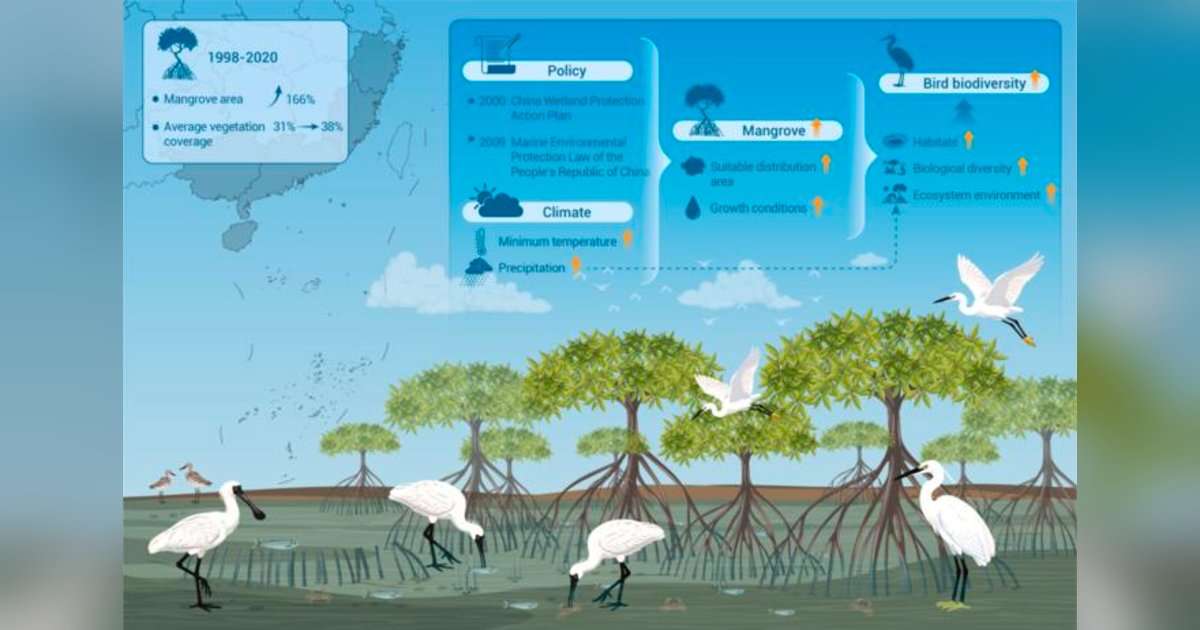
Reporting in The Innovation, researchers at Ningbo University find that China’s mangrove area grew 166% between 1998 and 2020, from 10,617 to 28,194 hectares. Over the same 22 years, the number of bird species recorded along the coast rose from 148 to 397, and IUCN Red List threatened species from 11 to 21—a 91% rise.
The turnaround carries policy fingerprints: the 2000 China Wetland Protection Action Plan and the 2009 revision of the Marine Environmental Protection Law preceded the fastest growth phase, 2003 to 2008. Guangdong, Hong Kong, Macao, and Guangxi supplied 88% of the national increase, and average vegetation cover climbed from 31% to 38%—quantity and quality rising together.
The harder question is whether such restoration restores ecosystem function, not just tree cover. Birds make a practical yardstick: they sit high in the food web, respond quickly to habitat quality and food supply, and are counted by legions of volunteers. The team paired long-term satellite records of mangrove extent and density with those coastal bird observations, then used a path model to trace how mangroves might reach birds.
That model describes a chain: policy and a warming climate expanded mangrove area; larger, denser forests improved marine conditions and reshaped phytoplankton communities; bird diversity rose in step. Mangrove area tracked both bird abundance and richness closely (R² = 0.70–0.76, p < 0.001). Phytoplankton showed the strongest direct effect on overall diversity and abundance, and mangrove area the strongest on species richness. Climate had no significant direct effect—only an indirect one, through mangrove growth.
The authors are explicit about limits. Bird records come largely from observation databases in which survey effort varies by place and year, so part of the rise may reflect more observers rather than more birds. And denser mangrove is not uniformly good news: shorebirds that feed on open mudflats, such as sandpipers and plovers, can lose foraging ground when forest spreads across tidal flats. Restoration, the authors argue, should aim at a whole coastal wetland—mudflat, shallow water, and forest edge—not simply more trees.
Its contribution is scale and mechanism: a national, 22-year accounting that links a specific policy to a high-trophic-level group through measured environmental pathways, rather than a single correlation. The authors see the approach as transferable to other coastal nations weighing restoration against conservation commitments.