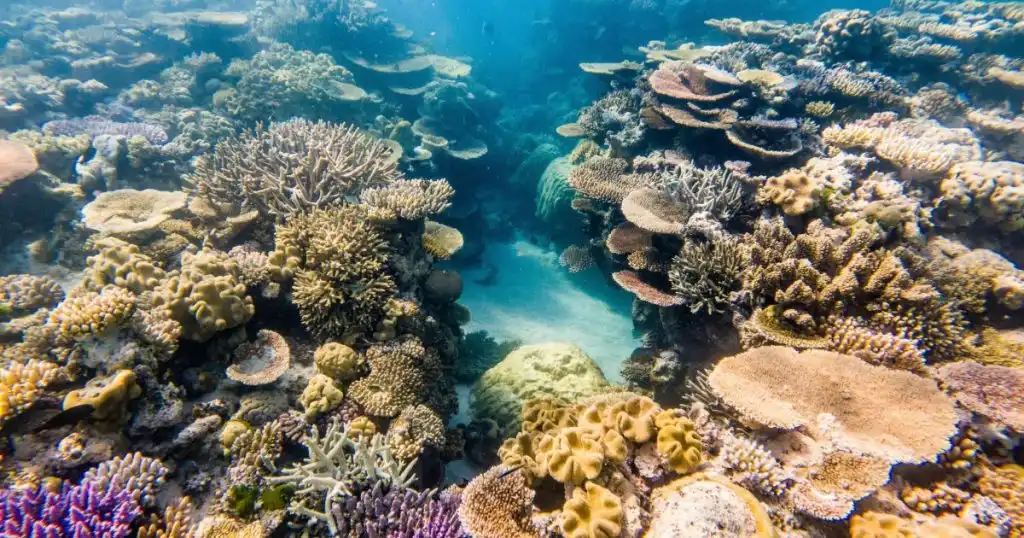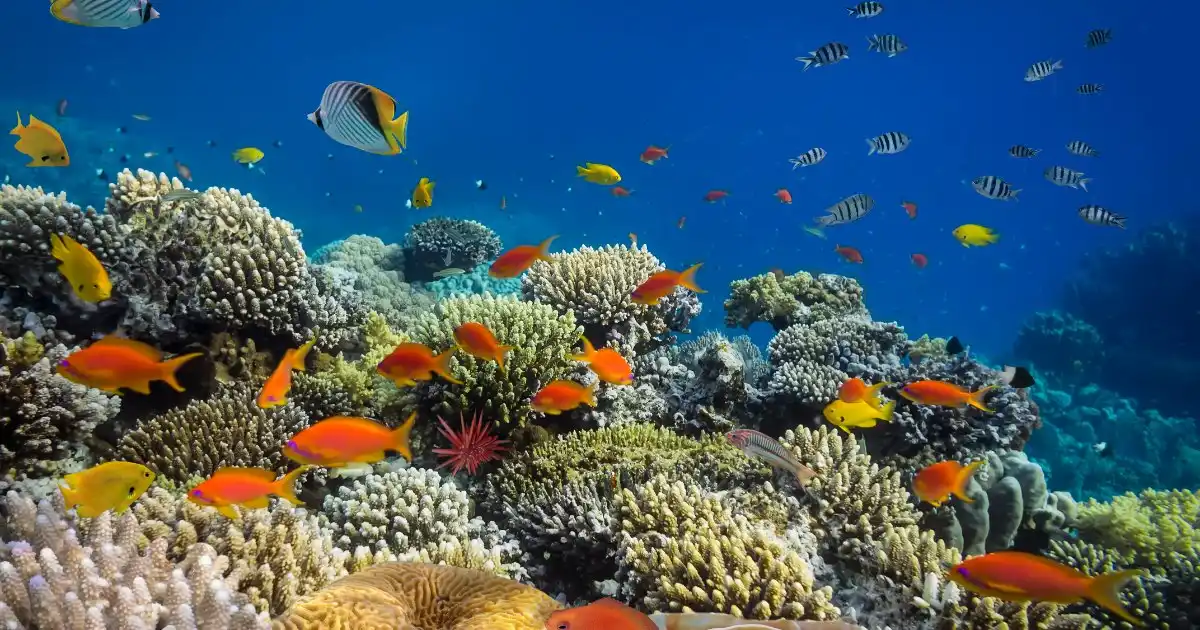
Marine heatwaves increase the chances of disrupting the tiny algae that live within corals, leading to coral bleaching and even mass die-off events. As human activities continue to raise global temperatures, the growing intensity of marine heatwaves at depth may leave tropical corals without cooler waters to retreat to, threatening biodiversity, fisheries, and tourism throughout reef regions.
“Ocean warming is not just a surface problem. What happens deep beneath the surface can also have serious consequences for coral reef survival,” said Chunzai Wang, an oceanographer at the Chinese Academy of Sciences and co-author of the study.
The study will appear in Geophysical Research Letters, AGU’s journal for high-impact, innovative, and timely articles on major advances across all major geoscience disciplines.
Peering beneath the Surface
Scientists have proposed using deep reefs as “seed banks”—transplant sites for reproduction-ready corals from suffering shallow reefs. But “going deeper does not necessarily mean escaping the heat,” Wang said.
To understand how marine heatwaves affect reefs beyond the top 30 meters (98 feet) of the ocean, researchers used global maps of warm-water coral reefs to filter ocean-wide simulations of daily water temperatures down to 150 meters (490 feet) from 1993 to 2023. These warm reefs occur around the world within 35 degrees of the equator, at latitudes roughly between Santa Barbara, California, and Adelaide, Australia.
The simulated water temperatures use ocean circulation patterns and physics to fill the gaps between real measurements, creating a more complete record of reef heatwaves than is available from satellite measurements, which can only see surface temperatures. With this deeper view of reef heat exposure, researchers tracked the number, durations, and temperatures of marine heatwaves, which oceanographers define as a stretch of at least five days with seawater warmer than 90% of the historical temperatures recorded for that time of year.
The team also calculated heatwave “intensity,” a metric that accounts for both temperature and duration. According to NOAA, corals risk bleaching once they’ve received four “degree-weeks” of heat—the equivalent of four weeks at 1 degree C above normal temperatures, or a commensurately shorter time at higher temperatures (for example, two weeks at 2 degrees C hotter, or just one week at 4 degrees C hotter).
Deep Reefs’ Demise
Deep reefs may still have been plausible coral refuges prior to 2010, the researchers suggested. Before this date, marine heatwaves typically impacted less than 50% of global reef areas per year, largely sparing deeper reefs from sustained high temperatures. Between 1993 and 2010, the average deep reef heatwave lasted less than 15 days except during the 1997–1998 El Niño.
From 2010 onwards, however, heatwaves hit over half of the world’s tropical reefs in eight of the 13 years studied—roughly four times more often than in the preceding 17 years. The average heatwave in reefs over 90 meters (295 feet) below the surface stretched to 15 or more days in all but two years, typically bringing temperatures around 2 degrees C higher than normal.
The worst coral conditions seen in the study came from three back-to-back La Niña events. Between 2020 and 2023, strong westward winds over the Pacific year after year built up an unusually deep-reaching pool of warm water in the western Pacific, ramping up global marine heatwaves beyond any other events since 1993. At their peak, the 2020–2023 marine heatwaves impacted over 75% of global tropical coral reef areas at all depths.
Coral Conservation
Although marine heatwaves at depth occurred less frequently than those at the surface throughout the study period, their increased duration after 2010 has made them more intense, on average, than those in shallower waters. According to researchers, this could scupper hopes of shelter for corals during the extreme ocean heat events on the rise due to human-caused climate change.
The most important intervention for protecting corals is limiting global warming from human actions. “Local conservation measures can help reefs withstand environmental stress, but they cannot fully protect coral ecosystems from increasingly widespread ocean heat extremes,” Wang said.