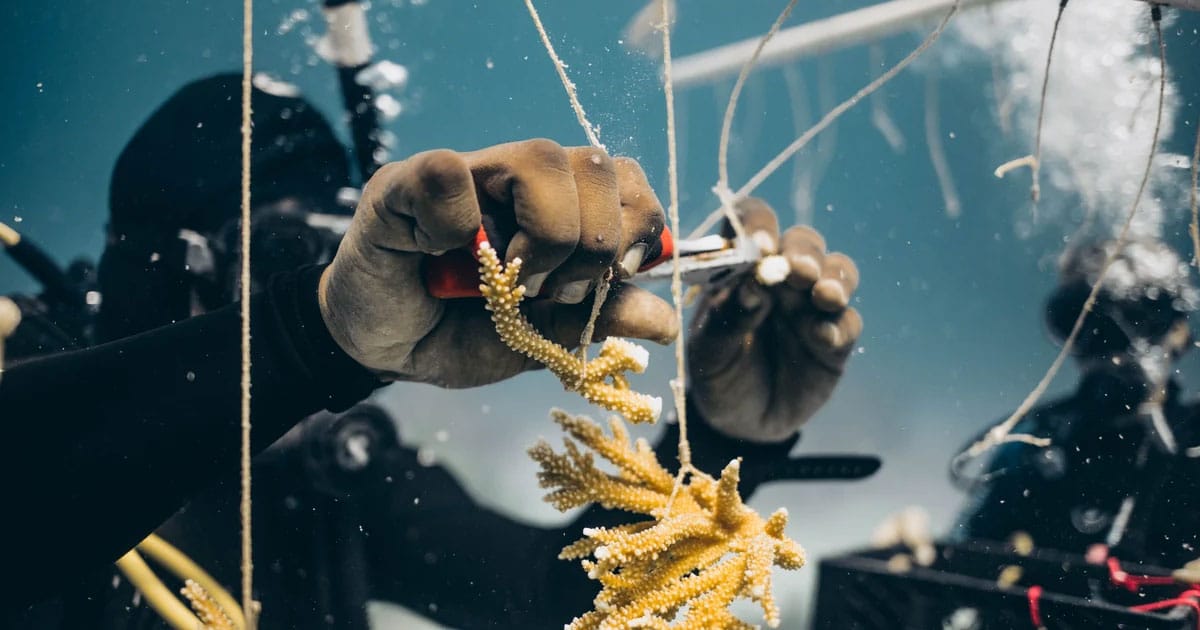
Coral reefs are undergoing an alarming decline, with about half of all global reefs lost since the 1970s. The main causes are rising ocean temperatures, pollution, and overfishing. Scientists warn that over 90% of remaining reefs could disappear by 2050. Coral reefs are the most biodiverse ecosystems on the planet, harboring up to 25% of all marine species. Millions of people rely on reefs for food security, coastal protection, and biodiversity. This is especially true in the Maldives, where society depends heavily on coral reefs.
A Blueprint for Large-Scale Restoration
To counter this evolution, maritime contractor Jan De Nul and expert in land-based coral farming, Coral Vita, have set up a unique project called AquaReef. The objective: to create a blueprint for large-scale restoration of coral reefs, applicable and scalable anywhere in the world.
Noa Ligot, Senior Marine Engineer at Jan De Nul: “With this project, we want to make coral reef restoration as efficient and affordable as possible. When we protect coastlines through beach nourishment or breakwater infrastructure, for example, we want to offer our clients the possibility to combine this with coral reef restoration. The reefs strengthen coastal protection and, on top of that, deliver huge ecological benefits. This is the win-win we are aiming for.”
Over 15,000 Corals in 24 Months
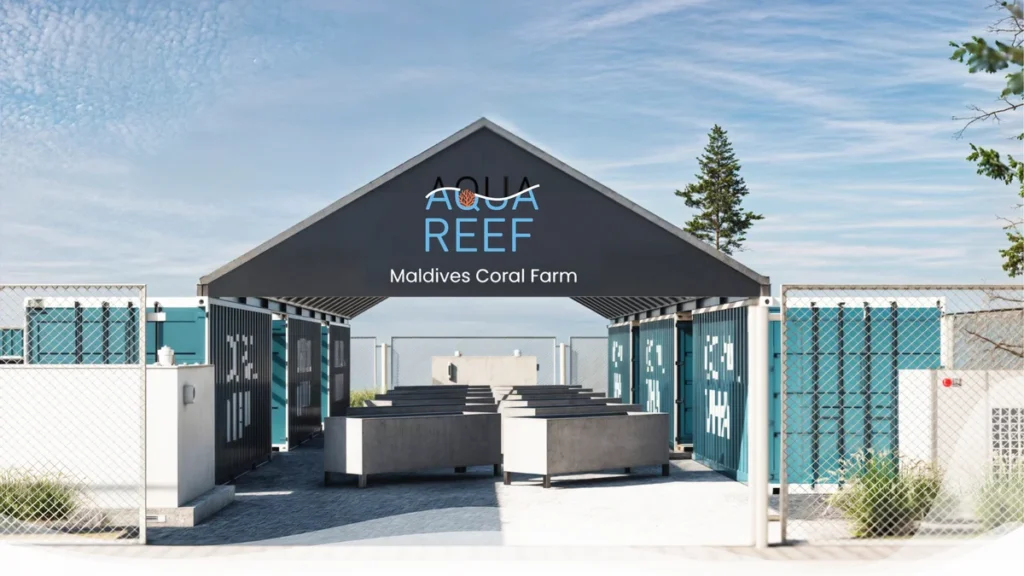
Jan De Nul has now officially started the construction of a coral reef farm on the island of South Malé Atoll. By autumn this year, Jan De Nul will have finished building the farm. Partner Coral Vita can then start with the coral production process. In a period of 24 months, the farm should be able to grow over 15,000 corals.
This starts with collecting small, healthy fragments from resilient reefs, ensuring no long-term harm is done. These are then cut into tiny pieces through micro-fragmentation.
Austin Martin, Chief Executive Officer at Coral Vita: “This technique enables rapid coral growth, increased coral species diversity, and enhanced resilience to climate change. Each piece is placed onto hard materials like rocks or bricks, we call these reef substrates, and transferred into controlled aquaria inside the farm. In this stable environment, where temperature, light, and water quality are precisely managed, the fragments grow rapidly and fuse into larger, robust colonies. Once they reach the right size and strength, which should be feasible by 2027, these corals are ready to be outplanted.”
Resilient to Warming Oceans
Through the process of assisted evolution, scientists look for corals that cope better with heat stress. These heat-tolerant corals are then used for selective breeding. The goal is to create future coral populations that are more resilient to warming oceans.
Austin Martin: “This partnership brings together cutting-edge and science-driven coral reef restoration techniques with world-class operational and logistics expertise. Coral Vita’s modular land-based farming technique matches perfectly with Jan De Nul’s ability to rapidly deploy and service complex operations in remote environments and its expertise in marine habitat restoration. Together, we unlock the potential to restore coral reefs at an industrial scale anywhere in the world.”
Investing in Large-Scale Nature Restoration
Jan De Nul has been investing for many years in its expertise in large-scale nature restoration projects. Besides coral reefs, they are also focusing on oyster reef restoration. Together with Ghent University, they have developed state-of-the-art oyster grow-out facilities where they are cultivating young oysters on suitable substrates.
Later this year, they will install oyster reefs in a Natura 2000 area in the North Sea, as they already did in the summer of 2025. Their goal is to combine nature restoration with core business activities like the development and installation of scour protection on offshore wind farms and coastal infrastructure.
Partners
AquaReef is a Jan De Nul project with Coral Vita as the main partner. Locally, the main supporting partner is the Maldives Airports Company Ltd (MACL), with further support from local research institutes.
“With this project, we want to make coral reef restoration as efficient and affordable as possible,” said Noa Ligot, Senior Marine Engineer at Jan De Nul.