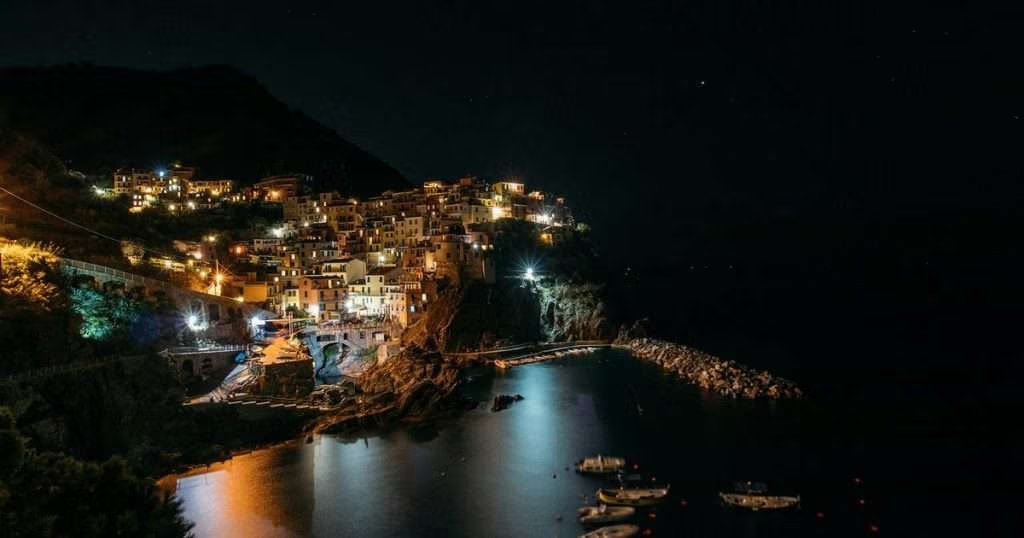
The portable containerized coral aquaculture system was used for the second year running on Maniyafushi Island, in the South Male Atoll by project partners the Maldives Marine Research Institute (MMRI) in conjunction with AIMS and CSIRO following spawning on local coral reefs.
Spawning is the way corals reproduce and replenish reefs, and the ReefSeed system is designed to take advantage of this process, helping researchers to seed healthy young corals onto reefs to fast-track recovery.
“This is the second year running that we have supported MMRI staff to use ReefSeed, and it was another successful year of capacity building, training, spawning and deployments,” said AIMS scientist Dr. Cathie Page.
“Using ReefSeed to produce corals for seeding is a multi-step process. ReefSeed is a complex piece of machinery, and MMRI staff have gained the skill, knowledge, and experience to use it effectively during a second year of operation in the Maldives. We will hand it over to them to run it from December with our remote support if needed.”
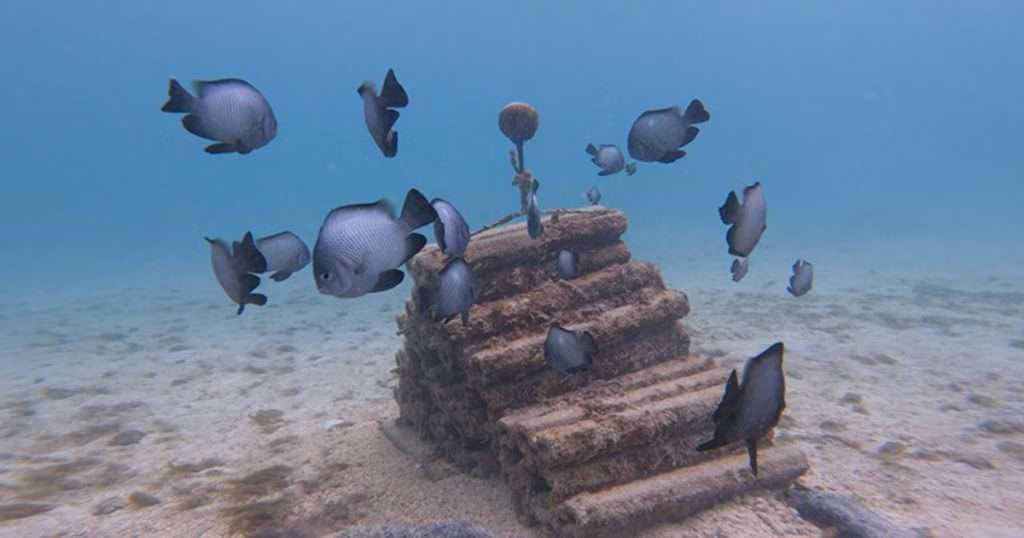
From just 46 coral colonies collected from local reefs, more than 9 million gametes (bundles of eggs and sperm) were collected this year in the ReefSeed system. These were then fertilized, with the resulting larvae reared and settled onto small tiles and placed into ceramic devices. A total of 2,146 devices, each with three tabs of young corals, were deployed to 24 sites. The Maldives Environmental Regulatory Authority also supported this work.
Ahmed Najeeb, Marine Research Coordinator at MMRI, said it was encouraging to see how far they had come in two years.
“Seeing some of the young corals from last year surviving and growing on Maldivian reefs is especially rewarding, and at the same time we are learning a great deal about where and how these corals have the best chance of survival,” he said.
“Just as importantly, ReefSeed project has helped us build the skills and experience within MMRI to carry this work forward and continue improving how we approach coral restoration in the Maldives.”
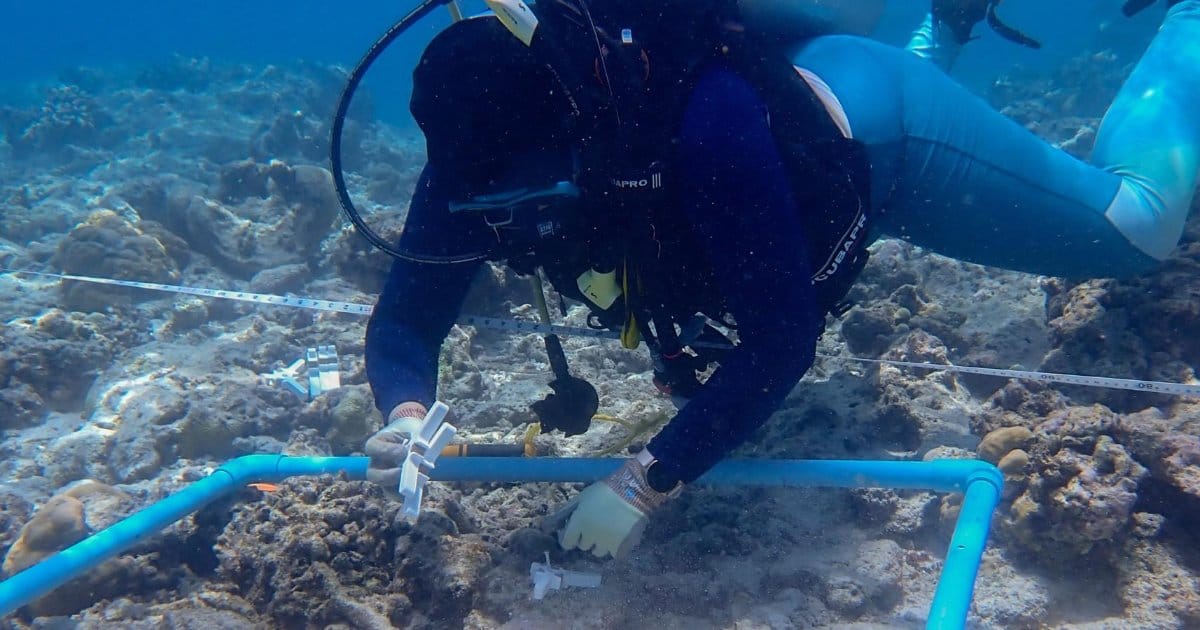
Dr. Page added: “This year’s activities in the Maldives also included monitoring of the corals we deployed last year, which we’re learning a lot from. We’ve experimented with our deployments this year to understand how we can improve survival.”
AIMS@JCU Ph.D. student Crystle Wee has been at the forefront of efforts to assess the success of deployments so far.
“Results from last year’s deployment were mixed; about 20% of deployed devices contained at least one live coral after one year, while 66% of devices had at least one live coral at the best performing site,” she said.

“We saw high survival on some reefs with the young corals living and growing well on the ceramic devices. The largest surviving 1-year-old coral was about 5 cm. However, on some reefs we observed lower survival, so deployments this year are designed to test the effects of various site characteristics on the survival and retention of the young corals,” she added.
ReefSeed was awarded $1.5 million (AUD $2.3 million) over three years by the G20 Coral Research and Development Accelerator Program (CORDAP), the only international organization fully dedicated to funding global research and development for tropical and cold-water coral restoration and conservation. ReefSeed uses science and technology developed under the Australian Government’s Reef Restoration and Adaptation Program (RRAP).
RRAP is funded by the partnership between the Australian Government’s Reef Trust and the Great Barrier Reef Foundation.