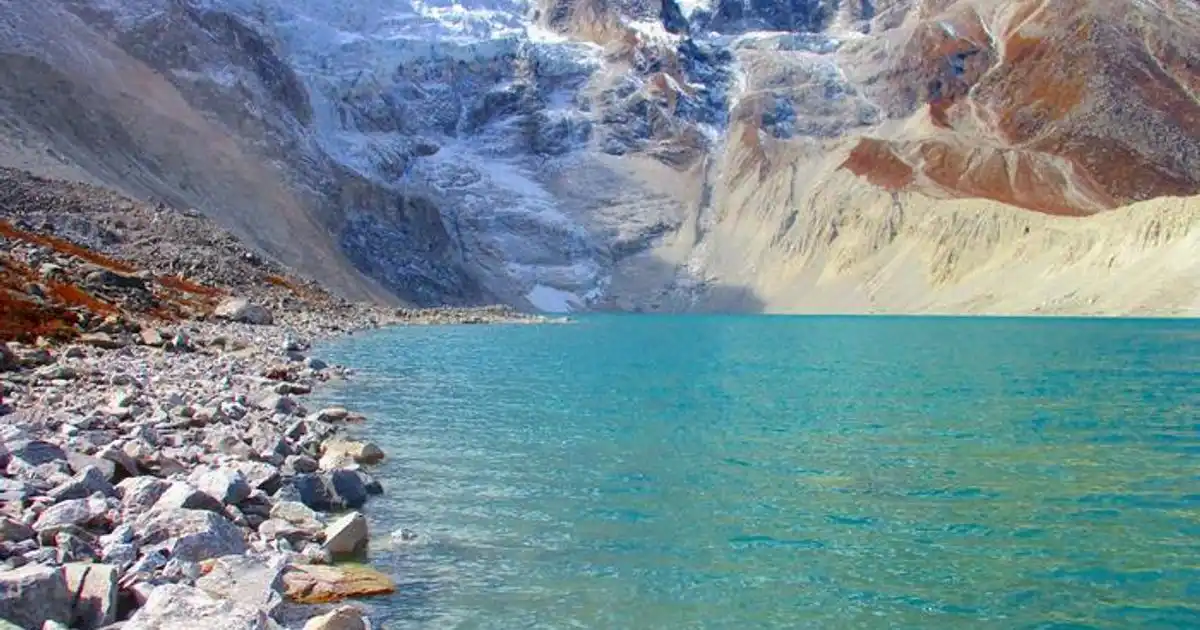
An international research team, including Tobias Bolch from the Institute of Geodesy at Graz University of Technology (TU Graz), has now investigated this question by mapping and analyzing all glacial lakes worldwide. The researchers have published their findings in the journal Nature Climate Change.
Climate and Topography Determine Ice Loss; Lakes Exacerbate It
The researchers found that lake-terminating glaciers lost an average of 66 centimeters of water equivalent per year between 2000 and 2020. This means that the annual loss of ice is equivalent to a layer of water with a thickness of 66 centimeters. For glaciers that end on dry land, the average was 40 centimeters per year; for glaciers with a tongue ending in the sea, it was 36 centimeters.
“Our research has shown that contact with a lake further accelerates the loss of ice from a glacier,” said Tobias Bolch. “While the climate and the topography of the glacier are the most significant factors influencing glacial mass loss, lakes significantly exacerbate it.”
More Lakes Formed by Glaciers Worldwide
For the study, the research team analyzed satellite imagery from 2000 and 2020. Artificial intelligence was used to identify glacial lakes from the images, which were then checked manually. Among other things, the researchers distinguished between lakes in direct contact with glaciers and those that are already separated from the ice.
The number of lakes in direct contact with glaciers rose by more than 3,500—or around 35 percent—over a period of 20 years. Their total area increased by around 600 square kilometers and their estimated volume of water by around 66 cubic kilometers; if this volume of water were spread evenly across the entire city of Vienna, the city would be submerged under around 160 meters of water. The expansion of the lakes was particularly pronounced in Alaska and the southern Andes.
A Stronger Foundation for Water Planning
The research team used machine learning models to assess the impact of various factors on the glacier mass balance. The mass balance describes how much ice a glacier gains or loses. Accordingly, in the model used, an average of 46 percent of the explained influence is attributable to the topographical characteristics of the glaciers, such as their altitude and slope gradient. Climatic factors such as temperature and precipitation account for around 43 percent. Glacial lakes account for around 11 percent. The results therefore show that the interplay of several factors is crucial.
“The findings from this study will help us to estimate future changes to the glaciers more accurately,” said Tobias Bolch. “This is particularly important for mountainous regions and their forelands, where meltwater is a significant source of water. Such findings are also relevant when assessing the risks posed by glacial lakes in the event of potential outbursts.”
In addition to TU Graz, the study also involved the Chinese Academy of Sciences, the China University of Geosciences, Xizang (Tibet) University, Lanzhou University, Jiangxi Normal University, the Central Asian Regional Glaciological Centre, ETH Zurich, the University of Potsdam, the University of Leeds, and Carnegie Mellon University in Pittsburgh, USA.