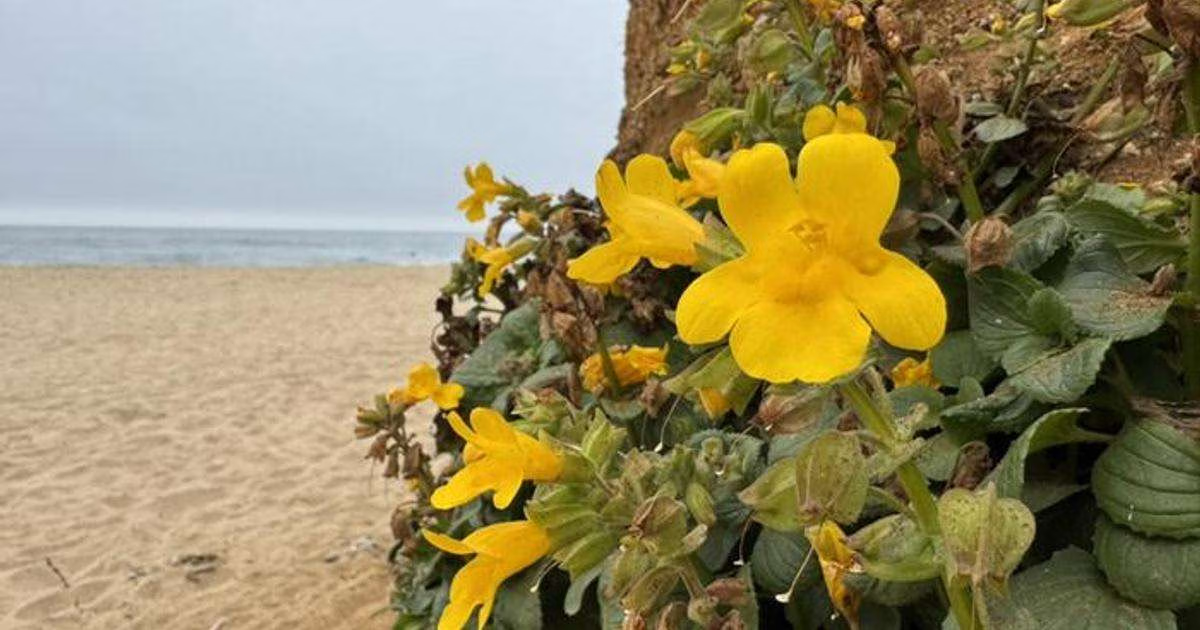
It’s called the yellow monkeyflower. And now researchers are beginning to understand how it manages to thrive in conditions that leave other plants burned, brown, and withered.
“The yellow monkeyflower has evolved multiple adaptations to salt spray,” said David Lowry, a biologist at Michigan State University and senior author of the new study, which was published this month in the American Journal of Botany.
By studying the diversity of ways that wild monkeyflowers adapt to salt spray, the researchers say their work could point to ways to make other plants, including crops, more resilient to salt exposure.
And not just from ocean spray, but from sources ranging from winter road salt to worsening storm surges, said lead author Madison Plunkert, a plant biology Ph.D. student in MSU’s Ecology, Evolution, and Behavior program.
To the untrained eye, monkeyflowers do not necessarily look like hardy survivors. But across their range in western North America, from the Pacific Coast to as far inland as the Great Plains, they are known to thrive in harsh, inhospitable places.
Take the margins of abandoned copper mines, hot springs, or serpentine soils that are toxic to most plants.
For monkeyflowers that live along the Pacific Coast, seaside life means contending with a relentless spray of salt blowing in from the ocean.
“It’s kind of hard to conceptualize unless you’ve gone out to the coast in California or somewhere else, and the wind is blowing 30 or 40 miles an hour, and you’re actually experiencing the salt landing on you,” Lowry said.
“A salty film gets all over the windshields of cars,” Lowry explained. “If you lick the leaves of these plants, you can even taste it.”
Anyone who has seen beachfront homes with rust spots and peeling paint can testify to salt’s corrosive effects. But as destructive as salt is to wood, metal, and paint, it is lethal to plants, causing roots and leaves to dry out and stunting their growth.
Nearly 20 years ago, Lowry noticed that when he sprayed inland and coastal monkeyflowers with salty water in the greenhouse, the inland plants wilted and turned brown, and many died. But plants collected from the coast survived.
This apparent ability to shrug off salt spray’s normally toxic effects left scientists puzzled.
To figure out how they cope, Lowry, Plunkert, and colleagues came up with a way to mimic oceanfront conditions in growth chambers from their lab in Michigan.
“We call it the ‘Saltmobile,'” Plunkert said. “It’s a cart with airbrushes and bottles of seawater that we’ve surrounded with a trash bag so that we don’t fill up the hallway with a haze of salt spray.”
The researchers took monkeyflower plants collected from five coastal and five inland areas across Oregon and California, sprayed them with salty water, and allowed it to dry. Then they measured the sodium levels inside the leaves.
The results were striking. For every square centimeter of leaf, coastal plants contained roughly 30 percent less sodium than inland plants.
“Coastal plants are better at preventing salt from entering their leaves,” Lowry said.
The researchers also took various leaf measurements to see how they kept salt out. Perhaps coastal plants had altered their pores to provide fewer opportunities for seawater to enter, they reasoned. Or maybe saltwater tended to bead up and roll off their leaves instead of staying on the surface where it could sneak in.
“None of the leaf traits we measured explained it,” Plunkert said.
In follow-up experiments, the researchers also found that, when salt does enter the leaves, coastal plants are better able to tolerate it.
The team used a hole punch to cut out circles from the leaves and put the leaf discs into Petri dishes, some of which had sodium chloride added, and others didn’t. Again and again across plants from multiple sites, they found the same result:
“Coastal plants were able to hold out longer,” Plunkert said. “They didn’t show signs of damage as quickly as the inland plants did.”
In a separate study, Lowry and Katherine Toll of the University of South Carolina found that coastal monkeyflowers have ways to protect themselves from salt spray at other stages of their life cycle, too.
Specifically, coastal plants bolt and flower later in the season than inland plants, when it’s less windy. By doing so, they avoid exposing themselves to the worst impacts of salt spray and stay out of harm’s way.
Looking forward, rising sea levels and choppier waves under climate change are likely to mean increased salt exposure for coastal plants.
As a next step, the team is trying to identify the specific genetic changes that enabled coastal monkeyflowers to keep salt from entering their tissues and wreaking havoc once there.
“There are hundreds of thousands of miles of coastline in the world, and plants living along most of that,” Lowry said. “They all have to deal with this stress, so we’re trying to understand it.”
This research was supported by grants from the US National Science Foundation (DGE-184-8739, IOS-2153100).
“Foliar salt spray exclusion and tissue tolerance underlie local adaptation to oceanic salt spray,” Madison L. Plunkert, P. Camilla Durant, Katherine Egeler, David B. Lowry. American Journal of Botany, Aug. 17, 2026. DOI: 10.1002/ajb2.70251