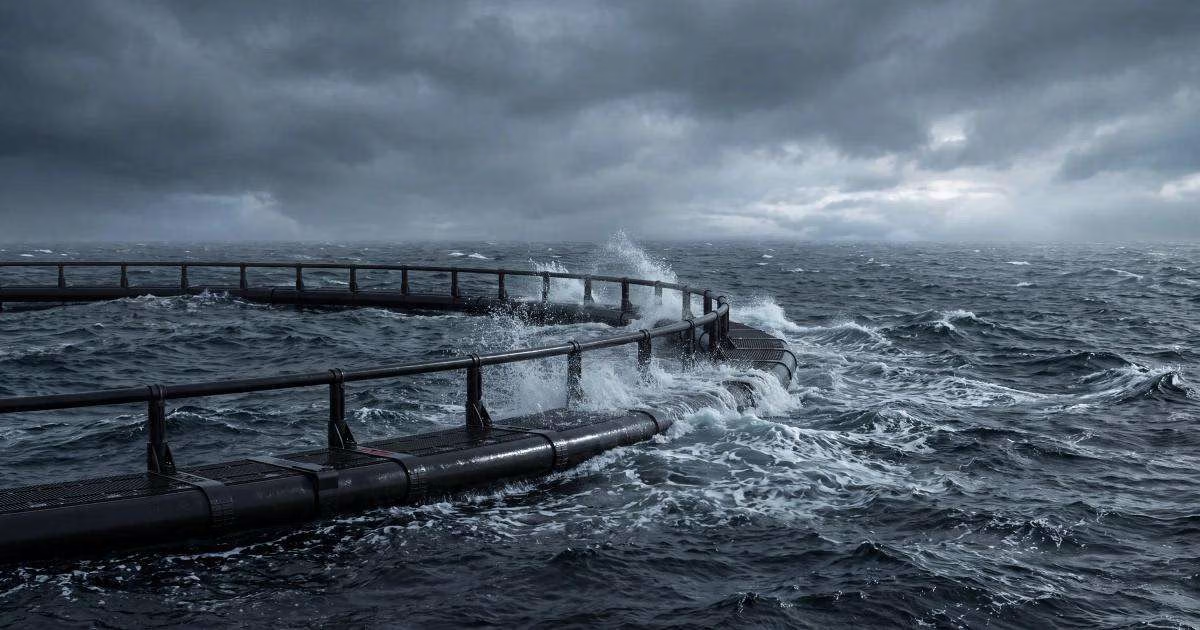
The first Polarcirkel 560SB is scheduled to be installed at sea in December. Increasing amounts of heavier equipment in and around the pen have been a key driver in the development of the new floating collar, which features flotation pipes with a diameter of 560 mm and is available in circumferences ranging from 140 to 200 meters.
The development of the new floating collar builds on more than 50 years of experience with Polarcirkel pens.
“We have continued to develop Polarcirkel floating collars in line with the industry’s needs ever since the first circular HDPE floating collar was delivered to Lovund Sjøprodukter in 1974. Polarcirkel 560SB is the next step, developed for increasingly exposed sites,” said Jøran Strand, Sales Manager Nordic at AKVA group.
Stronger Construction for Heavier Loads
The new floating collar features a reinforced mooring solution designed to withstand significant forces. The mooring attachment is designed to withstand loads of up to 60 tonnes under extreme conditions.
The name 560SB originates from Storm Bay in Tasmania, where challenging weather and sea conditions inspired the development of the reinforced model.
“When we experienced the conditions in Storm Bay, with Antarctica as the next stop beyond the edge of the pen, it became clear just how much stress aquaculture equipment can be exposed to. We wanted to develop a floating collar capable of withstanding precisely these conditions. That is why the strongest model was named 560SB, with SB standing for Storm Bay,” said Arnstein Hosaas, Chief Innovation Officer (CINO) for Sea Based at AKVA group.
The increased strength is also reflected in the construction itself.
“We have significantly increased the ring stiffness compared with Polarcirkel 500. This provides a more robust and stable floating collar capable of withstanding higher loads,” said Dag Ove Antonsen, Product Owner – Plastic Pens at AKVA group.
A Safer Working Environment
Polarcirkel 560SB features a walkway measuring 1,405 mm in width. The increased width provides more space for personnel and equipment, even when the floating collar is fitted with external posts, railings, or predator nets. Combined with increased buoyancy, this creates a more stable working platform and contributes to greater safety for those working along the edge of the pen.
“It is not just about building larger and safer structures to prevent damage, structural failures, and fish escapes. The increased size should also provide practical benefits for those using the floating collar every day and make it safer to work on,” said Strand.
Reduced Maintenance with Plastic Construction
Material selection is another important aspect of the development. Polarcirkel 560SB features a robust plastic construction without steel components that can rust or corrode. The plastic structure is designed for a long service life under demanding conditions, while the absence of steel reduces maintenance requirements.
Like the other Polarcirkel floating collars, the new model is free from expanded polystyrene (EPS). The flotation pipes are divided into several watertight chambers that limit water ingress in the event of damage. The absence of EPS also makes the floating collar easier to handle when it eventually reaches the end of its service life and is sent for recycling.
Polarcirkel 560SB is the top-of-the-range model, developed for the most demanding sites. For sites with lower loads, AKVA group also offers Polarcirkel 560, without the reinforced mooring bracket. Both models can be adapted for conventional farming and deep farming.
Trade-In Scheme for Existing Floating Collars
AKVA group now offers a new trade-in scheme for existing floating collars when purchasing new ones.
“The industry’s needs will continue to evolve, and our floating collars must evolve with them. Polarcirkel 560SB is not the end point, but the next step,” said Hosaas.