“The coastal ocean in the northeastern US has a very complicated seesaw between flow from the north bringing cold fresh water and flow offshore from the Gulf Stream bringing warm, salty water, and those influences swing back and forth,” said Woods Hole Oceanographic Institution (WHOI) Senior Scientist Glen Gawarkiewicz, lead author of the study. “It’s always in flux.”
Working closely with fishers, researchers collected and analyzed five datasets, including 11 years of ocean profiles collected by active fishing vessels through a partnership with the Commercial Fisheries Research Foundation of Rhode Island (CFRF). They found that during this cold pulse, surface temperatures across the continental slope and shelf were 5 to 9 degrees Fahrenheit below the 20-year average, and that ocean salinity had dropped.
“Many of the captains I work with have told me that ocean conditions are cyclical, but what they’re seeing now adds another layer of uncertainty. In 2021 and 2022, captains were seeing big sportfish like bluefin tuna off Block Island, while in spring 2024, I heard from several that their target species were up to five weeks late or missed their usual spring run altogether,” said Noelle Olsen, a senior research biologist at CFRF. “Partnerships between the fishing and scientific communities are important for reaching a more holistic understanding of ocean changes. The experiences of fishers help us understand what these shifts mean for fisheries and the communities that depend on them.”
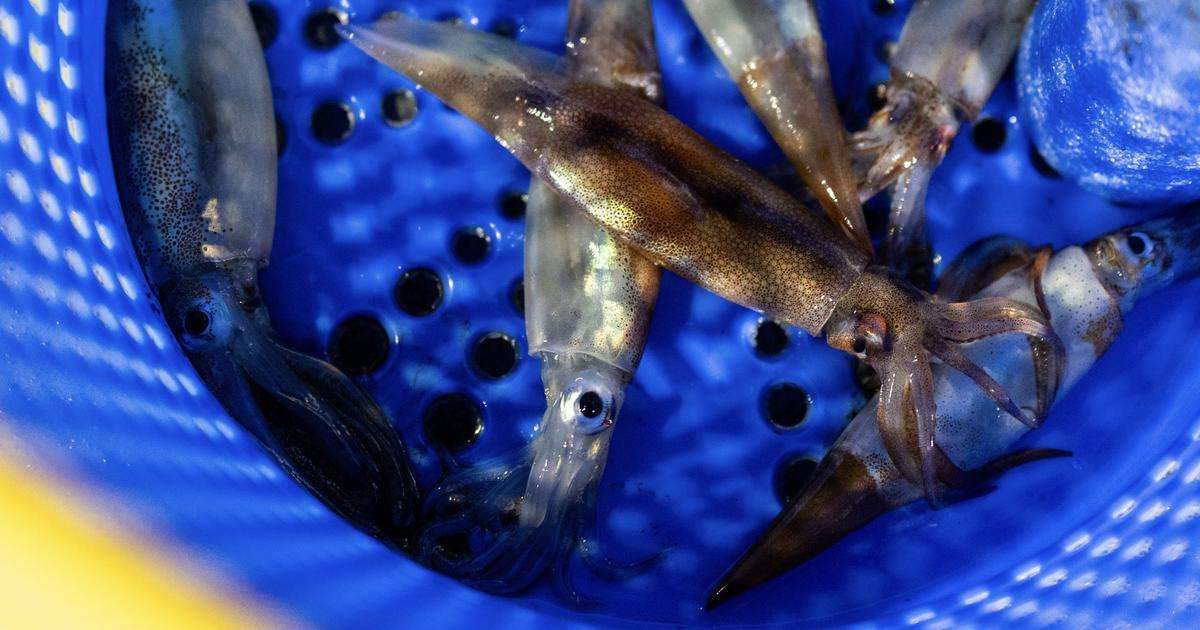
The effects of this anomalous cold pulse continue to reverberate across fisheries, with significant economic losses in some sectors, including the longfin squid fishery in southern New England. Longfin squid typically appear there in May and continue through June and July, but in 2024, they did not arrive until August.
According to NOAA Fisheries’ Commercial Fishing Landings database, the commercial harvest of longfin squid in the Northeast fell 25.6%, or 10 million pounds, from 2023 to 2024, while its commercial value declined by $6.5 million.
“The changes we saw on the water weren’t happening in isolation,” Gawarkiewicz continued. “They were part of a much larger shift in the ocean, with water moving into the region from farther north and bringing a very different set of conditions with it. Understanding where that water came from, and why it moved south, is an important part of understanding what happened to the fisheries.”
Researchers believe the cold, fresh pulse originated in the Labrador Sea and Grand Banks, then moved south along the continental shelf as ocean circulation and atmospheric conditions shifted. A southward shift in the Gulf Stream and changes in wind patterns in the southern Labrador Sea may have allowed more cold, fresh northern water to move into the region. While researchers can trace the water’s movement, they cannot yet determine the relative role of each factor in driving the event.
“It is important to zoom out when analyzing these types of anomalous events, since coastal regions like the Northeast US Shelf are heavily influenced by and connected to the circulation of the entire ocean basin on which they border,” said Paula Fratantoni, Chief of the Oceanography Branch at NOAA’s Northeast Fisheries Science Center and co-author of the study. “A relatively small shift in the trajectory of a large-scale current like the Gulf Stream can lead to dramatic changes locally, and understanding these relationships can help us better anticipate anomalous conditions in the future.”
This study also highlights how collaboration between fishing communities and researchers can strengthen our understanding of changing ocean conditions. By combining long-term scientific observations with information gathered on the water, researchers can build a more complete picture of how shifts in the ocean affect marine ecosystems, fishing communities, and the economies that depend on them.
“There is a lot of positivity in terms of the fishermen being really receptive to hearing about the science now, and for scientists to be more open-minded about all the knowledge that the fishermen have,” Gawarkiewicz explained. “There’s a real opportunity to bring those two perspectives together, because fishermen are out there experiencing these changes firsthand, and scientists can help put those observations into a broader scientific context.”