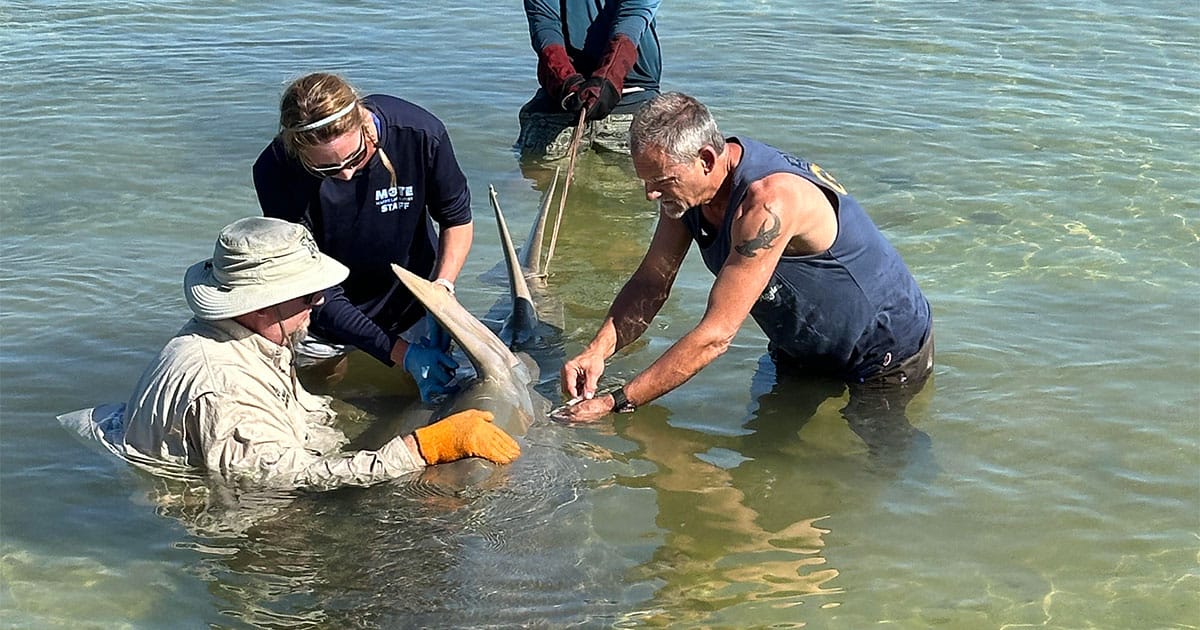
The interim holding tank at Mote’s Lower Keys facility gave the team a temporary area where they were able to stabilize the animal. While the animal was successfully rescued and received crucial stabilizing care, it remained in critical condition. After several days of treatment and monitoring, the team decided that the animal appeared capable of withstanding the several-hour drive to another Mote quarantine facility designed to provide more extensive rehabilitation treatment for sawfish.
On Thursday, April 11, 2024, biologists carefully loaded the sawfish into a transport trailer operated by Ripley’s Aquariums. Ripley’s Aquariums Conservation Team monitored the sawfish and water quality conditions throughout the duration of the transport to Mote’s facility.
Now at Mote’s more extensive quarantine facility, the sawfish will continue to be monitored 24-hours a day and treated in hopes of fully rehabilitating its health before releasing it.

The rescued sawfish in the temporary holding tank at Mote’s facility. (Image credit: Mote)
“Without hesitation or any identified source of funding support, Mote has made a commitment to provide FWC and NOAA Fisheries with significant ongoing assistance and support of our expert scientists across diverse disciplines, veterinary and animal husbandry staff, along with our significant specialized marine species quarantine facilities for responses that our partners at FWC and NOAA Fisheries deem necessary for rescue and rehabilitation of distressed smalltooth sawfish,” said Dr. Michael P. Crosby, CEO & President of Mote Marine Laboratory & Aquarium. “This is an unprecedented partnership initiative that is at the core of our mission – using the best available science and technology to rescue, restore, and conserve our precious marine species, habitats, and ecosystems.”
All the partners involved in this effort (including Havenworth Coastal Conservation and Dynasty Marine LLC, not previously mentioned) are excited about the successful steps to date in rescuing this endangered smalltooth sawfish and look forward to building upon lessons learned from this initial effort.