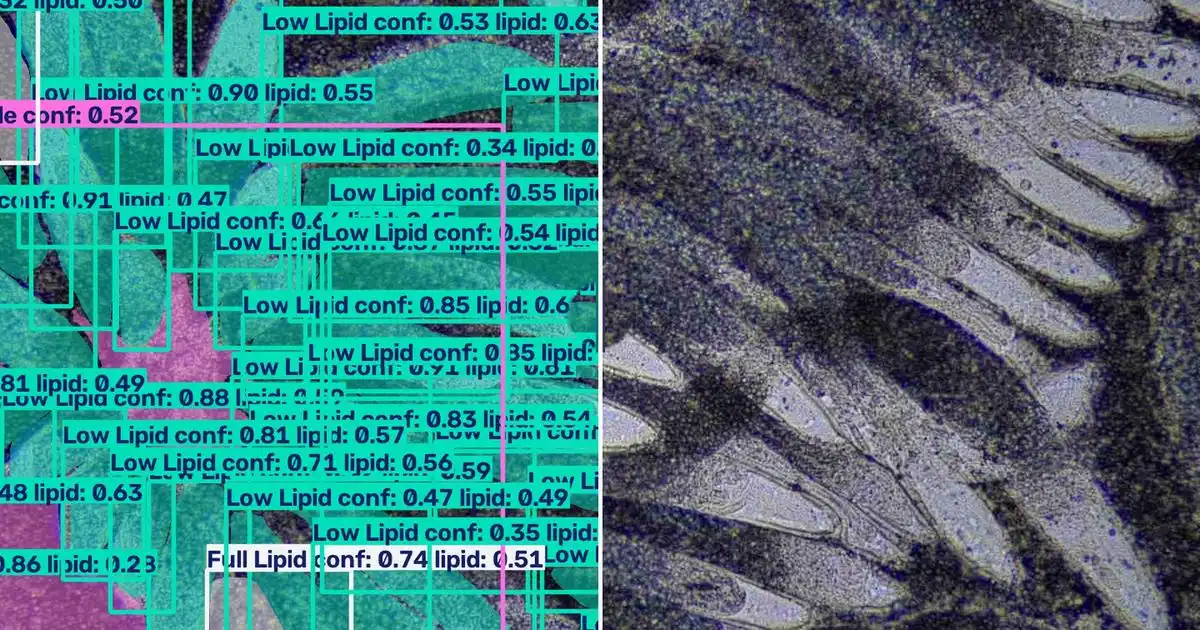
The global aquaculture industry loses some US$6 billion to disease and millions of salmon to plankton every year. Salmon and shrimp laboratories read water samples and animal tissue under a microscope to catch toxic plankton imbalances and signs of animal stress or disease. The process is manual, error-prone, and infrequent, so changes are confirmed too late, and intervention starts once losses have begun.
From Reactive to Predictive
Hadl turns this process from reactive to predictive. The models run on samples farmers can easily collect, replacing slow, subjective, and error-prone manual assessment with fast, consistent, and auditable AI analysis. Early signals of water imbalance, stress, or disease are detected before they turn into significant losses. The technology is deployed on-site for farmers or into the workflow of industry and governmental laboratories.
“Farming is a relentless dance with our environment, we often never know what caused a problem, and when we do, it’s nearly always too late to act. Our models and partnerships are uncovering the hidden patterns in our food systems and giving farmers, researchers and laboratories a trusted data set to work with,” said Alexander Farthing, CEO of Hadl.
Hadl has developed models, spanning salmon and shrimp, with partnerships and clients in 14 countries. Today the technology is deployed directly onto farming sites, as a technical service for input suppliers, or sitting inside laboratories’ existing workflows, improving sample throughput tenfold.
Built for Farm Environments
Hadl was founded by Alexander Farthing, a farmer and repeat technology founder. Hatch Blue backed Farthing’s previous company to a successful exit and acquisition. The wider team behind Hadl is a mix of Ph.D. researchers, farm operators and engineers, with a decade of experience deploying technology into laboratories and farms.
Hadl came to Hatch Blue through the Hatch CREST Accelerator in November 2025. Hatch Blue then followed by investing in Hadl from Hatch Accelerator Fund II.
“The problem with digital innovation in aquaculture is often its complexity, which limits farmer adoption. Adoption is critical to generate the vast data sets that ultimately fuel AI models and generate the enterprise values that we as investors are after. Alex, being a shrimp farmer, understands the issue and has built an easy-to-use digital solution to a large problem. This is step one of a great vision down the line, and we are happy to be a part of it,” continued Carsten Krome, Co-Founder and Managing Partner at Hatch Blue.
With capabilities in the US, Latin America, Europe, and Indonesia, Hadl builds models and solutions that big feed and additive companies distribute through their own infrastructure and channels, through active partnerships and trials today.
The Hatch Blue investments have supported the expansion of Hadl’s technology to Norway and Latin America. While Hadl has no plans to fundraise in the near future, they are always looking for partners and hardware providers in the rollout of their plankton and salmon health models to improve ease of sampling.