That response—what scientists call a “fear effect”—is at the heart of research by University of Rhode Island (URI) graduate student Maja Nielsen. A master’s student in URI’s Biological and Environmental Sciences program working with Assistant Professor of Watershed Ecology Shelby Rinehart, Nielsen is studying whether fishing-driven shifts change how ribbed mussels respond to the threat of predation.

Predators shape prey populations in two ways, she explains: by eating them or by scaring them. “There’s some evidence that the fear effect may be even more important in determining ecosystem functions than the consumptive effect,” she said, “because predators can scare a lot more prey than they can eat.”
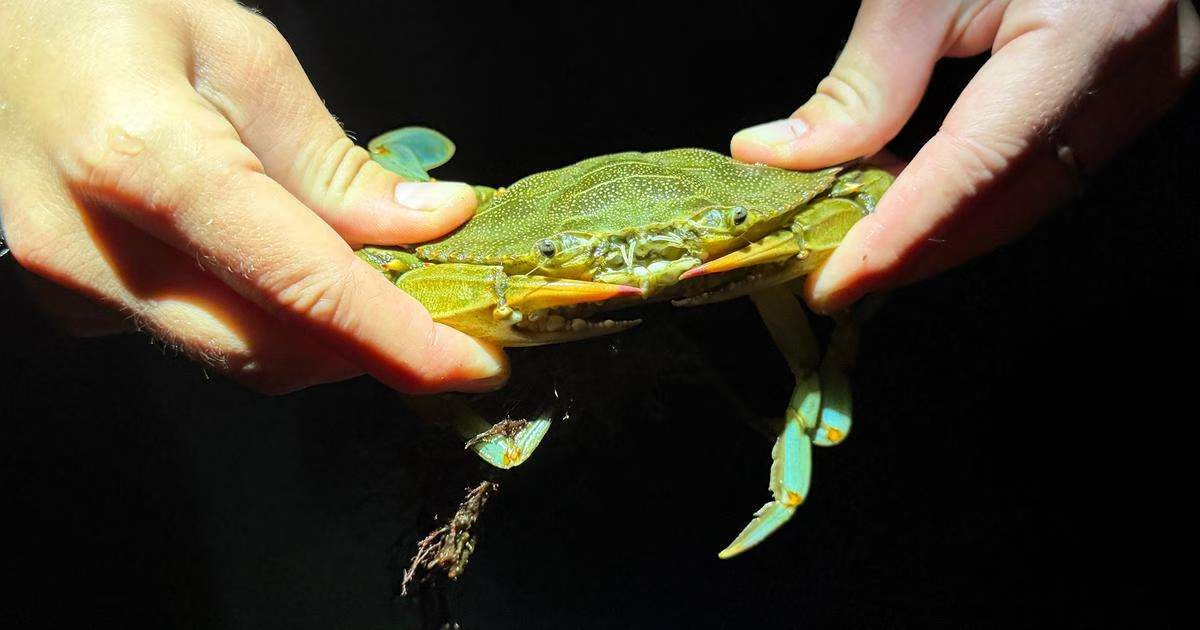
Blue crabs are not intentionally bullying mussels. Rather, ribbed mussels detect subtle shifts in the chemical compounds crabs release after feeding, triggering a fear response that changes their behavior.
Scientists have studied fear effects between blue crabs and blue mussels. Nielsen’s work is the first to examine this dynamic between blue crabs and ribbed mussels in New England salt marshes.
When Fear Ripples Through an Ecosystem
Fishing regulations for blue crabs primarily target large males, a strategy meant to protect the population and sustain reproduction. Over time, that selective pressure can favor smaller males and shift the average size of the population.
In neighboring regions, like the Chesapeake Bay, such fishing regulations accompanied a shift toward a higher proportion of females in blue crab populations.
Those changes could matter to animals on the receiving end of a crab’s threat. Because a crab’s size and sex can influence how threatening it appears to its prey, Nielsen is testing whether small and large crabs, as well as males and females, trigger different fear responses in ribbed mussels.
She is measuring behavioral, morphological, and physiological responses in the mussels, including how much they feed and how strongly they attach themselves to the marsh platform. Those seemingly small behavioral changes could have much larger consequences.
Ribbed mussels filter food from the water and deposit feces onto the marsh platform, providing nutrients that help cordgrass grow and photosynthesize. If fear changes how much mussels feed, it could alter the nutrients available to the plants around them.
Their byssal threads also help anchor them to the marsh platform, providing structure that helps cordgrass establish shoots and roots. Together, mussels and cordgrass trap sediment at the marsh surface. “By continuously accreting sediment on the surface, marshes are able to grow and be resilient to storm surges and rising sea levels,” Nielsen said.
If fishing-altered crabs really do inspire a stronger fear response, the effects could show up in the mussels’ grip on the marsh platform itself. When mussels sense a predator nearby, they’ve been shown to strengthen their byssal-thread attachment. Nielsen expects that a stronger fear response could therefore help mussels hold more tightly to the marsh platform, potentially increasing sediment accretion and strengthening the marsh platform.
A Marsh in 100 Buckets
Nielsen’s experiment has become as interwoven as the ecosystem she is studying. She began her research at the docks in Point Judith, gleaning invaluable tips from both commercial and recreational fishermen.
“I am constantly impressed with Maja’s abilities to engage people in her science and make connections with folks across our community,” Rinehart said. “She has ingratiated herself with our local fishing communities in ways I never expected, learning from their extensive ecological knowledge of our coastal systems.”
Her experiment now contains 100 buckets of living organisms with a system designed to recreate a full tidal cycle. Ed Baker, who runs the seawater facility at URI’s Graduate School of Oceanography, helped design the system. Lab mates, friends, and family helped harvest 50 marsh sods from Succotash Marsh—impressively, all on one hot summer day—and research technician John Moran and other friends have helped Nielsen haul in roughly 40 crabs a week ever since.
Teamwork proved especially valuable when one of the seawater tanks collapsed while Nielsen was traveling. Baker sprang into action, helping shore up the tanks within minutes. Moran then took over the plumbing repairs, pulling in his friends and classmates to help.
“It was definitely stressful for me, because I couldn’t do anything to help, but knowing that there was a team of highly capable people there to help rebuild was a huge relief,” Nielsen said.
“This experience solidified my belief that no research can be done without a team,” she added. “Everyone brings their own expertise and ideas, and the best results come from being open to learning from anywhere.”
That lesson mirrors the ecosystem Nielsen is studying. A blue crab, a mussel, a blade of cordgrass, and a fishing regulation may seem worlds apart. But changes to one can ripple outward, influencing the others—potentially affecting some of the services salt marshes provide to people, from storing carbon to buffering coastal storms.
“I hope to convey how interconnected these systems are, and uncover how our own fishing practices can cascade to influence ecosystem functions like storm surge protection and carbon sequestration,” Nielsen said. “I hope that people learn about this work and are able to see themselves as part of the marsh ecosystem.”
This story was written by Anna Gray in URI’s College of the Environment and Life Sciences and was originally published here: https://www.uri.edu/news/2026/10/the-fear-factor-how-blue-crab-fishing-could-reshape-a-salt-marsh/