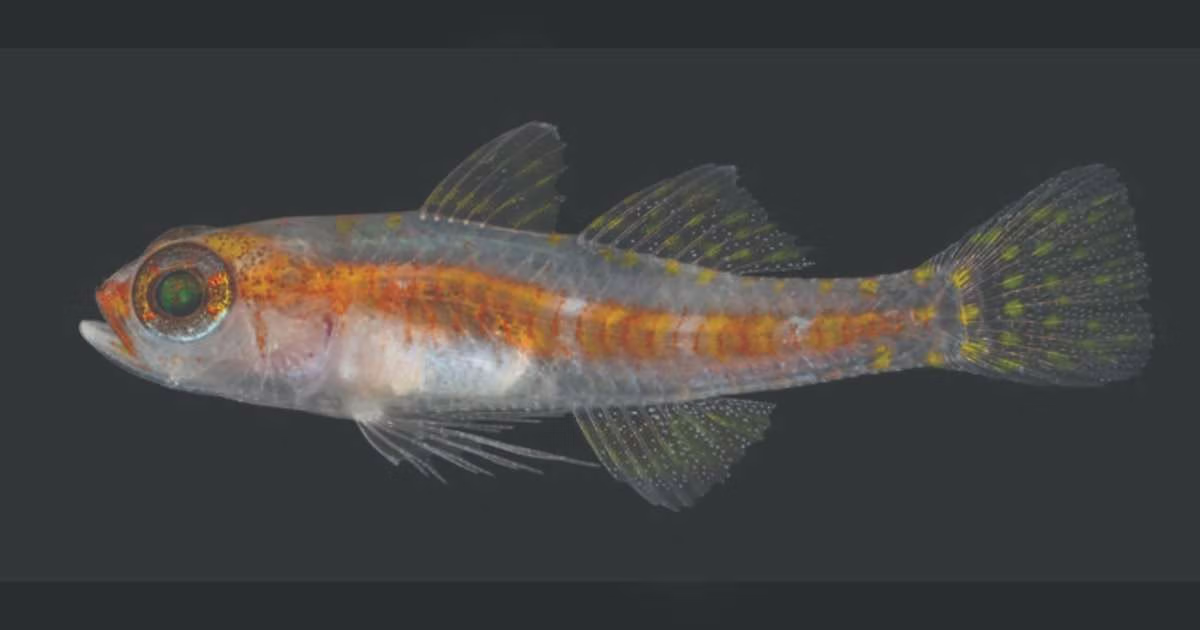
The study was led by Viktor Nunes Peinemann at the Marine Science Program, Division of Biological and Environmental Science and Engineering, King Abdullah University of Science and Technology (KAUST), Saudi Arabia. His co-authors are Matthew D. Tietbohl Talas and Michael L. Berumen of KAUST, and Sergey V. Bogorodsky of the Senckenberg Research Institute and Natural History Museum Frankfurt, Germany. It is published in the open-access journal ZooKeys.
A name inspired by gold coins
The species is named after Charon, the ferryman of Greek mythology who carried the dead across the river into the underworld. The dead were traditionally buried with a coin to pay for the crossing.
“One of the most striking features of the new species is the golden spots scattered across its tail fin,” said Peinemann. “They cover most of the fin and resemble small gold coins.”
The name also reflects where the fish may live. The team suspects the species is more common on deep “mesophotic” reefs below 30 meters, which remain largely unexplored. “These dark, deeper, unexplored reefs could be viewed as a kind of ‘underworld’ beneath the shallow, well-lit, and better studied reefs most of us are more familiar with,” he said.
A Clue to Deeper Discoveries
The fish was collected in May 2023 at Walih Island, at 30 meters, the maximum depth of the team’s scientific diving. Despite extensive searches of similar habitats since, it has not been seen again. “So far, the entire species is known from only a single encounter and two specimens,” said Peinemann. The team suggests it may simply be the shallow edge of a species that mostly lives deeper. “Red Sea reefs below that depth almost certainly hold more undiscovered gobies.”
The new species looks similar to the pallid pygmygoby (Trimma anaima), which is found from East Africa to the Pacific but has never been recorded in the Red Sea. Genetic data suggest the two are close relatives, though further work is needed to confirm this. “While one species seems to have spread across much of the Indian and Pacific Oceans, its closest relative appears to have stayed in the Red Sea and evolved separately for millions of years,” said Peinemann.
A Field Guide for Hard-to-Spot Fishes
With this discovery, 11 Trimma species are known from the Red Sea, making it the most species-rich goby genus in the region. At least nine appear to be found nowhere else in the world. The paper also provides an illustrated identification key to all 11 species, along with photographs and field notes on where each lives.
“Knowing which species are present, how to accurately identify them, and where they live, is the most foundational step to building a stronger understanding of these species and ecosystems,” said Peinemann. “They still have many secrets and deserve much more attention.”