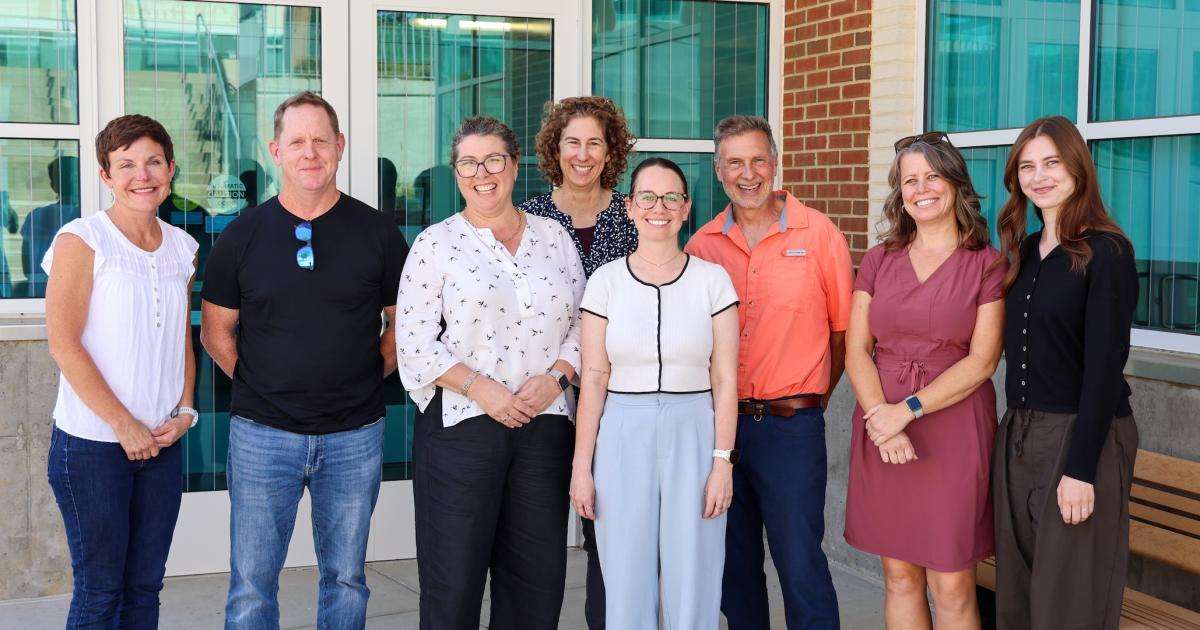
As South Australia’s Department for Environment and Water (DEW) shifts toward recovery and resiliency efforts, William & Mary’s VIMS & Batten School welcomed members of its team to discuss how shellfish restoration could support those efforts.
The visit came as communities on Virginia’s Eastern Shore dealt with the aftermath of their own HAB event. Against this shared backdrop, scientists from opposite sides of the world came together to exchange knowledge and explore how South Australia can restore shellfish reefs in support of coastal ecosystems and communities.
For South Australia DEW’s Alison Wright and Cassie Hoepler, a visit to VIMS & the Batten School was a natural fit. The two were making several stops along the East Coast before traveling to the International Shellfish Restoration Society Conference in Washington state.
“Over the last decade, we have come to learn a great deal about shellfish restoration in South Australian waters,” explained Wright, a shellfish restoration program coordinator. “But there’s still so much to learn, and this next phase of restoration is at a much larger scale than what we’ve done so far. We’ve got to think bigger and address some items related to predation and community buy-in.”
Building on previous restoration efforts and in response to the recent HAB event, the South Australian government recently launched the Rebuilding South Australia’s Lost Shellfish Reefs Program. The initiative aims to restore historic shellfish reefs along the state’s coastline, with the hope that these ecosystems can help strengthen coastal resilience and mitigate the impacts of future HAB events.
Exploring Challenges and Opportunities in Shellfish Restoration
The visit began in discussion with Megan La Peyre, associate dean for research and advisory services at VIMS & the Batten School. La Peyre, Wright, and Hoepler explored some of the shared challenges in shellfish restoration seen across species and ecosystems, including site selection, predation, and modeling.
With one of VIMS’ oyster research farms visible from her office window, La Peyre outlined the day’s activities and provided an overview of shellfish research underway at VIMS.
“I thought it would be interesting to connect you with faculty and students covering a breadth of research related to shellfish,” explained La Peyre. “Our coastal anthropologists, aquaculture specialists and shellfish pathologists can share insights into our work that hopefully inspire ideas and help fill knowledge gaps as you invest in this next phase of reef restoration.”
For Adriane Michaelis, a coastal anthropologist and assistant professor at VIMS & the Batten School, community engagement is central to successful restoration. Her experience informing shellfish restoration in the Chesapeake Bay, along with her research on community resilience, contributed to a broader conversation about the human dimensions of ecosystem restoration.
“There are federal, state, and local policies that all inform what is possible. There’s a lot of partner investment, and sometimes they work harmoniously together,” Michaelis explained. “There’s also the reality of working with the coastal communities, which have their own cultures and personalities. The success or longevity of projects is dependent upon those factors.”
Community engagement is one of many factors related to shellfish restoration work. The resiliency of shellfish is another key component to long-term success.
For Ryan Carnegie, a shellfish pathologist and chair of the Ecosystem Health section at VIMS & the Batten School, investing in oysters’ capacity to establish and sustain healthy populations is critical.
“The oysters are the most important partners at the table,” shared Carnegie. “Their readiness to succeed, their ability to adapt to local pressures and diseases, is a major factor in large-scale restoration. We need to invest in the capacity of these animals. That takes time, and it takes money, and we must be willing to play the long game.”
The potential to scale restoration work through shellfish production was on full display inside the 20,000-square-foot Acuff Center for Aquaculture, where Bill Walton and Jessica Small of the Shellfish Aquaculture Program guided the visiting scientists through the full scope of hatchery and aquaculture operations.
“This is an incredibly impressive and well-run facility, underpinned by extensive technical knowledge and experience,” reflected Wright. “Seeing the full oyster life cycle, including broodstock management, larval rearing, feeding requirements, spat settlement and growth, was a fascinating and highly valuable learning experience that reinforced the critical role hatcheries can play in supporting restoration efforts.”
The exchange extended beyond faculty discussions to include graduate students from the Batten School of Coastal & Marine Sciences, who had an opportunity to hear directly from Cassie Hoepler about the Shellfish Reef Program’s findings and next steps.
Over lunch, Hoepler presented on the resiliency that Australian mud flat oysters displayed during the recent HAB and on the challenges they face, particularly predation. “We have reason to be optimistic about the success of these reefs,” shared Hoepler. “As we’ve already seen, the oysters are establishing themselves and putting out seed. What remains to be seen is how they can build on that early success and establish populations capable of withstanding predation events.”
The visit and discussions held throughout the day highlighted shared interests and opportunities for continued collaboration as South Australia scales up its restoration efforts.
“We are very keen to maintain and strengthen our connection with VIMS moving forward,” shared Wright. “The complementary experience and expertise between our programs create a strong foundation for collaboration, particularly in areas such as restoration monitoring, hatchery development, aquaculture practices and restoration innovation.”
For La Peyre, the day was a reflection of VIMS’ mission to advance science and translate it into practical solutions for the world.
“It is always my hope that we can share our breadth of expertise and long-term research with others in order to foster innovation and advise partners on potential pathways forward,” reflected La Peyre. “I look forward to continued collaboration and engagement with Alison, Cassie, and the team as they scale up restoration efforts in South Australia.”